South Dakota floats toward moderation, even without a wave
Nov 14, 2026 | 8:00 am ET
Description
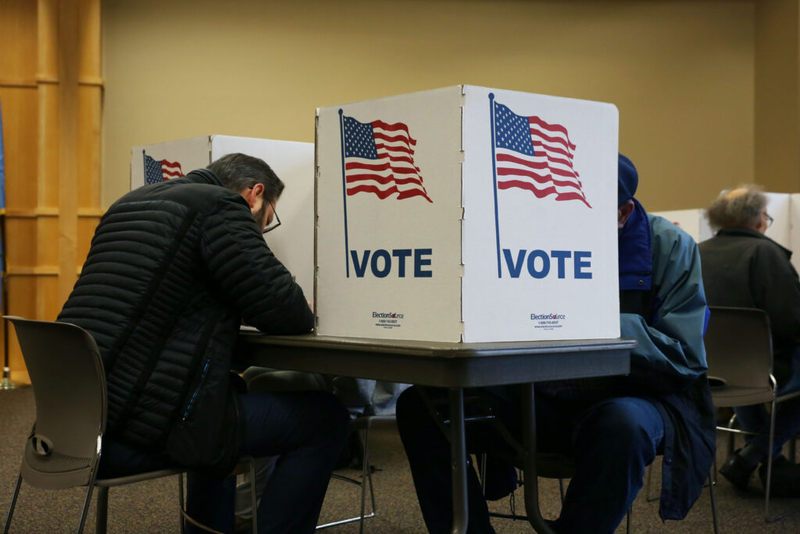
Sioux Falls residents vote in South Dakota's general election on Nov. 3, 2026. (Photo by Makenzie Huber/South Dakota Searchlight)
“The Blue Wave Washed Across Much of America,” said a recent headline in The New York Times, “But Not Here.”
It was a reference to South Dakota, and it missed some nuance.
There was in fact a political shift that washed across the state this year. But it was less like a wave crashing on the shore, and more like a flood creeping over the land.
The shift was toward moderation — or South Dakota’s version of it, anyway — and was best exemplified by four developments: the fall of Kristi Noem, the rise of less-absolutist Republican legislators, the trouncing of a MAGA millionaire in the race for governor, and the first Democratic gains in 18 years.
Noem’s bad year

Officers working for the federal Department of Homeland Security — which Noem led as secretary — shot and killed American citizens Renee Good and Alex Pretti during January immigration enforcement operations in Minneapolis. Public and congressional outrage forced President Donald Trump to demote Noem by early March. A tabloid reported a titillating story about Noem’s husband a few weeks later, and by September, they began divorce proceedings.
All of that turmoil is perhaps what kept Noem, who formerly served as governor and in the U.S. House, from challenging Republican U.S. Sen. Mike Rounds in the June primary election. While neither of them can be counted on to moderate Trump’s excesses, Rounds, who won reelection, spends a lot of time on bipartisan efforts like supporting the military, improving the Postal Service and incentivizing grassland conservation. Noem would use a Senate seat mostly to pad her social media following and chase higher office.
The fight for the Legislature
The back-and-forth battle among Republican legislative factions continued this year, resulting in 16 lawmakers losing to fellow Republicans, after 14 such losses in 2024.
The Republicans who rose to power two years ago effectively blocked a controversial carbon-capture pipeline proposal as one of their first orders of business. They were responding to property-rights concerns that contributed to incumbent losses in the low-turnout 2024 primary election.
But the property-rights crusaders weren’t the only faction empowered by the 2024 primary. Republican lawmakers hoping to relitigate the pandemic, push Trump’s false election fraud claims and wage culture wars also found themselves newly empowered.
Many of those bills ultimately failed, and in this year’s June primary election, so did many of the lawmakers who sponsored them. The Republicans who seized power in this year’s higher-turnout primary are led by lawmakers who opposed some of the more extreme ideas from their soon-to-be-former colleagues.
Rise and fall of a MAGA millionaire

Aberdeen businessman Toby Doeden finished first in June’s four-way primary race for the Republican nomination for governor, but lost the top-two runoff by 42 points in July despite spending $5.3 million of his own money on the campaign.
What’s instructive about Doeden is how he aligned himself with the politics and persona of Trump, and how little it helped. Doeden played up his business prowess and wealth, much like Trump, and featured Trump in campaign ads. Doeden also had his version of a big, beautiful idea: eliminating property taxes, which fund South Dakota schools and counties.
The candidate who beat Doeden and won the general election, Gov. Larry Rhoden, agrees with Trump on a lot of issues but disagrees with him on some, and is about as un-Trump-like in his personality as it’s possible to be. Instead of repealing property taxes, he has signed bills reducing them for homeowners with revenue from higher sales taxes.
First Democratic gains in years
It may seem silly to find significance in Democrats’ meager rise from eight to 12 seats in the 105-member Legislature. But that slight upward tick is imbued with outsized importance when weighed against the state party’s prior trajectory.
South Dakota Democrats had not gained any legislative seats since 2008 and still have not won a race for statewide office since 2008, all while suffering a roughly 70,000-person decline in registered voters. The wins by Democratic legislative candidates in this year’s general election aren’t much, but they’re a baby step away from one-party rule.
Taken together, Noem’s political demise, the rise of more pragmatic Republican lawmakers, the rejection of a Trump wannabe, and a tiny advance by Democrats all reflect South Dakotans floating a little closer to the center, or at least a little further from the edge.

Pierre, SD