First working waterfront conference highlights lingering challenges from 2024 storms
Nov 13, 2026 | 6:20 pm ET
Description
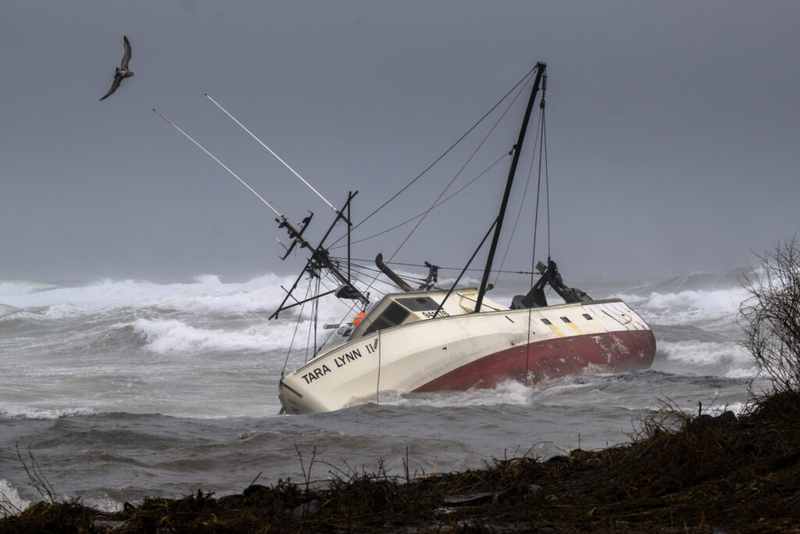
The fishing vessel Tara Lynn II crashed into the rocky coast of Cape Elizabeth amid powerful winds and record-breaking tides on the coast of southern Maine. The crew was rescued. Jan. 13, 2024. (Photo by Jim Neuger/Maine Morning Star)
Nearly three years since the devastating January storms that ravaged Maine’s coast, the state’s working waterfront says it is still feeling the effects.
Groups from across Maine’s coastal community gathered in Bar Harbor Thursday and Friday for the first ever Maine Working Waterfront Conference to discuss the lingering impacts of storm damage as well as other pre-existing challenges facing the seafood industry.
“We put a lot of work into that, and in a quick second, it was gone,” Milbridge business owner Amity Chipman said. Amity and Monica Chipman own Chipman’s Wharf seafood market, along with their husbands, brothers Chris and Jason Chipman. They bought their property in 2002, and over the years built the wharf themselves.
“We lost the wharf about an hour before high tide, and basically, what happened was the surf took the building on the end first, and then it just lifted up the wooden structure, the whole thing like a raft, just came off from the pilings,” Amity Chipman said, recounting the devastation from the first of two Jan. 2024 storms.
The severe storms hit Maine’s coast just a few days apart, bringing rain and winds of nearly 60 miles per hour. Paired with a high tide, the storms brought severe flooding along the waterfront and caused extensive damage to piers and wharfs.
Many coastal communities also had flooding into homes and businesses, damaging structures, electrical systems and more.
While the brothers, fourth generation fishermen, were out on the boat Thursday, Amity and Monica Chipman attended the conference and spoke at the session on storm recovery.
“We kind of felt like we are the poster children of devastation, and it’s really hard because we watched in a matter of seconds over 20 years wash away,” Monica Chipman said.
Maine communities receive $25.2 million in storm recovery grants
Although the loss of the wharf was “devastating,” Amity Chipman said the silver lining was how the community rallied around them.
“The most amazing thing was the next morning I drove down there, and the parking lot was full,” she said. “I couldn’t find a place to park, and the community showed up.”
There were challenges to rebuilding, Amity Chipman said. They had insurance on the wharf, but it didn’t cover a wind event like the storm, so they weren’t compensated for the losses. They went through the federal Small Business Administration, and were told they could get a loan but would have to put their houses up as collateral.
Luckily, Amity Chipman said, they were able to get a matching grant from the Working Waterfront Resiliency Grant Program. The program was launched in the spring of 2025, expressly aimed at rebuilding coastal infrastructure damaged in the storms, and making it more resilient to the impacts of climate change.
“Honestly, I don’t think that we could have rebuilt without the help of that,” Amity Chipman said.
But that hasn’t meant that the reconstruction has been fast or cheap, she said.
“We’re finally getting to the point of completing the permitting process, and I think right now we have spent over $50,000 on just permits in this project,” Amity Chipman said.
And the rising prices of materials has caused further issues, Monica Chipman said.
“Then there was a shortage,” she said, “we’re trying to order things as quickly as we can because we know everybody on the coast has been damaged.”
Amity Chipman said they were able to rebuild the wharf because they had set money aside over the years, but they haven’t been able to rebuild those savings.
“Currently, we’re at the bottom of the barrel,” she said. “We have put everything that we can into rebuilding that wharf. Monica and I run the retail seafood market, and we serve lunch. And our motto is: We are building back the wharf one lobster roll at a time.”
Lewis Pinkham, town manager for Milbridge, which lies at the mouth of the Narraguagus River in Washington County, said the town was hit hard by the storms, including the town-owned pier.
“The beginning of the pier almost disintegrated,” he said.
Like the Chipmans, Pinkham said the local community showed up to help.
“So we had almost two dozen fishermen that took the time and went down with my Board of Selectmen and other people, and they rebuilt ours, so our major pier, Jordan Pier, could be operational for every fisherman in town,” he said.
It’s not just the piers and wharfs that the town has to think about, Pinkham said, there’s the other infrastructure that is affected. For example, he said the town recently got a grant to raise one of the roadways that frequently floods — leaving local residents trapped in town.
Jonesport Harbormaster John Church said their town, just north of Milbridge, was able to get funding support from the Federal Emergency Management Agency, but that hasn’t been a quick process either.
“It is the slow process, the snail process that FEMA uses,” he said. “We spent the money. We’re still waiting for money to come back.”
He said Jonesport has started a project on its working waterfront, but is concerned the plans aren’t enough to prepare for future incidents of extreme weather.
“The height and the design that we built it for, we’re now questioning,” Church said.
At another session focused on public and private collaboration, Curt Brown, owner of Bold Coast Seafood, said businesses rely on that public infrastructure.
He said his company, based in Prospect Harbor, buys a substantial number of lobsters from Stonington.
”If we don’t have the public infrastructure to get it over the causeway and then over the bridge — which, with some of the storms we’ve seen, is at risk, can be at risk, will be at risk in the future,” he said.
Other challenges facing coastal industries
Severe storms aren’t the only pressure on Maine’s working waterfront, said keynote speaker Colin Woodard.
Woodard is a journalist and author of “The Lobster Coast: Rebels, Rusticators and the Struggle for a Forgotten Frontier.” He said there has long been pressure on waterfront real estate for development of high-end homes and for the hospitality industry.
The pandemic was a “rapid accelerant” for that pressure, as people left cities to work remotely from more rural areas, Woodard said, putting home ownership out of reach for “most families with incomes tied to the local economy.”
And that can have ripple effects for the community, he said.
“Local businesses, schools and nursing homes can’t find the workers they need to operate properly because there’s nowhere for the people to live on the incomes they receive,” Woodard said. “The coastal communities are generally the most impacted, which is a special problem for fishing families who have to drive all the way to the waterfront to start their day.”
Linda Nelson, economic and community development director for Stonington, agreed with Woodard.
“It’s not just the people that work on the boats,” Nelson said. “The people that work on the boats need the schools for their kids to go to. They need the carpenters and the electricians and the plumbers because they can’t necessarily fix everything on their own.”
It’s particularly challenging in smaller towns, Nelson said.
“How do we balance the influx of people with a lot more money that they’re making in other places where the salaries are higher, that then inflate our property taxes and our property values?” she said, noting that towns can’t increase property taxes on those homeowners because of how the state constitution is structured.
Brown said that he’s seen how the general uncertainty in the fishing industry and coastal communities is leading younger generations to question whether it’s a viable path for them..
“Without harvesters out on the water, none of what we do in the private sector works; it just doesn’t exist, and so that next generation is a concern,” he said. “So, how do we as an industry make that look appealing? Like, how do you draw the next generation into that? And I would say that would probably be my top concern right there.”
Augusta, ME