After migration delay, rare whooping cranes making yearly trek across Kansas
Nov 13, 2026 | 10:55 am ET
Description
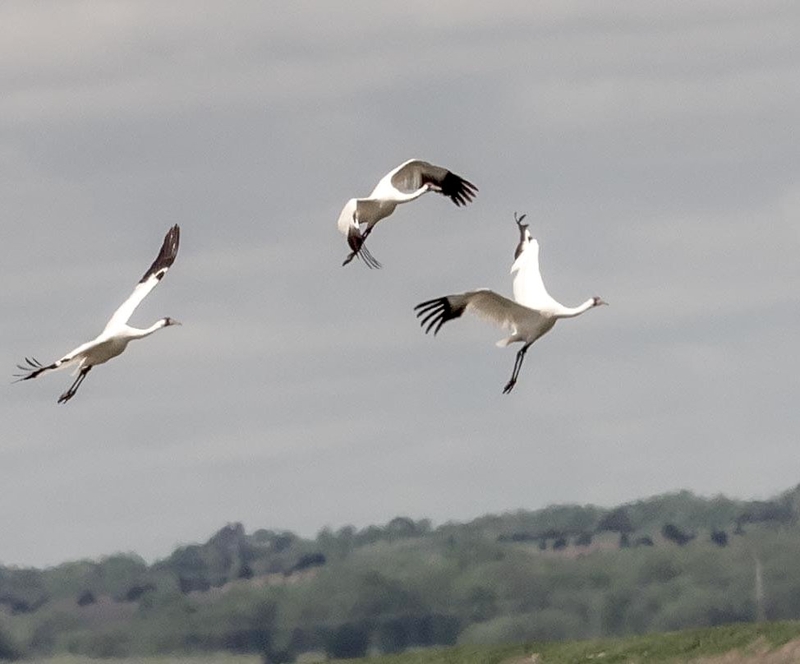
Whooping cranes soar over the Cheyenne Bottoms Wildlife Area in the fall of 2025. This year’s annual migration from Canada to Texas is underway, but it got a late start. (Photo by Dan Witt)
BARTON COUNTY — Each fall, around 500 endangered whooping cranes wing their way along the Central Flyway — a 2,500-mile avian superhighway over the Great Plains — from their breeding grounds in Canada’s Wood Buffalo National Park to their wintering grounds along the Texas Gulf Coast at the Aransas National Wildlife Refuge.
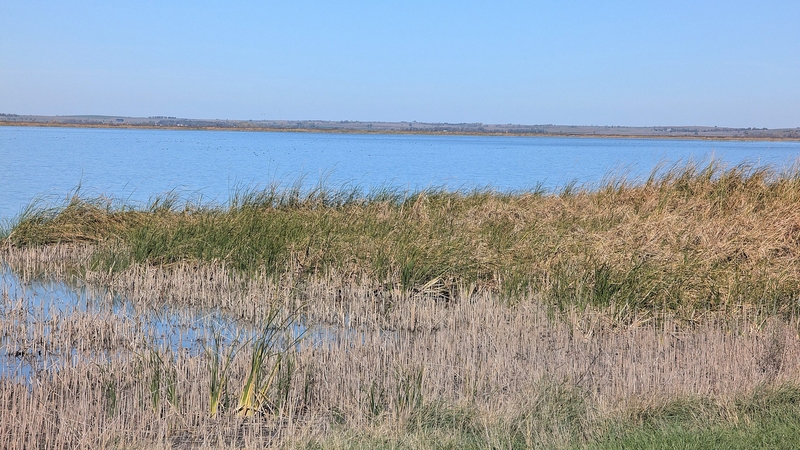
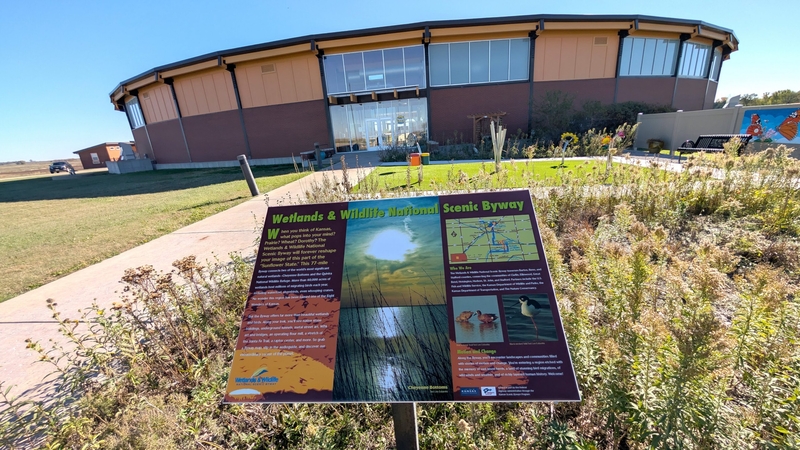
But this fall, migration has been different, said Kansas Wetlands Education Center director Curtis Wolf. He should know, since his center sits across K-156 from the Cheyenne Bottoms Wildlife Area in Barton County, a wetland of international acclaim that hosts thousands of birds, including many of the cranes, that travel along the flyway every fall and spring.
“This has been an interesting year,” he said.
The cherished white whoopers prized by birdwatchers usually start showing up in early October at the state-managed Bottoms and its sister Quivira National Wildlife Refuge, 40 miles south along the Wetlands and Wildlife National Scenic Byway in Stafford County. However, the first local appearance wasn’t reported until last week.
“They spotted 15 at Quivira,” Wolf said, noting there had also been scattered reports in North Dakota, South Dakota and Nebraska. But none have been seen at the Bottoms.
With the flyway stretching up to 1,500 miles wide, not all of the migrating cranes choose to make a pit stop in central Kansas, “but it is odd to just now seeing them,” he said.
With the delay, Wolf said the cranes may arrive in one big mass or, feeling rushed, may bypass the refuges entirely.
The delayed migration is due to a warmer autumn in Canada, leaving the birds in no hurry to leave, said Mike Rader, wildlife education supervisor for the Kansas Department of Wildlife and Parks. “They are finding what they need there.”
With climate shifts, these delays are becoming more common, he said. The fall migration has been getting later over the past several years, with whoopers spotted at Quivira over Christmas 2025 when normally the last of the birds have passed by mid-November.
This same phenomenon is also affecting other crane species, such as the sandhill crane, Rader said.
Other than the whoopers being tardy, “this has been a good year for birding,” Wolf said. The water level at the Bottoms and the bird numbers are strong, with ducks, other waterfowl, and shorebirds flocking to the wetlands.
Why so few?
The global population is estimated to be more than 800.
“The numbers have started to make a comeback in the past decade,” Wolf said, thanks to conservation efforts.
In the United States, about 550 make the Central Flyway journey, with a few more migrating along the eastern seaboard. There are also nonmigratory populations in Florida (around 80) and Louisiana (in the teens).
However, they remain threatened by illegal hunting (conviction for killing a whooper, a federal crime, can result in a $100,000 fine and a year in prison), natural predators, power lines, and habitat loss. Droughts and shortages in their food sources can also harm numbers.
In addition, it takes years for them to reach breeding age. Even then, not every pair succeeds in producing offspring, and females may raise only one surviving chick per season.
“They just don’t have the capacity to keep up,” Wolf said.
And, “It’s a slow process,” Rader said of rebuilding the population.
Whooping cranes can stand as tall as five feet with a seven-foot wing span. They are named for their loud, single-note, trumpeting calls — or “whoops” — made when they are alarmed or communicating.
A prized find
“People want to see the whoopers,” Wolf said, adding that it is a bucket-list find for birdwatchers.
In fact, participants in last weekend’s Audubon of Kansas annual Crane Festival, based out of Sterling, just east of Quivira, were the first to report the whoopers.
Like most migratory birds, whooping cranes fly south in the fall and back north in the spring. But there are more opportunities for sightings in the fall, Rader said.
Although they can make the entire trip in a matter of days with a good tailwind, they are more likely to linger while traveling to Texas, where they feed on blue crabs and wolfberries. When heading north, however, they are destined for their breeding grounds and have other priorities and make fewer stops, he said.
In the meantime, both Wolf and Rader said there is ample time for those wanting to spot the elusive birds. The 20,000-acre Bottoms and 22,000-acre Quivira form a wetland complex designated as Wetlands of International Importance under the Ramsar Convention and are considered among the most critical stopover areas in the Western Hemisphere for millions of migratory shorebirds and waterfowl along the Central Flyway.
Topeka, KS