Fraud Or Incompetence? Lawmakers Probe Homeless Housing Program
Nov 13, 2026 | 10:02 am ET
Description
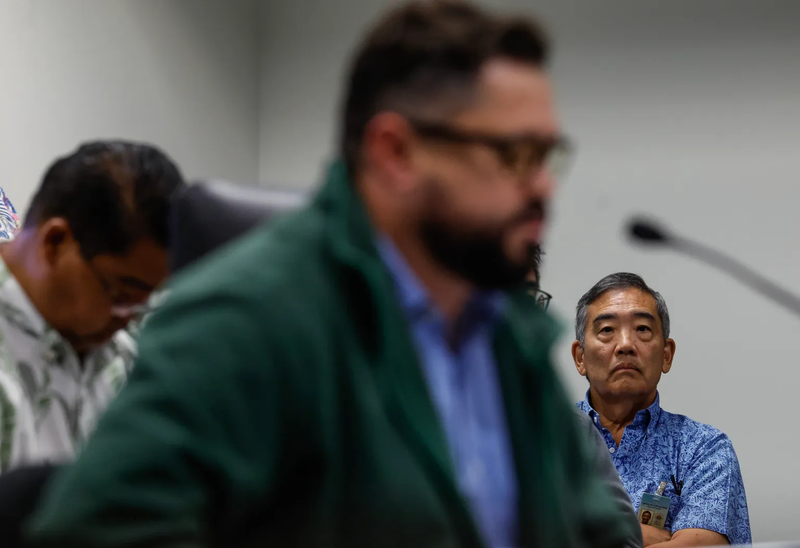
State Auditor Les Kondo, right, listens as Kimo Carvalho, CEO of HomeAid Hawaiʻi, speaks during a Senate hearing on the state’s kauhale initiative in November. (Jamm Aquino/Civil Beat/2026)
The charges had no apparent connection to homelessness: office space, laptops, food and drink — including beer. An oceanview condo in Wailuku. A parking ticket. Steel-toed boots. Jeans from Nordstrom Rack.
But HomeAid, the state’s homeless contractor, billed Hawaiʻi taxpayers. And the state paid.
State lawmakers got an earful at a briefing on Thursday and were left deeply dissatisfied with the answers provided by some of the key architects of the state kauhale program, Gov. Josh Green’s signature effort to address homelessness.
“Is it fraud, or is it incompetence?” House Rep. Ikaika Olds asked the state leaders of the program, Joe Campos and Jun Yang.
They didn’t answer.
The state senate briefing Thursday was the first opportunity lawmakers have had to pose direct questions after a scathing audit of the state’s management of the initiative identified more than $13 million in questionable or unauthorized payments through no-bid contracts with its sole provider, HomeAid Hawaiʻi. Some of those questionable payments were for hundreds of thousands of dollars, the committee heard. The audit followed Civil Beat reporting on the high costs and lack of documentation for HomeAid’s state-funded programs.
At the meeting at the Hawaiʻi Capitol, State Auditor Les Kondo outlined in searing detail how the state took a nonprofit with one employee and a desk and showered it with millions in taxpayer funds.
The nonprofit charged taxpayers for software to identify prospective HomeAid donors and hired subcontractors on the taxpayers’ dime to do various tasks, including organizing someone’s desk. One tech subcontractor based in Vancouver, Canada was owned by the CEO’s family member. Others, owned by HomeAid employees, were paid monthly fees. HomeAid even billed the state for its own public relations and advertising, Kondo showed.
Kondo painted a picture of a nonprofit using state money as its personal piggybank and a state agency writing it blank checks.
“Did the state protect public money while they were building kauhale?” Kondo said. “We found that they did not.”
HomeAid CEO Kimo Carvalho went on the offensive during a presentation characterizing many of the audit findings as “outdated, incomplete, misleading or false.” He said HomeAid was confident it could account for the $39.9 million in spending with nearly 13,000 receipts. The program has helped 499 people through 330 tiny homes, Carvalho said, and has seven new sites planned.
Carvalho said that some receipts had been entered into the wrong budget categories through software or staffing errors and that the nonprofit had since improved its internal systems.
“We have completed multiple independent audits by a Hawaiʻi-licensed CPA firm that has also confirmed and verified there is no misuse, and there is no fraud, of public funds,” Carvalho said.
Lawmakers did not hold back, calling into question the expertise of staff at the Statewide Office of Homelessness and Housing Services to manage construction projects or even properly assess the goods and services the receipts were for.
Department of Human Services director Campos and state homelessness coordinator Yang tried to use their time at the hearing to refocus attention on the kauhale program’s achievements to date. But Health and Human Services Committee chair Sen. Joy San Buenaventura wasn’t having it.
“You have 15 minutes to address the audit, otherwise the auditor’s presentation is gospel,” she said.
“I’m just about to get into the audit,” Yang said.
Olds said that his district has a large homelessness problem but that his constituents had lost confidence in the project and he was left trying to reassure them that there are now checks and balances in place.
“We need you guys to succeed,” he said. “Let’s not have another misstep like this.”
San Buenaventura and Senate Ways and Means Vice Chair Sharon Moriwaki both raised the issue of a thorough forensic audit of the entire program to go deeper than Kondo’s audit, which was focused narrowly on the state’s lack of oversight.
“It’s the arrogance, the arrogance to be asking taxpayers to pay for these expenses.”
State Sen. Samantha Decorte
They said Campos would be pushed hard to provide more detailed answers during his upcoming confirmation hearing.
“It’s the arrogance, the arrogance to be asking taxpayers to pay for these expenses,” said Sen. Samantha Decorte, referring to charges that had nothing to do with homelessness.
She cited so-called intimacy kits containing condoms, lubricant and sex toys from a hotel stay that HomeAid submitted for reimbursement but later repaid.
Yang said that his office had since reviewed all the receipts submitted by HomeAid across nine contracts and that a total of $550,000 has been reimbursed by the nonprofit. There is likely to be more.
But that is only half of the $1.2 million that the state overpaid HomeAid beyond the work it had actually completed, San Buenaventura said.
The rebuke from the lawmakers was not shared by Gov. Green, who wrote in a text to Civil Beat after the briefing that the program has already helped decrease homelessness by 13% statewide, reducing suffering and saving taxpayers millions of Medicaid dollars.
“The program’s critics will eventually grasp these benefits,” the governor wrote, an apparent jab at Kondo and lawmakers.
At the Senate briefing, Kondo characterized the stance of the governor and HomeAid CEO as: “Keep driving. Nothing to see here.”
“The documents tell a really different story,” he said. “I think there’s a lot to see. In fact, much, much more than what I showed you today.”
Reimbursed, Receipt By Receipt
State contractors usually get paid a set amount for meeting objectives through performance-based or fixed cost agreements. In those models, the contractor assumes the risk of cost overruns.
HomeAid’s contracts were different: They allowed the nonprofit to submit expenses for reimbursement on a rolling basis. The nonprofit was billing for items that were explicitly not part of its program budget, listing ineligible expenses under inaccurate categories, according to Kondo. But the state approved the expenses for reimbursement anyway.
HomeAid was also selected as the state’s kauhale contractor without having submitted a bid, after proclamations from the governor suspended procurement requirements.
That laid the groundwork for the mess the state is now in, according to San Buenaventura.
“If you folks had performance contracts in the first place,” she said, “you wouldn’t be asking for funding for more staff to go line-by-line through the receipts. I don’t understand why you chose to go around the procurement process.”
And San Buenaventura and others went further, asking why the state had practically paid to build up a nonprofit from scratch when other existing contractors could’ve built tiny homes.
“The bottom line is,” she said, “does the state own HomeAid?”
She asked Campos, who was deputy human services director when the HomeAid contracts were signed, how the nonprofit went from having one employee and $235,000 in revenue in 2022 to 13 employees and $143 million in revenue in 2024, 90% of which came from state contracts.
Campos said that he first came into contact with HomeAid after the organization had completed work on Pālama Ola, the kauhale pilot project that was launched in 2023, but couldn’t speak to the growth of the nonprofit.
Under persistent questioning from the chair and vice chair, Jackson Sayama, Campos said that it was on his suggestion that HomeAid became the primary contractor after the Lahaina wildfires, because the state already had a pre-development contract in place with the nonprofit.
Carvalho, Yang and Campos all said that the $13.7 million highlighted by Kondo was not unaccounted for, but was invested in the 935 kauhale units built so far under the project.
Yang said that the audit was politically motivated, “a shot at the office, done without asking whether the questions were warranted.”
Campos said he accepted the factual findings of the audit, but objected to the “subjective language” used by Kondo’s office.
Tapping Contingency Funds Without Approval
The hearing did more than just rehash the audit. Kondo went to great lengths to list an inventory of reimbursements the state had made to HomeAid that were completely outside the terms of its contract.
Those receipts had been paid for without anyone asking whether the costs were part of the initiative, he said.
Kondo spotlighted a $6,300 purchase for software called Kindsight, which identifies potential donors for nonprofit organizations, $87,000 spent on video production and a standing monthly charge of $40,000 to a contractor for fundraising, event management, and media relations services. That ended up totaling over $400,000.
“A receipt shows an expense was incurred,” Kondo said. “It doesn’t mean the state must pay it. And that is the fundamental weakness our audit identified.”
The Statewide Office of Homelessness and Housing Services, Kondo noted, is a policy office that doesn’t have the construction expertise to take on a project like it did.
Yang said receipts were approved by his staff, and questionable charges were discussed. He said he has asked for reimbursement for the Kindsight expense, among others.
“These types of things have already been discussed and brought back to the state,” he said.
Kondo pointed to other expenses that he said the state should have questioned before approving, including $463,000 in management liability insurance coverage. Normal insurance was understandable, “but these other coverages raised questions about whether the state was paying for insurance to protect HomeAid, not just the work it was contracted to do.”
The state’s HomeAid contract contained over $2.5 million in contingency funds, but charges to those funds were only meant to be made with the state’s written approval. Without approval, HomeAid spent the money down to the last available penny, Kondo said.
Kondo also noted that the state paid HomeAid for the full amount of one contract — approximately $726,000 — even though the final cost of the work was less than that.
“Why did the state pay the full contract amount?” Kondo asked.
Honolulu, HI