‘It’s Called Fundraising Stupid,’ Heastie Says. So Where’s the Proof?
Nov 13, 2026 | 10:21 am ET
Description
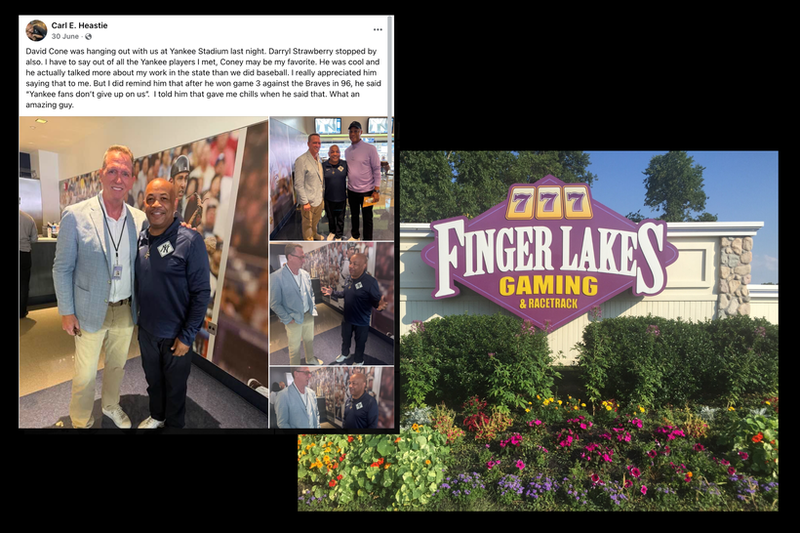
Speaker Carl Heastie defended the Democratic Assembly Campaign Committee's spending on sports. / Images: Facebook and Mmrvideo / Wikimedia Commons
Suite packages at Boston Celtics games. Meet-and-greets with Yankees stars. Box seats for Knicks playoffs.
Total: More than $1 million spent on sports since 2015.
Last week, we published an investigation into how New York Assembly Speaker Carl Heastie’s passion for sports may have influenced spending from a campaign fund he helps lead. We found that Heastie has used the resources of the Democratic Assembly Campaign Committee, where he serves as honorary chair, to attend numerous sports games in luxury seats, often accompanied by staff and friends.
New York law prohibits politicians from using campaign resources on sports games for “personal benefit,” but allows it if there is a political purpose, like fundraising. In detailed questions sent more than a week before the story ran, New York Focus asked Heastie and DACC which sports games were fundraisers and how much they raised for the committee.
Neither Heastie nor DACC replied to our questions, but hours after the story went live, Heastie responded at length in a social media post.
“It’s called fundraising stupid,” he wrote. “Sports games are great ways to fundraise.”
He expanded on this idea in a radio interview Thursday on The Brian Lehrer Show.
“People actually like going to the fundraisers at these sporting venues,” he said. “Everybody doesn’t want to just go into a room with a plate of stale crackers and cheese and fruit.”
Heastie also claimed in the interview that New York Focus didn’t ask how much money the sports events raised. In fact, the list of questions we sent to Heastie’s office included a request for the “dollar amounts raised” at individual games.
In a statement to the news site Hell Gate, Heastie’s spokesperson Michael Whyland said the games “raised more than $10 million.” Heastie’s office has not answered questions about how it calculated that figure.
Since Heastie’s office didn’t respond to our questions, we took a closer look at the financial reports from the Democratic Assembly Campaign Committee, or DACC. The records don’t offer proof of whether the games were fundraisers, but they cast doubt on the officials’ explanation.
DACC’s spending on sports has shot up since Heastie became its honorary chair in 2015, but its fundraising hasn’t. Once inflation is factored in, DACC’s average fundraising haul has ticked down over that timespan. Adjusting for inflation, DACC raised $12.2 million during the 2024 election cycle, while spending over $420,000 on sports. In the 2008 election cycle, it raised slightly more money with about $8,000 in sports spending, or $12,900 in today’s dollars.
DACC’s sports spending was nearly five times higher in 2023 than in 2022, but total donations actually decreased that year. And the Democratic Senate Campaign Committee, DACC’s counterpart, has raised nearly as much money while spending less than a tenth as much on sports.
In addition, it doesn’t seem that most of the games generated waves of donations.
Through our analysis of social media posts and spending on stadium concessions, New York Focus identified 19 dates when Heastie or DACC staff likely attended sports games paid for by or donated to DACC. Four events that DACC hosted at Yankee Stadium in the 2010s were independently documented as fundraisers by a government watchdog group. Those four seem to have been effective: During the two weeks around each Yankees game, DACC brought in two to five times its typical fundraising haul for a median two-week period that year.
But most of the other 19 games, which happened in the 2020s, don’t show similar spikes. Only four showed fundraising boosts akin to those of the 2010s Yankees games. Eight brought in less than DACC normally raised during two-week periods in the year they occurred.
That’s unusual for a successful fundraiser, said Leo Glickman, a New York election lawyer with over two decades of experience.
“You would expect to see numerous contributions around that date,” he said. If donations are lower than usual instead, “that would lead me to ask more questions about the purpose of the expenditure,” and whether it really was a fundraiser, Glickman added.
One of the most notable shortfalls took place in Boston, home of Heastie’s favorite basketball team, the Celtics. Once a year since 2024, he and some of his staff have traveled there to watch Celtics home games from a donated suite.
The suites were all gifts to DACC from the hospitality company Delaware North, which owns and operates the Celtics’s TD Garden arena. Last week’s New York Focus investigation found that soon after the game this year, Delaware North successfully lobbied Heastie for a tax break on a casino that it operates.
Heastie told Brian Lehrer that it was “political theater” to draw a connection between the free suites and the tax break. “We’ve adjusted [casino] tax rates every single year, and Delaware North was not the only one that got a tax break,” he said.
Delaware North spokesperson Glen White told New York Focus the company followed applicable laws and did not discuss political matters with Heastie or his staff at the games. Delaware North made the gifts after a request to use the space “for political fundraising events,” he said.
But as with most of the other games in the 2020s, the most recent Celtics game didn’t provide an obvious fundraising boost. The fundraising in the weeks surrounding the game was lower than the median for two-week periods this year.
“It could be a fundraiser that flopped,” said John Bartos, a campaign finance consultant who has worked on numerous New York elections. “Or it could be that there was less fundraising going on than what it’s made out to be.”
The other two Celtics games fared a bit better. The weeks around the 2025 game saw slightly more donations than normal. And the week after Heastie attended the game in 2024, DACC received a small fundraising boost driven by the sponsor of the suite: Delaware North donated $10,000, and another $10,000 came from members of the Jacobs family, which owns and operates the company. Even then, the total earned in the two weeks around the game was still lower than the median in 2024.
It’s possible that some of the games weren’t exactly fundraisers, but rather perks offered to existing donors as a thank you or to lay the groundwork for asks down the line. That would complicate Heastie’s office’s claim that the events “raised” more than $10 million, but still could render the spending legal according to New York’s permissive campaign finance rules.
Albany