Idaho independent Achilles fell short against Republican US Sen. Risch. Can independents win here?
Nov 13, 2026 | 6:00 am ET
Description
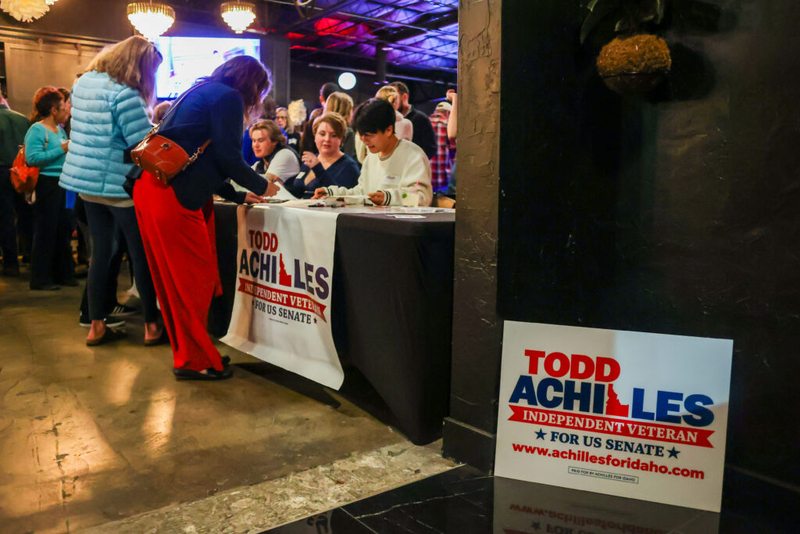
Campaign signs greet attendees at the election night watch party for independent U.S. Senate Candidate Todd Achilles on Nov. 3, 2026, in Garden City, Idaho. (Photo by Pat Sutphin for the Idaho Capital Sun)
Idaho’s Todd Achilles was one of a handful of major independent U.S. Senate candidates in red states to generate national attention ahead of the 2026 general election.
Although he and the other high-profile independents lost their races, Achilles argues there’s still a future for independents to be a competitive alternative in a two-party system, and a viable way to win in such a Republican state.
Achilles, a former Democratic state legislator, ended with 33.57% of the vote, compared to incumbent Republican U.S. Sen. Jim Risch’s 56.6% in the four-way race with no Democrat on the ballot. The other independent candidate, Natalie Fleming, received around 7% of the vote.
In an election year where many Republicans struggled in nationwide federal races, Idaho voters stood by their GOP incumbents.
“Idaho is different because, it’s just the advantage for Republicans among voter behavior is so outsized compared to even states in the South,” said Robert Jones, a partner and political strategist at Boise-based GS Strategy Group.
Nearly 62% of Idaho voters are registered with the Republican Party, and 12% are registered Democrats, according to the Idaho secretary of state’s office. More than 24% aren’t affiliated with either party.
Voters who deeply align with a major political party tend to stick with that party, even when they aren’t necessarily satisfied with their performance, said Idaho State University political scientist Edward Greer. Greer researches American politics, political psychology, and political behavior.
“If a political party is not meeting those needs, then there’s not typically going to be a lot of crossover to the other side,” Greer said. “Usually, people will just kind of sit out.”
Was this race different from past Idaho U.S. Senate elections?
The win, although still comfortable, was Risch’s closest general election race since he first won his U.S. Senate seat in 2008.
In 2008, Risch won with 57.7% of the vote against Democratic challenger and former congressman Larry LaRocco, who had 34.1% of the vote, with three other candidates on the ballot.
Achilles, speaking to the Idaho Capital Sun the day after the election, said his campaign “built a great foundation” for the independent movement in Idaho.

“We went from zero to 33% in 18 months,” he said. “… We got a lot of people excited. We had hundreds of meetings and town halls and events across the state. Everything I’m seeing in my inbox this morning is, ‘Let’s keep going.’ ‘We like what this independent movement is about.’”
Achilles said he hasn’t decided if he would run again, but that he plans to continue to be involved in politics.
His campaign garnered a similar share of votes as Democrats in other statewide races. Risch’s last challenger, Democrat Paullet Jordan, finished with a similar vote share, with 33.2% in the 2020 election.
Achilles this year narrowly outperformed Democratic gubernatorial candidate Terri Pickens, who won 32.25% of the vote in her five-way contest against incumbent Republican Gov. Brad Little.
In two-way statewide races, Democrats consistently won about 34% of the vote, with the highest coming from attorney general candidate Lori Hickman, who received 40.21% against incumbent Republican Attorney General Raúl Labrador.
Some Idaho Dems pressured their candidate to drop out of the Senate race and rally around Achilles, then Achilles lost. Now what?
After he won his May primary, Democrat David Roth withdrew from the U.S. Senate race in August, days ahead of the deadline to have his name removed from the general election ballot. He told the Sun he dropped out because he lacked support from his own party.
Leaders of the Ada County Democrats wrote Roth a letter asking him to drop out, arguing Achilles had the better chance to oust Risch, the Spokesman-Review reported.
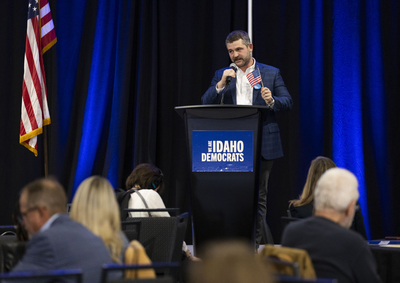
Ada County Democrats Chair Jared Deloof told the Sun he’d still probably send the letter today, because Roth wasn’t raising the money to be competitive. But he also thinks the future lies with more work within the Democratic party, and not with independents.
“This was, I really think, an experiment year, given the stakes of what’s going on in the country,” DeLoof said. “Folks seeing is this a path forward to confronting the threats that we’re seeing to freedom across the country? So I totally understand the want to try to do something new.”
“I will say now the results are in after last Tuesday, and we saw across the country independent candidates not doing well against Republican opponents, and actually saw Democrats in some of the deepest, reddest parts of the country fare very well, even in places like South Carolina, Mississippi, and Texas,” he said. “And so, my takeaway from this is that in deep red places like Idaho, we have to continue to do the work within the Democratic Party to build a party that can win here.”
Idaho Democratic Party Chair Lauren Necochea told the New York Times ahead of Nov. 3 that she thought “independent candidates will generally fade away after the election.”
“The Democratic Party will still be here doing the work to hold Republicans accountable,” Necochea said.
Is there a meaningful way forward for major independent candidates?
The Achilles campaign raised nearly $2 million, more than any other Senate challenger in recent years. However, Risch’s campaign surpassed $5 million, as of Oct. 14 Federal Election Commission data.
Greer, the political scientist, said it’s not impossible for independents to win in Idaho, but it is more difficult without the party infrastructure Republicans and Democrats have.
“I wouldn’t completely rule out the possibility of independents potentially doing better down the line,” Greer said. “There are some notable independent senators that have gotten elected before, closer to the East Coast. But it could be a question of, if the Democratic brand is unpopular in states like Idaho, it would be a matter of if independents could win over would-be Democrats while still keeping the Democratic brand at arm’s length to make it credibly seem that they’re not Democrats.”
The nation saw a blue wave this election. Idaho saw a ripple.
“And then at that point,” Greer said, “they might be able to win people over that are truly independents that aren’t wanting to align cleanly with either party.”
Jones, with GS Strategy Group which has worked with Republican-aligned campaigns and PACs, said Republicans are likely to keep winning in statewide elections in Idaho for the foreseeable future.
“Those things take a long time to change,” Jones said. “It doesn’t mean there won’t be a candidate or a single race where something happens that’s anomalous and somebody can get elected. But structural change, where Democrats are competitive up and down the statewide ballot, is a fair ways off.”
DeLoof noted that even among some victories for Idaho Democrats this year, it’s a “really tough uphill battle” to win in statewide elections.
“This is a similar trajectory to what Georgia did, what Texas did, states that you never could imagine showing up blue on the map,” he said. “I believe if we stick to it, we’ll eventually get there someday.”
Jones noted that Risch’s victory against Achilles was the slimmest among statewide general election contests in Idaho. One could argue he had a better chance than a Democrat, he said.
“So Achilles did the best, I guess if you want to put in that framework,” Jones said of the vote margins, “but an independent campaign is still a long way off from beating a Republican.”
Boise, ID