Alabama infant mortality rate increases slightly, remains above national average
Nov 13, 2026 | 6:01 am ET

Description
Dr. Scott Harris, Alabama State Health Officer, at the Oversight Commission on Opioid Settlement Funds meeting on Feb. 18, 2026, in the Alabama Statehouse in Montgomery, Alabama. Harris on Thursday said that the state’s infant mortality rate was 7.4 deaths per 1,000 live births in 2025, an increase from 7.1 deaths per 1,000 live births in 2024. (Anna Barrett/Alabama Reflector)
Alabama’s infant mortality rate worsened slightly in 2025 and remains above the national average, according to data released Thursday by the Alabama Department of Public Health.
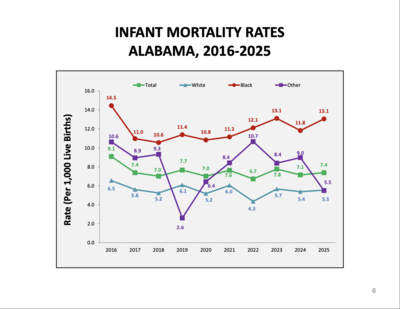
State Health Officer Dr. Scott Harris said that the state’s infant mortality rate, the number of infants who died in the first year of being born, was 7.4 deaths per 1,000 live births in 2025, an increase from 7.1 deaths per 1,000 live births in 2024.
“When we’re dealing with all these statistics, we talk a lot about statistical significance, and did things really change, or does the number look a little different,” Harris said during a meeting of the State Committee on Public Health. “But it’s not really statistically significant. Please understand what we mean when we say insignificant. Every death of a child is significant.”
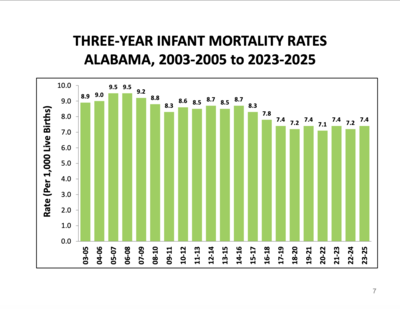
He said that while the rate increased, it was not statistically significant. The three-year average gives a “smoother curve” with 0.2 to 0.4 jumps over the last 10 years, and showed improvement from 2003 to 2015, when the state’s rate was between 8.3 deaths per 1,000 live births and 9.5 deaths per 1,000 live births.
Harris said the infant mortality rate is an indicator of overall health in Alabama and is a fair way to compare states.
“There’s so many different factors that go into this number that you’re going to see that you can look at that number and sort of get an idea of how public health is looking in Alabama,” Harris said.
The nation’s infant mortality average is 5.5 deaths per 1,000 live births, up from 5.4 deaths per 1,000 live births in 2024. Harris said the gap between Alabama and the national average has always been there, but the state roughly matches the nation’s trend.
In 1970, about 20 babies died per 1,000 births nationwide and about 24.5 died in Alabama. The rate started to descend after the implementation of Neonatal Intensive Care Units in the 1960s. In the late 1980s, Medicaid coverage was extended to pregnant women.
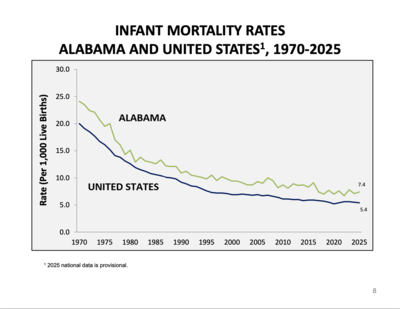
Harris said in an interview that the gap could close, and the state got close at its lowest rate in 2022 of 6.7 deaths per 1,000 live births.
“We absolutely have the ability to improve that, and we have a lot of people working on it,” he said. “We have a lot of people in Alabama outside of our agency who are really invested in these projects, but it’s going to take all of us.”
There were 57,192 total births in 2024, and 422 of those babies died before reaching their first birthday in 2025. The 2026 rate is still being calculated because all babies born in 2025 have not yet reached their first birthday.
A ‘stubborn statistic’
Racial disparities continue to be a challenge. Of the 422 infant deaths, 229 of them were white babies while 183 were Black babies. The mortality rate for Black babies in Alabama is 13.1 deaths per 1,000 live births, nearly 2.5 times as high as that of white babies at 5.5 deaths per 1,000 live births, Harris said.
“This is a really stubborn statistic. We spend a lot of time and effort thinking about how to address this. We’ve not really made a big difference in that,” he said. “The white infant mortality rate is right at the U.S. average, but because we’ve not done the job we should do with the Black infant mortality rate, we’re typically in that bottom tier of states overall, unfortunately.”
About 72.1% of babies were born to white mothers in Alabama, and about 24.5% of babies were born to Black mothers in 2025, according to the data. Harris said the birth rate, regardless of race, has been on a steady decline since 2021.
Dr. Marquisha Jarmon, a Hoover-based pediatrician and member of the committee, said the department should work directly with Black groups to raise awareness to reduce the mortality rate.
“I love hearing this information about infant mortality because it just sheds a light on the problem, especially in the African American community,” she said. “The question that we’re all asking is: What really is the problem in our community when everyone else is getting better and we’re staying the same?”
Harris called closing the racial gap the “million dollar question.” He said in an interview that some of the social determinants – poverty, race, education, ZIP code – is not something that the health department can address, but it can educate mothers-to-be on a healthy pregnancy.
“It’s challenging to know how to address that. The way we address it is by trying to find specific reasons that we’re losing our babies that we can intervene with,” he said. “That might be prenatal vitamins and safe sleep education, trying to get people connected to healthcare for chronic disease management. That’s our approach.”
Risks and causes of death
Harris said that ensuring adequate prenatal care is crucial for a successful pregnancy. According to the data, 75.7% of live births in 2025 received adequate prenatal care, and only 2.8% of pregnancies with no prenatal care resulted in a live birth.
The top three causes of infant deaths are congenital abnormalities, preterm births and low birth weights, and sudden infant death syndrome, according to the data. About 23.2% of infants died by SIDS, a 7-point increase over 2024 when the cause of death was the lowest ranked. The deaths often occur while the infant is asleep, often caused by accidental suffocation, strangulation or an unknown cause.
“We really believe that sleep-related deaths ought to always be preventable. We think education is the way to get there,” he said.
Harris said safe sleeping, babies sleeping alone, on their back and in a crib, is important to prevent SIDS.
Many things can contribute to infant mortality, like maternal age, smoking and chronic disease; preterm birth, low birth weight and congenital abnormalities. A mother’s income, race, level of education and ZIP code impact her baby’s chance of survival, according to the data. These factors also impact a mother’s access to health care.
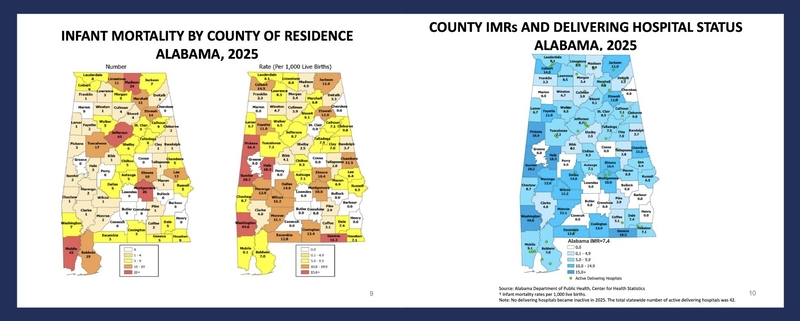
According to the data, the infant mortality rate is much higher in rural counties like Pickens, Sumter, Hale and Washington in the Black Belt, and Geneva County in the southern part of the state. Those counties directly correlate with counties without hospitals that can deliver babies, according to the data.
According to the University of North Carolina’s Sheps Center, nine rural hospitals have closed in Alabama since 2009. Only 30% of the state’s rural hospitals have labor and delivery units, leaving many expectant parents to drive long distances for care. One labor and delivery unit in Mobile closed this summer.
“We aren’t necessarily able to prove a statistical association because the numbers are really small, but it doesn’t seem like a coincidence that when you live really far away from a delivery hospital your infant mortality rate is higher, and that’s what we see,” Harris said.
The department has nine programs related to infant mortality: Safe Sleep initiatives; Well Woman; family planning services; newborn screening; sexually transmitted infection/disease diagnosis and treatment; Women, Infant and Children program; Children’s Health Insurance Program; Fetal and Infant Mortality Review; and Pregnancy Risk Assessment Monitoring System.
Montgomery