In Alaska’s legislative elections, a handful of races remain undecided nail-biters
Nov 12, 2026 | 5:27 pm ET
Description
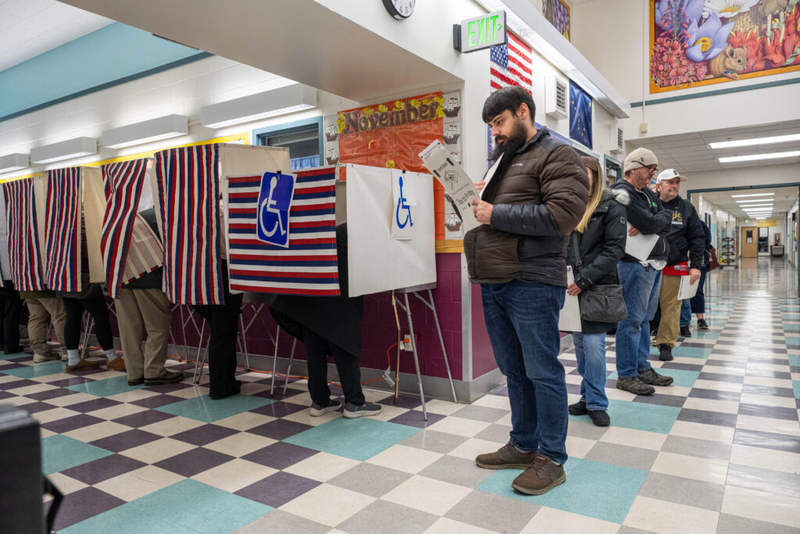
People wait in line to vote on Election Day, Tuesday, Nov. 3, 2026 at Scenic Park Elementary School in East Anchorage. (Photo by Loren Holmes/Alaska Beacon)
In the Matanuska-Susitna Borough, candidates in two different Alaska House of Representatives elections are separated by five votes, according to preliminary, partial ranked choice runoff data published by the Alaska Division of Elections on Wednesday night.
The winners of those two races are not expected to change the balance of power in the Alaska House, which is on course to be controlled by a multipartisan coalition, but they would be significant in determining who represents the state’s fastest-growing region in that chamber.
The Division of Elections doesn’t perform its official ranked choice runoff until Nov. 18, the deadline for the last absentee ballots to arrive internationally, but it publishes preliminary data that allows observers to conduct their own unofficial ranked choice tabulations.
The Beacon, using data updated by the division on a regular basis since Election Day, has performed multiple tabulations using RCTab, an open-source computer program used to audit ranked choice results across the country.
On Wednesday, elections officials added more than 6,000 ballots, mostly from the Mat-Su, to the statewide total.
In House District 30, which covers the western Mat-Su and the Denali Borough, Republican candidate Doug Massie leads incumbent Republican Rep. Kevin McCabe by just five votes in a hypothetical ranked choice tabulation. An estimated 160 votes are uncounted in that race.
In neighboring House District 29, incumbent Rep. Garret Nelson leads Republican challenger Steve Menard by five votes in a different hypothetical ranked choice runoff. There are an estimated 101 ballots uncounted in that contest.
Other races, including Wasilla’s House District 27, Eagle River’s House District 24 and Homer’s House District 6 also remain too close to call.
Under Alaska’s general election system, voters rank up to four candidates in a race. If one candidate has at least 50% of the top-rank votes, they win. If no candidate hits that threshold, the person with the fewest top rankings is eliminated.
Votes for them are redistributed to the other candidates, based on the rankings that voters chose. The eliminations continue until two candidates are left. The person with the most votes wins.
Five state House races remain too close to call
In House District 30, initial preliminary ranked choice results showed McCabe trailing by 49 votes, but that gap shrunk as absentee and early votes were counted and added to the Election Day total.
Similarly, Nelson held a substantial lead in initial ranked choice tabulations but has seen his lead shrink as more ballots have been counted.
With more than 100 ballots left to be counted in both races, the result remains undetermined.
In Wasilla, Republican incumbent Rep. Elexie Moore now trails Republican challenger Stephen Wright by 43 votes. Moore led Wright by six votes immediately after Election Day.
For House District 24, where longtime Republican Rep. Dan Saddler has retired, former state legislator and Republican candidate Ken McCarty leads fellow Republican candidate Gina Wall by 52 votes. The Division of Elections reports that more than 1,100 absentee and early votes remain uncounted there.
In Homer, where Republican Rep. Sarah Vance is being challenged by independent Brent Johnson, Vance has a substantial 210-vote lead, but elections officials have yet to count almost 2,400 votes — more than 20% of all ballots cast in that district.
In both the Eagle River and Homer races, because there are only two candidates, ranked choice tabulations aren’t necessary.
Two Mat-Su races have near-certain winners after rankings
For Alaska Senate District M, which covers Wasilla, Republican candidate Ryan Berry has all but defeated incumbent Sen. Cathy Tilton, R-Wasilla.
In preliminary ranked choice tabulations Wednesday night, Berry had 51.9% of the final vote to Tilton’s 48.1%.
According to ballot data published by the division, voters who backed Republican Zane Vrvilo and Democrat Pat Chesbro in that race have so far preferred Berry to Tilton, pushing the challenger over the top even though Tilton led in first-choice votes.
The percentages are likely to change; rankings have not yet been published for about 270 ballots, and another 268 votes have not been counted, according to Division data.
Republican Rep. DeLena Johnson, R-Palmer, is on course to clinch re-election, according to preliminary ranked choice tabulations from Wednesday. While she has just over 35% of the first-choice votes in a three-way race within House District 25, voters who preferred independent Steve Merritt as a first choice have so far overwhelmingly preferred Johnson to Republican challenger Michael Bowles as a second choice.
In the latest available tabulation, Johnson finishes with more than 55% of the vote.
Only 147 votes in that district were known to be uncounted on Wednesday, not enough to change the result.
Ranking data unreliable in close rural Alaska races
The ranking data published by the Division of Elections comes from ballot scanners used by elections officials across the state. In rural Alaska, more than 130 precincts hand-count their ballots, which means ranking data is unavailable until those ballots are mailed to regional or state headquarters.
In southwest Alaska’s Senate District S, Speaker of the House Bryce Edgmon is leading the race to replace Sen. Lyman Hoffman, D-Bethel, but a lack of available data makes his lead uncertain.
Of 7,489 votes counted in that race, ranking data is available for only 4,904 votes. In addition, the Division of Elections has reported 595 early and absentee votes that haven’t been counted at all.
House District 38 is part of Senate District S and faces a similar issue. Rep. Nellie Unangiq Jimmie, D-Bethel, leads a four-person race, but the shortage of available ranking data makes her lead uncertain.
Juneau