Nessel launches antitrust lawsuit against Mackinac ferry operator, alleging monopoly
Nov 12, 2026 | 5:14 pm ET
Description
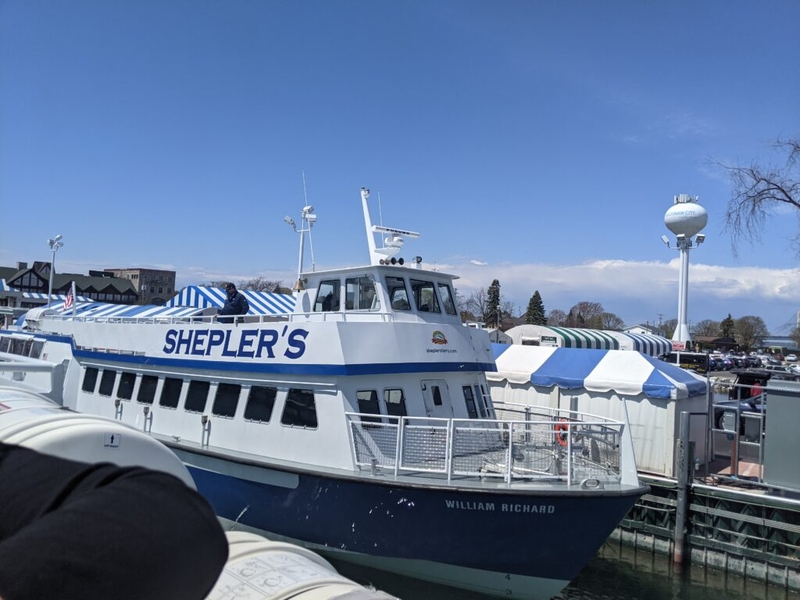
Shepler's Ferry (Photo by Laina G. Stebbins/Michigan Advance)
Michigan Attorney General Dana Nessel has filed an antitrust lawsuit against the Hoffmann Family of Companies, a Florida-based private equity firm, which currently owns all of the passenger ferries that serve Mackinac Island. Nessel’s office alleges that the company’s acquisitions have created an illegal monopoly.
“Every tourist, worker, and resident who rides a ferry to the Island must buy a ticket from Hoffmann, and most of them must also pay Hoffmann to park for the duration of their visit,” the lawsuit, which was filed Thursday in state circuit court, argues.
Historically, the island — which does not allow motorized vehicles — had been serviced by three passenger ferry companies, all separately owned. In 2016, the Star Line Mackinac Island Ferry purchased Arnold Transit Company when it went out of business, reducing the number of ferry companies to two; the Star Line and Shepler’s Mackinac Island Ferry. Hoffmann purchased Shepler’s in 2022 and the Star Line in 2024, which had rebranded as the Mackinac Island Ferry Company, eliminating all competition, and has since increased ticket prices for ferry riders.
The lawsuit also lays out that Hoffmann owns “every dock on the Island, in St. Ignace, and in Mackinaw City that can serve passenger ferries,” as well as “the vast majority of long-term parking near those mainland docks, which most visitors need in order to reach the Island.”
“Hoffman wields enormous monopoly power over two markets essential to the island’s well-being: ferry service to the island and long-term parking for anyone traveling to the island overnight, or even for a quick day trip,” Nessel said in a press conference announcing the lawsuit. “Since they consolidated their control in these areas, eliminating any competition for ferry service or parking, we’ve seen Hoffman do exactly what you’d expect a monopolist to do. They’ve raised prices, limited services, and leveraged their massive power in alarming ways, even threatening to suspend ferry service to Mackinac Island entirely if local government didn’t give them favorable extended agreements to let them keep hiking their prices.”
In the past, when the Mackinac Island City Council has tried to rein in price increases, Hoffmann threatened to cease all ferry service, which the lawsuit describes as essentially holding residents and seasonal workers “hostage.”
“Ferry access to the island is far and away the most common way tourists, visitors, residents, and workers move between the mainland and the island,” Nessel said. “90 to 95% of all traffic to Mackinac Island, which receives more than 1 million guests every year, comes by ferry service from Mackinac City or St. Ignace. That’s also how the island gets much of its freighted goods, including food and medical supplies. In the summer months, the ferry service lines run all day and well into the evening, with large commercial docks on the island and in each mainland city.”

The lawsuit also draws contrasts to the cost-per-minute charge of other ferries in the Great Lakes, including the Miller Ferry from Catawba Island, Ohio, to Put-in-Bay on South Bass Island in Lake Erie, the Kelleys Island Ferry from Marblehead, Ohio, to Kelleys Island in Lake Erie, and the Washington Island Ferry from Wisconsin’s Northport Pier to Washington Island in Lake Michigan — all of which charge around half the price-per-minute of the Hoffman ferries to Mackinac Island.
Legislation put forward by state Sen. John Damoose (R-Harbor Springs) and signed by Gov. Gretchen Whitmer in June sought to increase the ability of the island’s local government to restrict fare increases and exert oversight over the ferry companies. That law was approved by voters on Mackinac Island in the November general election.
But the lawsuit notes that the oversight in the legislation will be delayed in going into effect — Hoffmann said publicly after the ballot measure passed that “it will continue to operate under its existing franchise agreements, which run through June 30, 2027, and that the new law cannot modify those agreements and will not affect the 2027 season.”
The lawsuit is seeking “divestiture and other structural remedies to reopen these markets to competition, provide consumers with meaningful choices, and ensure fair market conditions for residents, businesses, and visitors,” a press release from Nessel’s office explained.
Asked what those remedies might entail — including whether Hoffmann could be forced to sell one of its ferry companies — Nessel said the details would be up to the courts.
Assistant Attorney General Jonathan Comish said the court could also seek to increase competition among parking operators, adding, “There were three separate ferry lines, so we would seek the court to force the divestiture of some ferry operations. Now, that’s a delicate procedure, often involving investment banks and lots of consultants to make sure that the transaction goes through in a way that’s healthy and restores competition in the long term.”
A statement from the Hoffmann Family of Companies noted that they are aware of the lawsuit and will respond in court, and are “confident we will prevail, because we are not violating state or federal antitrust laws.”
“As a reminder, the federal court has already twice rejected the City of Mackinac Island’s antitrust claims in its federal litigation against us,” the statement continued. “Most important: In April, AG Nessel issued a statement encouraging all parties to resolve the ongoing disputes. We wholeheartedly agreed with her and are in active mediation. We believe this lawsuit threatens to derail those efforts. While we are surprised and disappointed by this development, our goal remains the same: reaching agreement on a viable contract extension that serves the public interest and ensures sustainable ferry service for years to come.”
Comish addressed questions about the previous lawsuits, which were dismissed for lack of standing.
“The city asserted antitrust damages, which is a tricky thing that you have to allege in a private antitrust lawsuit saying that the harms you suffered were linked to anti-competitive conduct,” he explained. “Since we are the sovereigns, we don’t have to meet that requirement. So we have the ability to bring a lawsuit against anyone who violates our antitrust laws just because they violated the laws, so we get to skip that step.”
Mackinac Island Mayor Margaret Doud said in a statement released by Nessel’s office that the city’s goal has been to ensure the ferry system serves the public.
“This was never only an Island issue. More than 1.5 million people travel to Mackinac Island each year, and many of them are Michigan families,” Doud said. “Over 80% of the Island is designated as Mackinac Island State Historic Parks, which belongs to the people of Michigan. The State has stepped forward on their behalf, and we are grateful.”
Advocates who have supported the legislation and ballot initiative on the island also shared appreciation for Nessel’s lawsuit.
“The Legislature and governor previously acknowledged our concerns about higher costs we all face when one company owns both ferry services. Their approval of SB 304 led to more than 90% of voters approving a city charter amendment on November 3 that protects residents, workers and visitors,” said John Sellek, a spokesperson for Fair Access to Mackinac Island Coalition, in a press release. “Our goal remains a swift and fair resolution between the City and the ferry owner that ensures affordable, reliable and uninterrupted ferry service for everyone.”
Nessel also took time in her press conference to address her hopes for antitrust enforcement under her successor, Eli Savit, as she will leave the office at the end of 2026. She noted that Michigan has among the weaker antitrust laws, meaning that the attorney general’s office must often be the one to respond.
“State law doesn’t require adequate pre-merger and pre-acquisition notices to state agencies, unlike many other states in the country that do require these notices, and that means oftentimes my office and others with an interest in maintaining competitive markets have to rely on reactively because we aren’t able to get involved proactively,” she said. “I strongly recommend that the next legislature address this issue, and I am hopeful the attorney’s office, the attorney general’s office, will remain under my successor as a strong advocate for these kinds of changes in the law.”
She compared Michigan’s antitrust operation, which only has one full-time antitrust attorney, to Washington’s, which has 15 full-time antitrust attorneys despite having a smaller population than Michigan.
Lansing, MI