The Sand trap: Will Rob Sand become the next Chet Culver?
Nov 12, 2026 | 2:26 pm ET
Description
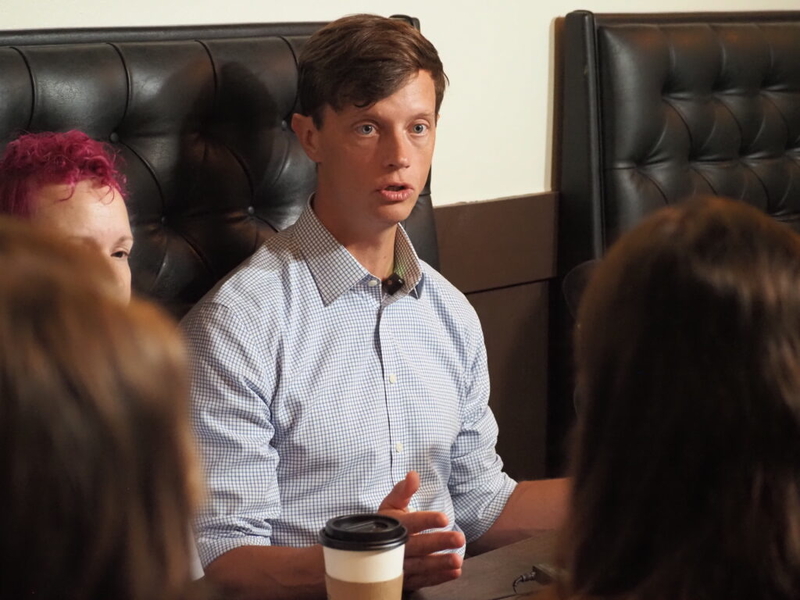
Gov.-Elect Rob Sand. (Photo by Robin Opsahl/Iowa Capital Dispatch)
Gov.-elect Rob Sand may have just been handed the keys to Terrace Hill in a situation reminiscent of the last Democrat to hold the office, the one-termer Chet Culver.
During the Great Recession, Culver faced massive budget shortfalls, rising unemployment and declining revenues. He made deep spending cuts that proved unpopular and became a political liability in his unsuccessful 2010 re-election campaign.
Sand faces his own financial peril. He inherits the consequences of years of deliberate tax reductions that have substantially reduced state revenue and limited the money available for government services. With Republicans controlling both chambers of the Legislature, Sand will have to be a world-class negotiator if he’s going to keep his promises to help struggling Iowans.
In October 2009, after state revenue estimates plunged, Culver ordered a 10% across-the-board reduction in covered state appropriations to keep the budget balanced. The cuts totaled about $564 million. They hit virtually everything, including typically sacred education and public safety budgets.
K–12 education lost about $238.5 million in state foundation aid, along with a $49.4 million reduction in state support for special education. School districts, already struggling with the recession, faced another round of painful financial decisions.
Culver took a huge political hit and ultimately lost his job to former Gov. Terry Branstad in 2010.
Voters tend to hold governors responsible for the condition of their state, even when the governor doesn’t control all the decisions that created the problems. Sand takes his turn in the crucible in January. And he won’t have much wiggle room.
A decade of Republican control of the executive and legislative branches effectively tied off and padlocked the purse strings, sealed them in an iron vault and dropped them in the deepest spot of the Des Moines River.
Iowa’s 3.8% flat individual income tax, which took effect in 2025, is part of a series of tax reductions that have substantially reduced state revenue.
The state collected about $635 million less in general fund revenue in the 2026 fiscal year than it did the year before. Meanwhile, projected revenue for the 2027 fiscal year is approximately $1.11 billion below the state’s budgeted spending. Assuming modest revenue growth and no spending increases, that gap would narrow to approximately $820 million in the 2028 fiscal year.
Those gaps cannot be attributed entirely to the flat tax. But the tax reductions have contributed to the state’s revenue pressures.
To be fair, the outgoing governor, Kim Reynolds, and Republican budget officials have argued that the reductions were deliberate and that Iowa accumulated billions of dollars in reserves to help finance the transition to lower income taxes.
At the close of the 2026 fiscal year, the state’s Taxpayer Relief Fund held approximately $3.2 billion, with another $1.6 billion in its ending balance. Those reserves give Sand and lawmakers some breathing room.
But reserves are not an endless source of money. Eventually, recurring revenue and recurring spending have to come closer together. That will make any new initiatives Sand proposes all the more difficult.
Urban and rural areas face challenges
Iowans, urban and rural, have different problems, and all of them are looking to the state for help. Growing urban and suburban counties face rising housing costs, development pressures, changing demographics and increasing demand for schools, roads and public services. Meanwhile, many rural counties struggle with population loss, aging residents, declining school enrollment, long bus routes and difficulty recruiting teachers.
Urban hospitals face demands for behavioral health care, emergency services and the costs of treating patients who cannot pay. Rural hospitals face questions about their survival, shortages of doctors and nurses, ambulance coverage and longer travel distances for patients.
Growth demands new infrastructure in urban and suburban counties. Across rural Iowa, the challenge is maintaining thousands of miles of secondary roads, aging bridges and water systems with limited resources. Broadband access remains a challenge in some rural communities, even as statewide coverage improves. And water quality is everybody’s problem.
Urban areas struggle with flooding, stormwater runoff and drinking water contamination. Rural counties face agricultural runoff, soil conservation needs and increasingly expensive damage from extreme weather.
Don’t look to local governments to solve these problems on their own. The Reynolds administration and the Republican-controlled Legislature have already tightened restrictions on local governments’ ability to raise revenue.
A property tax law passed this year generally limits annual growth in revenue from certain city and county property tax levies to 2%, with exceptions, including new construction. The nonpartisan Legislative Services Agency estimates the cap could cost Iowa cities approximately $103.7 million in property tax revenue over its first four budget years.
Other provisions of the law, including an expanded homestead exemption and changes to state reimbursements, could further reduce local government revenue.
Earlier Republican legislation also restricted when local governments can hold bond referendums, generally requiring those elections to take place in November.
Cities must figure out how to provide services to growing populations while facing new limits on property tax revenue. Rural communities must try to maintain essential services with stagnant or shrinking tax bases. And communities with little new construction may have an even harder time making up lost revenue than fast-growing suburbs.
Thes problems all share one need: money. Where Sand is going to get that money may well be the question that defines his governorship.
Iowans sent state government a clear message about income taxes in November. By a margin of roughly 56% to 44%, voters approved a state constitutional amendment requiring a two-thirds majority in both chambers of the Legislature to increase individual or corporate income tax rates or establish new state income taxes.
Everybody needs something from state government. Nobody wants to pay for it — a classic American dilemma.
The burden now lands squarely on Sand’s shoulders. If the governor-elect doesn’t figure something out, he could become the next one-termer in a state that adores long-serving governors.
Good luck and godspeed, Gov.-elect Sand.
Des Moines, IA