Energy, PFAS and Knowles-Nelson on the environmental agenda as Democrats take control
Nov 12, 2026 | 4:45 am ET
Description
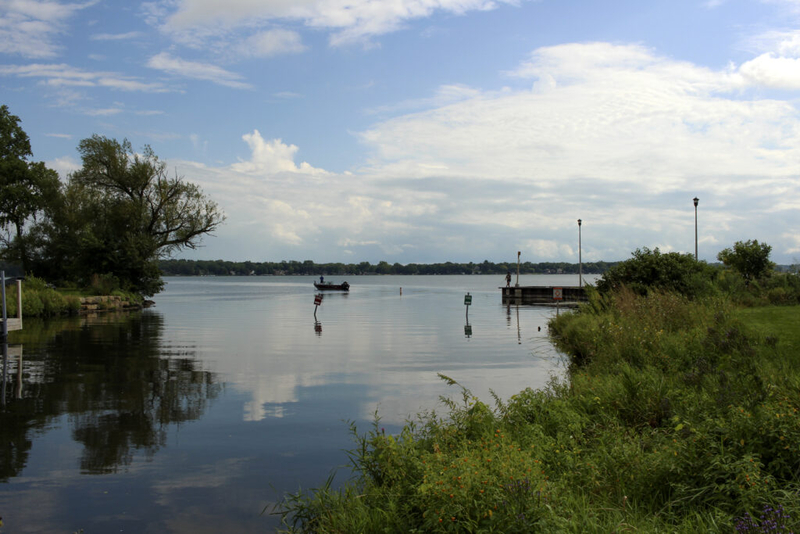
Starkweather Creek empties into Lake Monona at Olbrich Park in Madison. (Photo by Henry Redman/Wisconsin Examiner)
Following a campaign in which Wisconsin voters frequently cited concerns about data centers and energy affordability as major issues and Democratic candidates for the Legislature touted plans to restart the state’s land conservation program, Wisconsin Democrats are signaling they’ll use their new control of state government to take action on a number of climate and environmental issues.
“We are going to deliver bold action for Wisconsinites. We are going to lower costs, support our public schools, protect our rights and freedoms, help working families, ensure safe and welcoming communities, hold big corporations accountable, fight back against federal overreach, ensure a clean environment for future generations, and much more,” Rep. Greta Neubauer (D-Racine) said in a statement after being elected to serve as the next speaker of the Assembly.
Wisconsin Democrats will take over state government at a time when President Donald Trump’s administration has prioritized extractive industries and rolled back environmental protections.
There are limits to what officials in one state can do to address a global problem like climate change, but state government’s purview over environmental issues includes regulating pollutants in the state’s air, land and water, purchasing and maintaining public land, overseeing the state’s electric utilities and funding efforts to protect the environment.
As Democrats prepare to take majority control of the Legislature in January, advocacy groups are pressing Democratic lawmakers to address their concerns both through standalone legislation and in the next state budget — which will dominate the agenda next summer.
Clean Wisconsin has released a list of its policy priorities for 2027, which include increasing efforts to keep pollutants such as PFAS, nitrates, lead and phosphorus out of the state’s water; providing farmers with more tools to responsibly manage the land; investing in county-level initiatives; regulating data centers; changing how utility companies plan their energy development and expanding renewable energy.
“We’re really focused on pragmatic work, like a long list of on-the-ground programs that help protect our water systems, our groundwater, drinking water, our surface water, and help protect our climate and our air, and put some meaningful guardrails in place around AI data centers,” Amy Barilleaux, a spokesperson for Clean Wisconsin, told the Wisconsin Examiner. “I think people want to hear, ‘Oh, this big thing and that big thing,’ but it takes like a thousand little things to accomplish that big thing.
Barilleaux said that Gov.-elect David Crowley and whomever he appoints to run the state Department of Natural Resources can have a significant effect on environmental protection in the state simply by working to restore the agency’s muscle to what it was before Republicans slashed its staffing and budget under former Gov. Scott Walker.
“I think it’s not that the DNR doesn’t recognize some authority, but you have to have people to do the work,” she said. “It’s been very difficult with understaffing at some agencies to really be able to do the work they are in statute being asked to do. So that’s a big one as well. We just need to improve the function of our government.”
Utility regulation
In the days since their electoral victory, Wisconsin Democrats have signaled that their first priority in January will be addressing the affordability concerns that dominated the debate on the campaign trail. For environmental groups, that has led to a focus on how the state regulates its utility companies.
In recent months, the Public Service Commission — the agency responsible for utility regulation — has taken some actions to prevent data center developments from increasing electric bills and to slow down requests to raise rates. But, Barilleaux said, the commission has also said in its recent decisions that if it’s going to do more, the Legislature needs to give it some help.
Clean Wisconsin and a number of other groups are pushing for integrated resource planning. Under current law, the state’s utilities are not required to make long-term plans for where they’ll get the energy required to meet the state’s demand. This means that as hyperscale data centers have begun to pop up around the state, the utilities can do whatever they want to meet that increased demand. So far, that has meant extending the life of or planning to build new plants that rely on fossil fuels such as coal and natural gas.
Moving to integrated resource planning would require that the utilities get their future plans approved by the PSC, which advocates say will encourage them to use energy from sources that are cheaper in the long term, largely solar and wind.
“Our utilities don’t have to be transparent about what they’re doing, they don’t have to have a big picture where we look at different utilities together for a full statewide energy system in Wisconsin, and that leaves us very vulnerable in this moment, extremely vulnerable as we have these AI data center projects coming in and demanding just intense amounts of energy, historic amounts of energy,” Barilleaux said. “So we’re just sitting here flat-footed with no integrated resource plan. So the Public Service Commission … when it approved the latest two gas plants, it was almost a cry for help, saying, ‘We can’t, we don’t have any authority to do anything about this,’ and that should be alarming to everyone. Even though integrated resource planning does not sound like a super exciting topic, when you see how things are unfolding here in Wisconsin, when you see the Public Service Commission saying we need help from lawmakers right now — we’re expecting lawmakers to take that very seriously.”
PFAS
Barilleaux said that another big priority for Clean Wisconsin is doing more to clean up PFAS contamination in the state’s water.
Over the last year, the Legislature and Gov. Tony Evers have finally passed legislation to spend $125 million set aside for PFAS mitigation after years of partisan deadlock. The Natural Resources Board recently established a standard for the amount of PFAS allowed to be in the state’s groundwater after years of failed efforts.
Barilleaux said more money beyond that previous appropriation is needed to address the full scope of the problem statewide and added she’d like to see a total ban on the use of PFAS in the state.
“We need to take this seriously. We can’t pretend like it’s not happening. We can’t pretend like groundwater standards and surface water standards and drinking water standards are it, because it’s not,” she said. “It is over $100 million a year in health harms that PFAS exposure is causing right here in Wisconsin, and so these are tremendous costs. I think sometimes things get characterized as, you know, cost versus environmental protection, or jobs versus environmental protection, but really, this is people’s health on the line. It is expensive to be sick from pollution and contamination. You know, this is about protecting the health of our communities.”
Knowles-Nelson
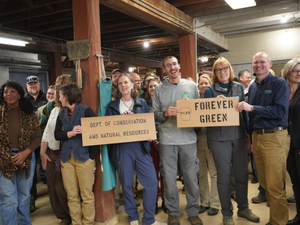
Among the most divisive environmental issues during the last legislative session was the failure to reauthorize the Knowles-Nelson Stewardship Grant Program, which for nearly four decades had allowed the DNR to fund the purchase and maintenance of public land.
A faction of Republicans in control of the Legislature had become hostile to the program — which had previously enjoyed bipartisan support — over broad objections to government land conservation and more specific complaints about the hit to local property tax revenues that can be caused by state land purchases.
Multiple compromise bills were proposed, but nothing was able to pass and the program expired this summer. The reauthorization of the program was a campaign issue in some of the legislative races that helped Democrats win majority control.
Charles Carlin, the director of strategic initiatives at the land conservation nonprofit Gathering Waters, told the Examiner that Democratic control opens up new possibilities for what the program can become, balancing how much money is spent purchasing new public land and how much is spent developing existing public land into both usable space for recreation and wildlife habitat.
“It feels like everybody is sort of absorbing the ramifications of the elections, what’s possible,” Carlin said. “But I think that certainly one of the things that you know that we are looking at now is it feels like there is a real opportunity here to have a long-term authorization for Knowles Nelson, one that is appropriately funded, and I think the other thing we’re looking at is there’s an opportunity to rebalance the program between development projects and land acquisition.”
He said it’s helpful not to have to negotiate with people who are hostile to the idea of public land conservation and added that the complaints about dwindling local government revenue on this issue tie in to coming debates about local government funding in general that are likely to play a major role in the work of the new government.
“Local government revenue is likely to be a hot topic of conversation in the next legislative session on all kinds of issues,” Carlin said. “So public lands is one small one, but shared revenue, school funding, transportation — these are all going to be things that get talked about and considered a lot. But I do want to see a renewed emphasis on DNR soliciting input from local governments on projects that are happening in their jurisdiction and taking those viewpoints and that feedback into account. I also think that if the conversation in the Legislature can be more fact-based and less driven by an anti-conservation ideology, then I think that creates the space for us to have a really solution-focused conversation about how tax and land use policy really impacts local government revenues.”
Madison, WI