In La Crosse and Eau Claire, citizen committees will tackle rising healthcare costs
Nov 12, 2026 | 4:30 am ET
Description
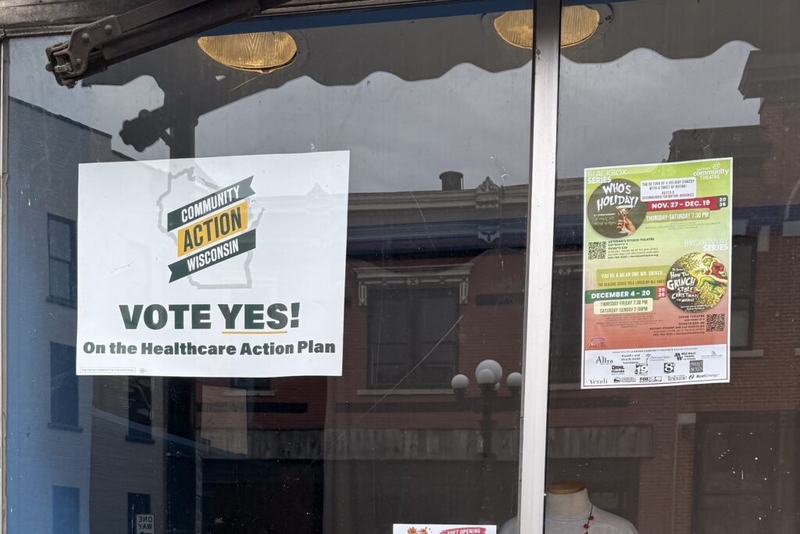
A campaign poster urging people to vote for a referendum to create a citizens committee to study healthcare issues in La Crosse hangs in a store window. (Photo courtesy of Nick Padesky)
The cost of healthcare was front and center across Wisconsin in last week’s election — and in western Wisconsin, the story was no different.
“It’s really bad,” says Shawn Phetteplace of Main Street Alliance, which counts some 400 western Wisconsin small business owners among its members.
They’ve been distressed by a spike in the cost of health insurance for people who buy coverage on the federal healthcare marketplace, Phetteplace says. He adds that “a disturbing number of people” have dropped coverage entirely.
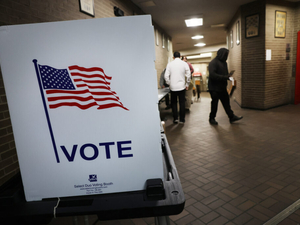
Now two western Wisconsin cities, Eau Claire and La Crosse, are preparing to appoint teams of local citizens to dig into the issue. Voters in each city approved ballot measures on Nov. 3 to create healthcare action task forces.
Eau Claire voters approved the proposal 55% to 45%, while in La Crosse, the vote was 67% in favor to 33% opposed.
“It’s a novel approach, but I think it’s an exciting opportunity for people who are feeling directly the impact of healthcare costs skyrocketing, small business owners and people interested in seeing city government taking a bigger role,” says Nick Padesky, who worked as a full-time time organizer for the campaign to pass the measures.
“In many ways it’s an expression of frustration with the federal and state governments for doing so little on managing healthcare costs,” says William Garcia, who led organizing for the La Crosse vote.
Sam Roecker, a Madison political strategist and a member of the team that pulled the task force campaign together, says the proposals grew out of conversations among advocates in the spring of 2026.
People who joined the campaign were frustrated about steep Medicaid cuts that will start in 2027 from the massive tax-cut and spending bill passed by Republican members of Congress and signed by President Donald Trump in 2025, Roecker says. The bill is expected to carve almost $1 trillion out of Medicaid over the next 10 years.
Roecker says people have already been seeing how the end to enhanced subsidies for health plans sold at HealthCare.gov has sent premiums soaring for people buying their own coverage. GOP lawmakers in Congress rebuffed repeated attempts to extend the subsidies, which expired at the end of 2025.
While the healthcare task force campaign was officially nonpartisan, Roecker has worked on Democratic campaigns in Wisconsin and elsewhere. Local Democratic groups promoted the ballot measures, and the reelection campaign of U.S. Rep. Derrick Van Orden in Wisconsin’s 3rd Congressional District was also a backdrop.
“Van Orden was still out there trying to frame that he in no way cut Medicaid,” says Roecker.
Van Orden, a Republican, voted for the 2025 GOP law while rejecting the characterization that the measure had imposed Medicaid cuts. He lost on Election Day to Democrat Rebecca Cooke.
Garcia chairs the 3rd Congressional District Democratic Party, but says that for the task force campaign, “I signed on not as a Democrat but as a citizen of La Crosse.”
Members of Main Street Alliance got involved in advocating for the ballot measures, Phetteplace says. Health professionals who belong to the advocacy group Committee to Protect Health Care did as well, says that group’s spokesperson, Annika Isaguirre.
The measures were introduced as direct legislation, provided for in the Wisconsin statutes for residents of a municipality to introduce local ordinances on their own. The state law requires that the municipality’s board or council vote on the measure or submit it to voters in a referendum.
Organizers in La Crosse submitted more than 5,000 signatures and in Eau Claire more than 8,000 signatures. While they could have left the issue just in the hands of the city councils, “We asked them specifically to send it to referendum,” Garcia said. “We wanted the community to have a say that this was a good idea.”
The ballot measures in each city asked voters whether the city should create a citizens advisory healthcare action committee. Each was tied to a lengthier ordinance that prescribes the number of members for the committee (seven), how they’re selected and what their duties and responsibilities are. Each committee is to produce a report every two years.
“They’re tasked with analyzing the state of healthcare in the cities,” says Padesky — what premiums residents are paying for their health insurance, how many small businesses have health insurance plans for their employees, the presence and demographics of population groups with less access to healthcare and other facts and trends.
The committees’ recommendations could include advocacy as well as possible strategies — “what do we need from state and federal policymakers to what direct actions can the cities of La Crosse and Eau Claire take to make healthcare more accessible and affordable with everyone in the cities,” Padesky says.
In structuring the proposals, the organizers sought to keep the committees open-ended, Roecker says, avoiding prescribing specific solutions.
Organizers say they didn’t encounter a concerted campaign against the ballot measures in either city. In Eau Claire, the local chamber of commerce issued a statement the Friday before Election Day that raised objections to the proposal, but stopped short of calling for a vote against it.
“Our concern is not with the goal of the proposal, but with whether the committee’s structure, authority, and resource requirements would meaningfully advance that goal,” the chamber statement said.
The organizers acknowledge that many of the problems relating to healthcare costs are due to state and federal policies.
“When I talked to people individually about it, the only concern that anybody expressed was the fact that, in many ways, the city does not have a lot of leeway in terms of what happens with healthcare costs,” Garcia says.
“Everyone acknowledges that most healthcare policy is decided at the federal and state level,” he says. “But that doesn’t mean local governments are completely useless in the matter.”
Madison, WI