Will a new farm bill arrive in Kansas farmers’ stockings this holiday season? Don’t count on it.
Nov 12, 2026 | 4:33 am ET
Description
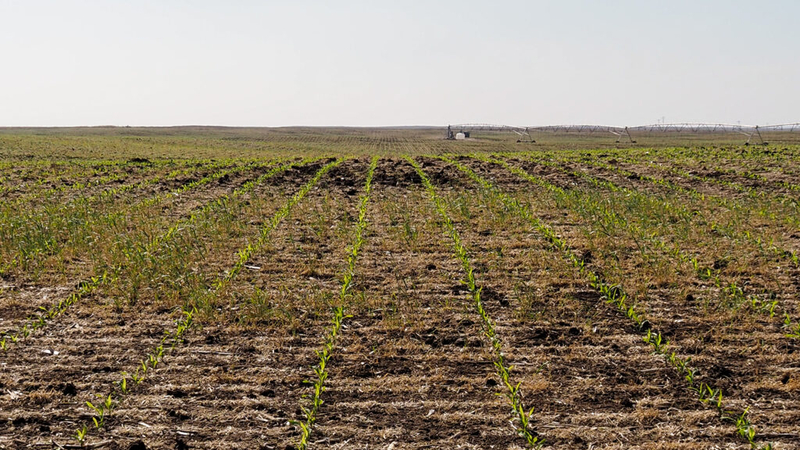
Despite years of competing proposals, our columnist suggests that a new farm bill won't emerge from Congress before year's end. (Allison Kite/Kansas Reflector)
During his reelection campaign, Republican U.S. Sen. Roger Marshall trumpeted his role writing a new farm bill. It was minimal and apparently not enough. Democratic Sen.-elect Adam Hamilton said he would have voted to advance the Senate’s bill.
Kansas politics rewards farm largesse and punishes parsimony — Sunflower State bipartisanship. Our congressional delegation fronts every pass-the-farm-bill parade.
Its members should prepare to be disappointed.
The lame-duck Congress must replenish the government’s coffers by mid-December. Defense Department activities await perdurance. The president’s war looms. Will Congress let him waste more money on it? The administration paired its request to increase war spending with $11 billion more in farmer bailouts. If the former fails, will the latter survive?
That’s a daunting agenda for a productive Congress in the best of times. This one isn’t, and they aren’t.
Is a new farm bill a must-do, too? No, it’s a can’t do, won’t do. The House bill dies when Congress adjourns, and the stalled Senate bill remains stalled — a double flop. Lawmakers will pass sheepishly a fourth extension of the 2018 act.
That actually is a good thing.
Incoming leaders of the agriculture committee should abandon — or at least curb — the recklessly out-of-control subsidies. They hit $54 billion this year.
Those same leaders need to jettison the failed policies that futilely masked 22 months of missteps strangling the farm economy and greedily fractured the farm-food alliance.
Neither of the proposals would rectify these mistakes. No bill is better than rushing to pass flawed legislation.
Policy quicksand began swallowing farm programs with former U.S. Sen. Pat Roberts’ Freedom to Farm bill. It manipulated congressional budget scorekeeping, ending the formerly foundational counter-cyclical farm policy philosophy that low prices trigger aid. Its touchstone: mandated, maximum payouts.
Supporters peddled the scheme as “transitional.” That’s aggie lingo — it translates to “until we come up with a new buzzword.” Perhaps “bridge payments,” the Trump administration’s label for its massive bailouts. Freedom to Farm, boosters claimed, would save the treasury $2 billion over seven years. Spending ballooned to $141 billion in just five.
Lawmakers and lobbyists were undeterred by the shocking underestimate of the bill’s cost. They vigorously labored to keep money flowing and shunned evaluating efficacy of the cash tidal wave.
Congress stopped asking simple, fundamental questions: Is this spending working? Have taxpayers gotten their money’s worth?
Their dereliction deepened when they capitulated to Trump-think and fell under the spell of don’t question Trump-think. Neither agriculture committee examined whether the Trump bailouts — in this term or his first — achieved their objective or whether the tariffs benefited or hurt farmers. They hurt.
The Kansas beef economy suffered some of the worst damage. Republican U.S. Rep. Tracey Mann of Kansas heads the House subcommittee with jurisdiction, but he didn’t convene it for a single minute to assess the carnage. A new leader will take over in January.
In the 2025 session, the House Agriculture Committee approved more than $1 trillion in new farm subsidies. Its chairman explained that Congress had not approved new commodity program payments since 2002, therefore it must approve the spending in his bill — spend more money for the sake of spending more money.
That was the sum of his rationale. Even if inadvertent, he succinctly stated three decades of farm policy — the apotheosis of Freedom to Farm.
Most congressional farm state lawmakers, including those from Kansans, and the farm lobby boasted they were “putting the farm back into the farm bill.” That’s more aggie lingo. It means raiding SNAP — the Supplemental Nutrition Assistance Program — of nearly $300 billion to pump up farm spending.
To the 10,000 Kansas kids who lost access to SNAP, it means going without a meal.
That plunder ended food assistance to as many Kansans as the residents of Derby, Dodge City or Garden City. They have fewer resources to feed themselves and their families than before this avaricious transfer of income to well-heeled farmers and tax cuts for upper-class taxpayers. The number could swell ninefold when “putting the farm back into farm bill” fully takes effect.
Although Roberts engineered unprecedented spending, he didn’t raid feeding programs like the current Congress. He knew no food aid meant no farm spending. Rural lawmakers can’t pass farm bills alone — they rely on urban votes. While writing his bill, again in 2013 and 2018, he played a key role in keeping the coalition together. But there is no Roberts in the Republican conference today, or someone like U.S. Sen. Bob Dole, the Kansas Republican who likewise had the political sense and skill to preserve the farm-food alliance.
Today’s GOP farm lawmakers’ spending gluttony wrecked the alliance. Thus no new bill arrived in 2023, 2024, 2025 or 2026.
Marshall blamed Democrats, whitewashing the obvious: He and his fellow Republicans controlled Congress every year it failed to produce a farm bill. Their legislative malpractice was unquestionably due to misprizing the Dole-Roberts presumption.
The farm-food coalition has served both sides well, a bedrock that many lawmakers forgot, never learned or don’t understand. They need a refresher in farm bill politics 101, starting with this reading:
It is hereby declared to be the policy of Congress, in order to promote the general welfare, that the Nation’s abundance of food should be utilized to the maximum extent practicable to safeguard the health and well-being of the Nation’s population and raise levels of nutrition among low-income households. The Congress hereby finds that increased utilization of foods in establishing and maintaining adequate levels of nutrition will tend to cause the distribution in a beneficial manner of agricultural abundances and will strengthen our agricultural economy.
That’s not some woke, “socialist,” extremist manifesto. A bunch of aggies memorialized their commitment to the farm-food partnership into those first passages of the original Food Stamp Act.
Greg Frazier helped write several farm bills while staff director on the House Agriculture Committee and USDA chief of staff before serving as USTR chief agriculture negotiator. He lives in Kansas City. He lives In Kansas City. Through its opinion section, Kansas Reflector works to amplify the voices of people who are affected by public policies or excluded from public debate. Find information, including how to submit your own commentary, here.
Topeka, KS