New Greater Boston housing data show recent progress but troubling signs for the future
Nov 10, 2026 | 9:31 am ET
Description
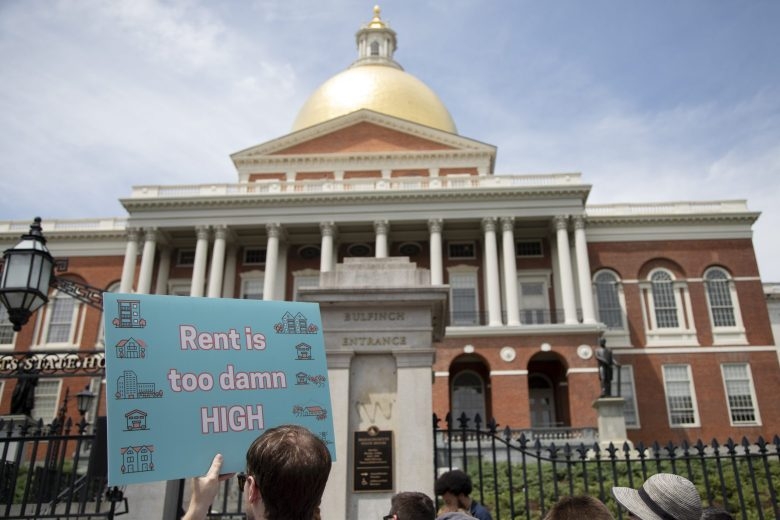
A rallygoer protests the high cost of rent in Massachusetts at an Abundant Housing Massachusetts event on May 27, 2026.
AN ANNUAL REPORT on the state of housing in Massachusetts’s most populous region offers a grim assessment of the housing crisis, just days after voters narrowly shot down a ballot question seeking to make it easier to build single-family homes on smaller lots.
Greater Boston’s infamously high rental prices and home prices are leveling off, according to the Greater Boston Housing Report Card from the Boston Foundation and the Joint Center for Housing Studies at Harvard. But permits for new units have hit their lowest level in a decade, population growth is slowing, and new units are down, setting the stage for a period of sluggish housing growth as the state struggles to get a handle on its cost-of-living crisis.
“There’s a bigger question on what’s the health of the region’s economy in the next few years,” said Luc Schuster, executive director of Boston Indicators, the research arm of the Boston Foundation. “We could see a stagnation or recession,” he said, and while that may bring prices down, “that’s just not the way we want to address the housing cost problem.”
The report found 32 Greater Boston municipalities had median single-family sale prices above $1 million in fall 2026. Cambridge, Wellesley, Weston, and Brookline all had median single-family prices above $2 million, and just six of the 147 municipalities in Greater Boston had median prices below $500,000. Despite the high costs, the speed of house and rent prices slowed over the year so far.
A decade ago, 42 towns had median single-family sale prices below that amount, adjusted for inflation.
To afford a home in one of the lower-priced towns today, a Greater Boston household would need to earn about $180,000. Almost half of renters in the region are cost-burdened, meaning they spend 30 percent of more of their income on housing.
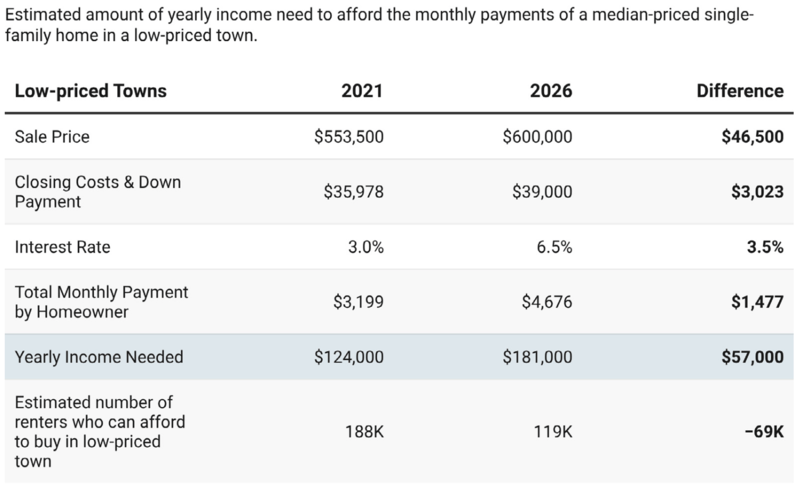
Macroeconomic factors are also squeezing Massachusetts. Immigration restrictions are throttling the state’s growth and interest rates remain high. Having fewer immigrants and international students in Massachusetts may have reduced competition for some rental properties, researchers note, but it bodes poorly for the overall economic stability of the state.
The state’s aging population, with over 1.8 millon residents aged 60 or older, is creating compounding housing problems. Older adults wield significant power over the housing market, as most of them own their homes, but the large and aging baby boomer population also means a rising number of households with fixed incomes and in need of more medical and social supports, according to the state.
The report card lands after an unsuccessful swing at housing policy change via ballot.
Question 7 on last Tuesday’s ballot would have taken aim at the state’s inconsistent lot size requirements by barring cities and towns from requiring more than 5,000 square feet of land to build a single-family house if the lot is served by public water and sewer systems.
It drew significant support from cities in the Greater Boston region — though Boston itself would have been excluded from the new zoning rules — and opposition from many of the smaller towns that also would have been exempt because they lack sewer systems.
The Massachusetts Municipal Association, which opposed the measure, disputed proponents’ contention that reducing the lot size for single-family homes would bring down prices.
In a high-demand market, the group argued after the ballot question was defeated, reducing lot size “does not compel developers to build ‘starter’ homes, as evidenced by the abundance of homes on small lots selling for $1 million or more.”
Supporters argued the ballot measure’s defeat by a mere 1.2 percentage points did not signal a rejection of more housing supply.
Abundant Housing Massachusetts, the state’s main “Yes In My Back Yard” organization and one of the groups supporting Question 7, noted that “yes” narrowly prevailed in towns including Winthrop and Milton, which fiercely opposed the MBTA Communities multi-family housing law.
“The close margins on Question 7 show that despite the crowded ballot and technical nature of the question, many Massachusetts voters want more homes in their communities,” said Jesse Kanson-Benanav, the group’s executive director, in a statement.
Gov. Maura Healey and Lt. Gov. Kim Driscoll — who served as the mayor of Salem — endorsed the ballot measure.
Healey’s administration estimates that between 2025 and 2035, the state would need to build 222,000 units to address current housing needs and future population growth projections. The first year, her housing office touted, far exceeded the 22,000 units it would need to start the decade on target.
Massachusetts in 2025 added 34,561 units, according to a state housing tracker released in March. State housing officials said this surge included a major backlog of units stuck in the pipeline during the height of the COVID-19 pandemic and do not expect such prolific future construction.
“It’s clear that we need to build more homes to bring down costs,” Healey said in a statement. “This report recognizes the progress we’re making through new policies to accelerate housing production – from making [accessory dwelling units] available by right and reforming zoning to speeding up permitting and converting unused state land, office space and commercial buildings into housing. As a result, we already have 100,000 new homes in the pipeline.”
The report card authors expect 2026’s unit production will be near the 22,000 mark.
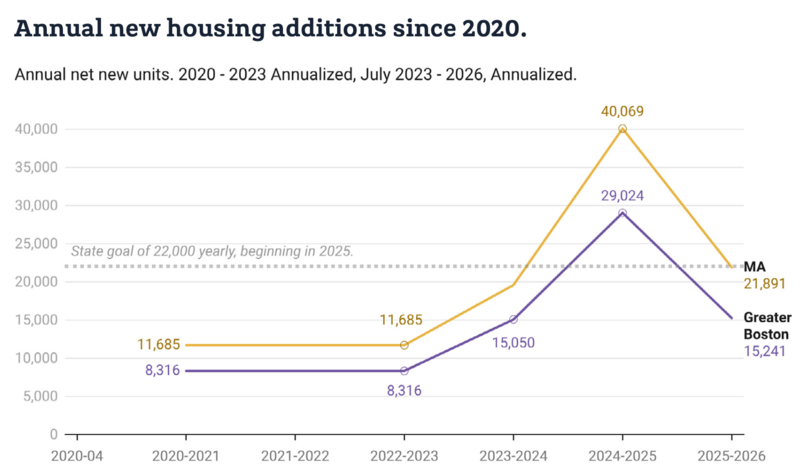
“The challenge, though, is permits for future construction appear to be down,” Schuster said. “Everyone is kind of expecting 2027 and 2028 to not meet that pace.”
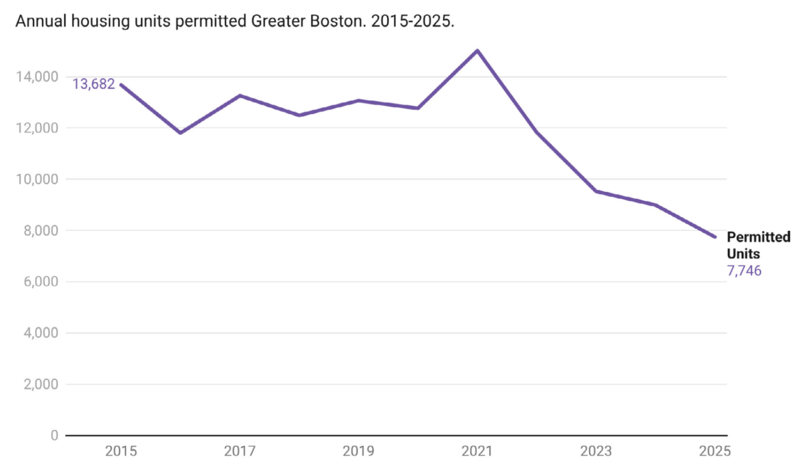
Housing permits are an imperfect estimate of future contribution, but they often offer a best-case picture of new units.
From 2015 through 2021, annual permits in the five counties that make up Greater Boston hovered between 12,000 and 15,000. In 2025, Greater Boston permitted just 7,746 units, according to the report.
The Greater Boston metropolitan area is responsible for the bulk of housing construction in the state. The Executive Office of Housing and Livable Communities, which has been tracking units produced in MBTA Communities districts and accessory dwelling units since 2024, counts about 10,000 units in the pipeline because of MBTA Communities and about 2,000 new ADUs. The vast majority of each housing type is located in Greater Boston.
“While this apparent uptick in 2026 is good news, it’s far from certain that this rebound will hold,” the report’s authors wrote. “The lowest-hanging fruit in MBTA Communities districts and for ADU construction may already have been permitted.”
Question 7, if passed, had been projected to create around 780 units a year, based on an analysis from the Tufts Center for State Policy Analysis. The water and sewer restrictions would have effectively excluded 78 percent of Massachusetts’s land area, according to the Greater Boston Real Estate Board, the major real estate trade organization for the region, which said in a statement that it was “disappointed” by the defeat at the ballot box.
Starter homes have become a particularly potent political quandary for the state, which for decades has seen early-career residents flee for cheaper pastures around New England.
Two decades ago, the Housing Report Card recounted, Greater Boston’s expensive housing stock was already “a long-term problem that has caused middle class and young workers between the ages of 25 and 34 to leave the state in increasing numbers in recent years.” Housing, researchers wrote then, “continues to be the No. 1 economic development challenge for the Commonwealth.”
The ballot question loss raises the stakes for the handful of housing reforms currently in limbo at the State House.
No sequel has emerged to the nearly $5.1 billion housing bond bill — the Affordable Homes Act — passed in 2024. But the House and Senate are reconciling their versions of a sprawling economic development bill, which respectively include a move to incentivize multi-family housing on land owned by religious organizations and up-zone the state to allow duplexes anywhere a single-family home can currently be built.
A final version could emerge at any time before the two-year legislative session ends in January. When it comes to Beacon Hill and the housing crisis, Schuster said, “how productive this session will end up being depends on how the economic development bill ends up being written.”
Boston