Pennsylvania’s Democratic trifecta renews calls to join National Popular Vote compact
Nov 09, 2026 | 5:08 am ET

Description
Already enacted in 18 states and the District of Columbia, the National Popular Vote Interstate Compact would bypass the Electoral College to guarantee the candidate with the most votes across the country wins the presidency. (Photo by Peter Hall/Pennsylvania Capital-Star)
Democrats’ midterm victories in Pennsylvania and other swing states have prompted renewed interest in an alternative to the Electoral College that proponents have urged the commonwealth to join.
With Democratic Gov. Josh Shapiro’s reelection and majorities in both chambers of the General Assembly, Democrats have a clear runway to launch popular progressive initiatives, such as increasing the minimum wage and protecting abortion rights under state law.
The commonwealth’s blue trifecta would also make it easier for lawmakers to pass legislation that supporters say would ensure that every vote counts in presidential elections.
Already enacted in 18 states and the District of Columbia, the National Popular Vote Interstate Compact would guarantee the candidate with the most votes across the country wins the presidency. Pennsylvania’s neighboring states Delaware, New Jersey and New York are among the members of the compact.
“Every voter in Pennsylvania should matter in every presidential election, not just when it’s so tight a court has to decide who won it,” said Patrick Rosenstiel, senior consultant to National Popular Vote. “We want voters in every state to participate and be involved in the presidential election.”
Five presidential elections have been won via the Electoral College by candidates who lost the popular vote. They include President George W. Bush who became president after the 2000 election despite losing to Vice President Al Gore by more than half a percentage point and President Donald Trump, who lost the popular vote to former Secretary of State Hillary Clinton by about a half point.
Rosenstiel added that he’s increasingly confident that a favorable environment with political support and legislative will exists to advance the legislation here. As a lifelong Republican and a resident of blue Minnesota, he added that the compact should appeal to any voter who feels their presidential vote hasn’t mattered.
While Rosenstiel said the concept is favored by 63% of Americans, others say its passage would foment voter backlash.
“It’s an exceedingly undemocratic idea,” Duquesne University constitutional law professor Bruce Ledewitz said, noting that he’s not opposed to a national popular vote to choose the president but doesn’t support the compact.
“You have to think about what it’s going to be like at the time,” he said, offering a hypothetical scenario. “The people will have voted for Trump, and suddenly the electors are voting for Biden … We already have distrust of the government; that would be a disaster.”
State Sen. Maria Colette (D-Montgomery) said flipping control of the Senate to a Democratic majority gives lawmakers “a real chance” to advance bipartisan election bills that languished in committees for years. “The National Popular Vote Compact is part of that conversation,” she said.
Shapiro said in an interview Saturday with “Pod Save America” host Jon Favreau at a Washington, D.C., event that he’s open to the idea of a national popular vote.
“I’ll work with lawmakers to figure out what the right mechanism is for moving forward on that. But look, we’re the ultimate swing state in Pennsylvania … I think Pennsylvania can still play a massive role even in a national popular vote,” Shapiro said.
Shapiro: I think the national popular vote makes sense…I'll work with lawmakers to figure out what the right mechanism is for moving forward on that. But look, we're the ultimate swing state in Pennsylvania…I think Pennsylvania can still play a massive role even in a… pic.twitter.com/1ZW2TPpSYw
— Pod Save America (@PodSaveAmerica) November 7, 2026
So, what is the National Popular Vote Interstate Compact and what would Pennsylvania lawmakers need to do to join it?
An interstate compact is a legally binding agreement in which two or more states pass laws in concert with each other to further a common goal. They’re often used to create government agencies that work across state lines to oversee ports, such as the Delaware River Port Authority, or watersheds, like the Susquehanna River Basin Commission. Compacts also exist to ensure credentials including medical licenses are recognized across state lines.
Under the National Popular Vote Interstate Compact, states pass legislation to commit their Electoral College votes to the candidate who receives the most votes out of all 50 states.
The states that have joined since 2007 collectively have 222 of the 270 Electoral College votes needed to win the presidency. That leaves 48 needed before the compact would take effect, Rosenstiel said.
With 19 Electoral College votes, Pennsylvania is one of the battleground states with state government trifectas National Popular Vote is now targeting along with Michigan (15 votes), Wisconsin (10), Arizona (11) and Nevada (6).
“We want every state who wants their voters to permanently matter in presidential elections,” Rosenstiel said, noting the commonwealth has been both a battleground and a flyover state. “What a national popular vote for president will do is lock in your permanent battleground state status because you’re not guaranteed that.”
Pennsylvania state lawmakers have pushed for the commonwealth to join since at least 2022.
That’s when Rep. Chris Rabb (D-Philadelphia) introduced legislation backed by eight Democratic co-prime sponsors to join the compact.
“We need to ensure that the voice of the people is heard, and that no election official can bow to public pressure to change the results of an election,” Rabb, who was elected to Congress last week, said at the time.
His proposal came after the 2020 election when 19 Pennsylvania Republicans submitted their names as alternate electors, voting for Trump when President Joe Biden won the commonwealth’s popular vote.
“We must defer to the collective will of voters irrespective of the victor’s party affiliation and uphold our constitutional imperative with rigor and integrity,” Rabb added.
This legislative session, Collett and Sen. Katie Muth, also a Montgomery County Democrat, circulated a memorandum seeking cosponsors for national popular vote legislation but didn’t introduce a bill.
Rep. Heather Boyd (D-Delaware) said she plans to introduce the legislation next session. She noted that she had received calls last week from colleagues whose constituents had asked about the compact. Boyd added that although Democrats will have at least a 111 seat majority in the 203-member House, she hopes for Republican co-sponsors.
“I do think the bill would be more powerful if it were understood by members to be a bipartisan effort,” she said.
In a statement Friday, Collett indicated she and Muth remain committed to, “ensuring that every vote in Pennsylvania carries the same importance as every vote in Texas and Montana and every single state in our union.”
“Pennsylvanians just told us what they want from their government, and election reform is part of that. People want a system where voting is easy to understand, ballots are counted fairly and on time, and every vote carries the same weight,” Collett said.
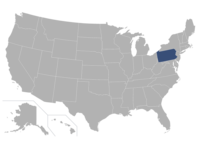
Harrisburg, PA