With Democrats sweeping Texas, the GOP-led war on cities nears its end
Nov 07, 2026 | 6:00 am ET
Description
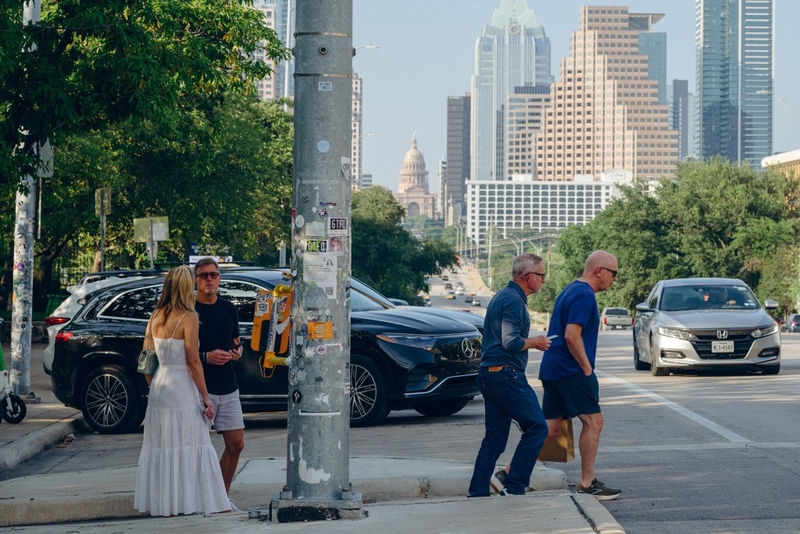
People walk across South Congress Avenue in Austin on April 24, 2026. (Manoo Sirivelu/The Texas Tribune)
For years, Republican state lawmakers engaged in an unrelenting assault on Texas cities in a bid to curb the power of the state’s bluer urban areas and stop the spread of progressive policies.
When Denton residents voted to ban fracking in city limits, the GOP-dominated Texas Legislature made it illegal for cities to do so.
When local officials enacted mask mandates to slow the spread of COVID-19 at the height of the pandemic, Gov. Greg Abbott overruled them.
And though Austin voters voted to raise their own property taxes to build the city’s first light-rail line, Republican officials have tried to stop it before a single track is laid.
On the campaign trail this year, they vowed to inflict more pain on localities, making it more difficult to raise taxes as cities and counties face considerable financial strain.
After Tuesday, local governments face a new reality.
“I don’t think we need to be on the defense the way we have in the past,” Austin Mayor Kirk Watson said.
With Democrats sweeping Republicans statewide office and winning a surprise majority in the Texas House of Representatives, city and county officials across the state have found themselves unclenching from a yearslong defensive posture against attacks on their authority by state Republicans.
As the state boomed, localities often felt left to their own devices to deal with the consequences of that growth on their own, or undermined by the state when they tried. Now, for the first time in decades, Democrats control the state’s major urban areas and the powerful arms of state government, an alignment that could help cities and counties with their biggest problems — like housing, transportation and economic development — or at the very least stay out of the way.
Before, the state was an adversary. Now, it’s a potential partner.
“The number one ask right now is partnership,” Fort Worth Mayor Mattie Parker, a Republican, said.
Across the state, local leaders seem to be drawing up their wishlists for what they’d like to see happen when state lawmakers convene in January — more funds for transportation, indigent care and policing, among them.
“Things just keep popping into my head,” Travis County Judge Andy Brown said. “So many of the things that we are trying to do are going to be so much easier to have a partner that is concerned about helping middle class Texans, helping improving the lives for working Texans and looking at it from a policy angle, not a partisan angle.”
The alliance between local governments and the state will have even further reach with Democratic pickups at the local level. Democrats flipped the GOP-controlled Tarrant County Commissioners Court and snagged the county judge seat — now controlling county government in all five of the state’s largest urban counties.
Still, the laws Republicans passed to curtail cities and counties remain on the books, and repealing them would likely take years to unwind — and in some cases prove politically tricky to repeal, such as property tax relief. And, while Democrats now control the Texas House, Republicans who backed many of those policies still hold a majority in the Texas Senate.
“There could be a lot of stalemates,” said state Sen. Paul Bettencourt, a Houston Republican who chairs the Senate’s powerful Local Government committee. “And there could be agreement.”
A huge question remains. While Democrats have long defended local control, they’ve recently shown signs they’re willing to strip city authority over at least one reason: to tackle the state’s housing affordability crisis.
Democrats signed onto bipartisan efforts to make it easier to build new homes by easing local rules in the state’s biggest cities, a bid to lower home prices and rents by boosting supply. Already, those laws have helped move along thousands of new housing units.
Some cities — particularly in the Dallas-Fort Worth region, the state’s largest economy — have resisted those laws and would like to see them curtailed or repealed.
“This idea that somehow elected officials are going to pump their brakes on housing affordability, I believe the opposite,” said Nicole Nosek, who founded the group Texans for Reasonable Solutions, which pushed a slew of housing bills last year.
Partnership over preemption
Republicans enacted a litany of laws aimed at curtailing localities over the years. As property owners fretted about their tax bills, GOP lawmakers limited how much new property tax revenue cities and counties could collect each year without asking voters. In the wake of the George Floyd shooting, the Legislature forbade cities from cutting their law enforcement spending unless voters signed off on it – a political impossibility. They barred cities from requiring landlords to accept federal housing vouchers and took aim at efforts to provide regular cash payments to needy families or make streets more friendly to pedestrians and cyclists.
Perhaps the climax of Republicans’ yearslong push against localities was legislation dubbed the “Death Star” bill, a sweeping law aimed at stopping cities and counties from adopting progressive policies. The law made it illegal for local officials to adopt rules that go further than what’s allowed under broad swaths of state law.
Abbott, GOP leaders and business lobbying groups had long sought such a law, arguing it was necessary to roll back local regulations that potentially harm business owners and hinder the state’s economic growth.
The law successfully wiped out local protections like water breaks for construction workers, payday lending ordinances and noise regulations. But it also prompted widespread confusion about just what local rules and regulations were out-of-bounds, and created a chilling effect that prevented local leaders from pursuing policies they worried could draw lawsuits.
With a Democratic sweep, city officials will likely push state lawmakers to repeal that bill and others, but it’s not clear how much of a priority those will be or whether Democrats can get those measures through a GOP-dominated Senate. Other GOP priorities, like making it harder for localities to raise property taxes or forbidding local governments from hiring lobbyists, are dead.
“I’m not going to get giddy and, with all of the challenges that the new Legislature under Democratic control and the new governor have to deal with, expect them to solve all of our problems at the local level,” said Harris County Commissioner Rodney Ellis, a former state senator. “Just do no harm.”
In the meantime, the Death Star bill’s enforcement mechanism comes from private citizens suing cities if they suspect a local rule flouts the law. A wave of Democratic judges that got elected Tuesday may not be too eager to hear those suits.
The state’s limits on local property tax revenue will likely stand for now, lest Democrats risk giving Republicans fodder to accuse the new class of lawmakers of raising property taxes.
Still, the state under Democrats might find other ways to relieve the financial pressure felt by cities and counties.
Texas has long held out on expanding Medicaid under the Affordable Care Act. If Democrats manage to find a way to insure more residents, it would bring financial relief to counties shelling out millions of dollars each year to provide indigent health care, Ellis said.
Texas requires school districts to provide armed security at campuses. Fort Worth ISD doesn’t have its own police department, so the district contracts with local police departments for school resource officers, including the Fort Worth Police Department. The city and district split the cost, but Parker said the state could help the city by picking up more of the tab.
Other blue states like New York, Massachusetts and Connecticut send money to cities to help fund their budgets. It’s too early to tell whether lawmakers would entertain that sort of funding.
Monty Wynn, who heads the Texas Municipal League, a lobbying group that represents more than 1,100 cities and towns, said he’s wary of that kind of set-up lest that money dry up — or state lawmakers add too many strings to that money.
In Austin, it’s thought the state will let up on efforts to gut Project Connect, the city’s voter-approved public transit expansion, the centerpiece of which is a planned 9.8-mile light rail line running through the heart of the city. Three of the newly elected statewide officials “all supported Project Connect, and get why the voters wanted that,” Watson said.
Rather than playing defense, local officials are now spitballing about what might be possible under the first Democratic administration in at least a generation.
What seemed like a pie-in-the-sky proposal to build commuter rail between Austin and San Antonio might now be possible with Democrats in charge and overseeing the Texas Department of Transportation, Brown said. So, too, might a home for the county’s mental health diversion program. If someone with a mental illness is accused of a minor criminal offense, the program routes them to mental health services rather than jail.
Meaningful collaboration between the state and locals on local priorities hasn’t happened for quite some time. And that muscle might take a while to build.
“There’s just been missed opportunities for the partnership, to really do the basics,” Wynn said. “It just became so adversarial that I think it just stopped that dialogue.”
Housing affordability
When it comes to tackling the state’s housing affordability problems, a key concern among Texas voters, the new Democratic regime may have few choices beyond preempting cities.
Last year, a bipartisan group of legislators passed laws making it easier to build apartments in commercial areas, Senate Bill 840, and homes on smaller lots in new subdivisions, Senate Bill 15, in the state’s largest cities. Those laws bypassed local rules that would’ve required those developments to go through a lengthy and more uncertain approval process with cities.
Among the House lawmakers who voted for those bills: Gina Hinojosa and Vikki Goodwin. State Rep. Senfronia Thompson, a Houston Democrat who’s the clear favorite to become Texas House Speaker, voted for SB 840 but against SB 15.
The push to add housing may look slightly different with Democrats in charge versus Republicans, Nosek said, but the aim is the same.
“All in all, it is the same push: more housing, more affordability, until our young people, until teachers, until firefighters actually have a shot at the American dream of homeownership,” Nosek said.
Still, some cities want to see those laws curtailed because it crimps on their local control, particularly SB 840. Several cities in the Dallas-Fort Worth region, including Frisco and Grand Prairie, have sought to thwart SB 840 by throwing up local regulations intended to hinder development under the law.
Parker said she’d like to see the law somewhat curtailed – not because Fort Worth doesn’t want to see housing, but to help the city retain leverage it once had to gain concessions from developers on matters like design and including ground-floor retail.
“When you take away a lot of that authority, it strips local communities of having a say,” Parker said.
It would be a mistake for state lawmakers to leave tackling the housing crisis to cities, housing advocates and experts have long argued. Legislators can’t realistically tackle housing costs without forcing cities to allow more housing, efforts they may not undertake for fear of local backlash from “not-in-my-backyard” opposition.
Without state involvement, it would take a lot longer for Texas to solve its housing woes, said Alex Horowitz, who directs the Pew Charitable Trusts’ Housing Policy project.
“We’re not going to dig out of this housing shortage if we have every single apartment building become a saga,” Horowitz said.
Austin, TX