Bryant elected to lead Arkansas Senate in vote that highlights deep divides
Nov 05, 2026 | 8:58 pm ET

Description
Republican Senate Pro Tempore Bart Hester shakes hands with Sen. Joshua Bryant in the Senate chamber at the Arkansas state Capitol on Nov. 5, 2026. (Photo by Ainsley Platt/Arkansas Advocate)
Republican Sen. Joshua Bryant was elected Thursday as the Arkansas Senate’s next leader following three hours of deadlocked voting that indicated divisions facing the majority-GOP chamber next year.
The vote for Senate president pro tempore came during the Senate’s organizational meeting and two days after a midterm election where Democrats expanded their ranks in the predominantly Republican Legislature.
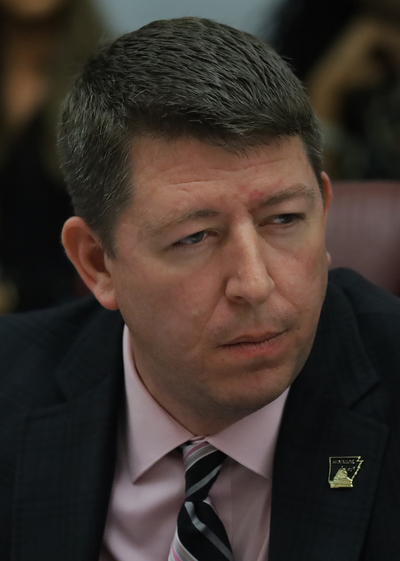
Bryant, a Rogers Republican who has served in the Senate since 2023, was elected following the third round of voting after neither the original president pro tempore designee, Republican Sen. Breanne Davis, nor Republican Sen. Ron Caldwell, received enough votes to claim the chamber’s leadership post.
Sen. Bart Hester, a Republican from Cave Springs, has been the pro tempore since 2023 but declined to pursue a third term. Bryant will still require final approval from the body after senators are sworn in in January.
The Senate currently has 34 senators and senators-elect, with one vacant seat. The vacancy made it possible for no one candidate to receive the required 18 votes. According to several senators, it was the first time the chamber failed to select a pro tempore since it began electing them.
Davis, a close ally of Republican Gov. Sarah Huckabee Sanders and the Senate sponsor of the governor’s signature education overhaul, was elected pro tempore designee in May. Davis, who was first elected to the Senate in 2018, managed Republican U.S. Sen. Tom Cotton’s reelection campaign.
But Caldwell, who was elected to the Senate in 2012, said earlier this year he would challenge her when the Senate voted on the matter again after the election. Sanders supported a challenger’s vitriolic but ultimately unsuccessful primary bid against Caldwell, who was one of several GOP lawmakers who opposed the governor’s plan to build a 3,000-bed prison in Franklin County. Sanders has put that prison project on hold after facing legislative resistance.
Senators select the pro tempore, who is responsible for presiding over the Senate in the absence of the lieutenant governor, via a secret ballot. It’s unclear who voted for who. Before the second and third deadlocked round of voting, Bryant was nominated, only for the nomination to be pulled after Davis or Caldwell was nominated again.
After the third round of deadlocked voting, Caldwell made a motion to close nominations after Republican Sen. Scott Flippo nominated Bryant, which no one opposed. With Bryant as the only nominee, no vote took place.
With Arkansas Republicans’ House supermajority lost, a changed dynamic
“Thank you, senators, for putting this trust in me today,” Bryant said after he was named designee. “I will do my best every day at the 96th General Assembly to make sure each one of your voices is heard.”
Republican Sen. Tyler Dees was selected as Senate majority leader after Bryant, who had previously been picked for that post, was elected Senate president. Democratic Sen. Stephanie Flowers was selected as minority leader.
Bryant sponsored a 2023 law that limited local governments’ ability to regulate cryptocurrency mines. After that measure faced a backlash from some communities, the Legislature passed followup legislation by Bryant to add new regulations to the operations.
In 2023, he was the only Republican in the Senate to vote against the initial version of a bill that would have criminalized transgender people using restrooms that match their gender identity. He later voted for a revised version after it was significantly scaled back to remove concerns that it would have been the most extreme bathroom bill in the country.
Bryant at the time said the original version of the bill went too far by allowing someone to be charged with a crime for being in a public restroom or changing room of the opposite sex when a minor is present, regardless of their intent.
Little Rock