Missouri childcare subsidy waitlist grows as providers struggle to fill classrooms
Nov 05, 2026 | 10:17 am ET
Description
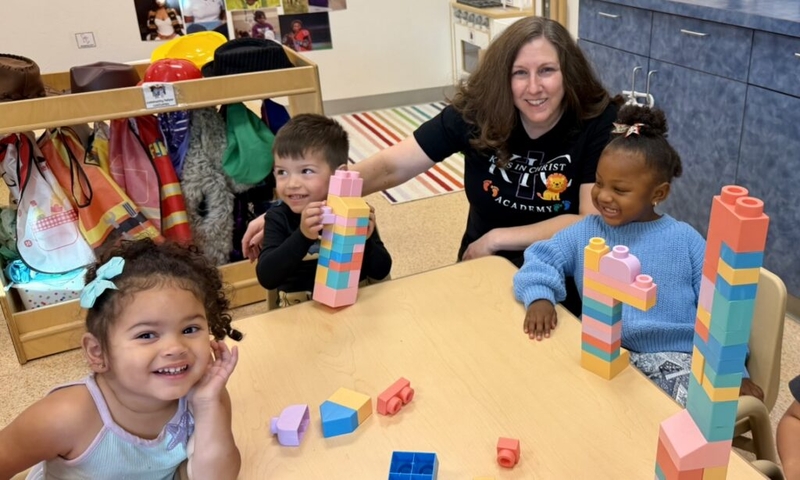
Children play at Kids in Christ Academy in Kansas City with teacher Heather Malone on Oct. 23 (Steph Quinn/Missouri Independent).
Missouri childcare providers have classrooms sitting empty and parents eager to fill them. But with funding stretched thin, the state isn’t approving most new applications for subsidies that would make those openings affordable.
There were 11,618 children on the waiting list for Missouri’s childcare subsidy program on Oct. 5 — more than a third of all children eligible for assistance — according to the Department of Elementary and Secondary Education.
The department established the waiting list after demand increased by 19% between January 2025 and late February, exceeding the amount of money appropriated for fiscal year 2026.
No children have been moved off the list since it started March 1.
The program helps cover the cost of childcare for families earning no more than 150% of the federal poverty level. That’s $40,980 for a family of three, or the equivalent of one person earning $19.70 per hour for a year of full-time work. Families are responsible for paying a sliding scale rate based on their monthly income.
The average annual cost of childcare for an infant in Missouri is $13,780, according to Child Care Aware of Missouri. For a 4-year-old, it’s $9,568.
For families on the waiting list, that means finding a way to pay for care themselves — or going without it.
Christina Puckett, owner of Kids in Christ Academy in Kansas City, which serves 84 children ages six months through preschool, told The Independent she tries to help when she can.
Even before the waitlist, Puckett said, some families receiving subsidies struggled to pay their sliding scale rate.
“The struggle was there before the waiting list,” Puckett said.
Now families ask Puckett if they can enroll their children at Kids in Christ and pay out of pocket until the department begins processing applications on the waiting list.
Puckett said she gives discounts “just to help some parents because they can’t afford that.”
“I have them text me, ‘Can I bring my kid in? I just want to pay you,’” Puckett said. “Well, I know they can’t afford to pay me, so then what do I do?”
Despite the growing waiting list, the department is not requesting additional funding for the program in fiscal year 2028.
Its budget request of $287.6 million would maintain an increase of about $139 million in state funding included in the current budget to replace federal funding that accumulated while COVID-19 relief funds were still flowing. But it would omit $17.2 million restricted by Gov. Mike Kehoe in June in the current budget.
A statement released by the department indicated requesting additional funds “was not feasible” because of state budget constraints.
The statement said the department plans to begin processing waitlisted applications when monthly subsidy payments consistently fall below $28 million — the amount available per month in the current state budget.
The department met that benchmark in September, the most recent month with published data, spending $26.9 million on subsidy payments.
But subsidy payment totals increased in four of the seven months since the waiting list started, peaking at $30.2 million in August compared to $27.1 million in March.
Higher utilization of childcare in the summer could be one reason for the increases, according to the department.
“At any one time, several thousand children already have approval to access childcare, but are not currently utilizing the service,” the statement said.
The statement also pointed out that while the total number of children receiving subsidies has decreased since March, the number of children who have entered the program because they are in the custody of the Missouri Children’s Division has continued to rise.
Children in foster care are not subject to the waiting list, and the department reimburses providers at a higher rate for their care — 100% of the rate determined in an annual market rate survey instead of 65% for most preschool and school-age children.
The current budget law for the department also directed the Office of Childhood — the agency within the department that administers the subsidy program — to meet with a stakeholder group and recommend changes to payment structures to “balance rates, availability and quality” and “improve access to low-income families and address childcare availability shortages.” The law gave the Office of Childhood a Nov. 1 deadline to report the group’s recommendations to the governor’s office and the chairs and ranking members of the House Budget and Senate Appropriations committees.
According to the department, as the group looks for ways to address the waiting list, they have considered “information on rate enhancements, (provider) base rates, and the sliding‑scale fees paid by families.”
Weighing options
Casey Hanson, deputy director of Kids Win Missouri, told The Independent providers who serve a high percentage of children receiving subsidies are facing losses from the waiting list.
As children receiving subsidies start kindergarten, providers are left with vacancies they can’t fill.
“They have parents that can come into those slots, but if they’re parents that rely on subsidy, then they’re not able to fill them,” Hanson said. “There’s a lot of providers that have classrooms sitting empty, and their subsidy receipts are way less than they’re used to.”
Christy and Paul Prevo, owners of Tiger Tots Child Development Center and Tiger Tots Academy of Early Learning in Columbia, told The Independent they are serving about 50 fewer kids than in previous years because of the waiting list.
“We have about 15 students that, if they received subsidy today, they would be here tomorrow,” Christy Prevo said.
Both Tiger Tots locations serve more than 50% subsidy-eligible families: about 55% at one location and close to 75% at the other. Together, the two locations serve more than 300 children.

The waiting list is also affecting the centers’ ability to staff their classrooms.
Christy Prevo said a teacher with three children on the waiting list quit because childcare took so much out of her paycheck that it didn’t make sense to keep working — even with a discount.
Puckett estimated that about 85% of the children at Kids in Christ Academy receive subsidies. Eighty-four children currently attend the academy, which has a capacity of 108.
While there’s no shortage of parents looking for childcare, Puckett said she has to be careful not to accept too many families paying out of pocket to avoid losing a 30% rate enhancement she receives for being accredited and because more than 50% of the children her academy serves qualify for subsidies.
Puckett said the rate enhancement allows her to attract highly qualified staff and pay them competitively.
“I’ve got a teacher here who has a bachelor of education,” Puckett said. “Instead of working in a school district, she wanted to work for me.”
If the state eliminated the 30% boost, Puckett said, “I don’t know where I’d be.”
Rate enhancements also help providers serve children with special needs.
Christy Prevo said Tiger Tots can hire staff with the skills to care for children with special needs because of the rate enhancement.
“My understanding is families were having much difficulty finding a place for a special needs child because there was no extra incentive to do that for centers,” Christy Prevo said. “…And having the state say this is important to us that these students also have a place to be—I feel very strongly about both of those rate enhancements.”
Lawmakers proposed a $51.5 million cut in March that would have eliminated rate enhancements, but the funding was restored in the final version of the budget.
Paul Prevo said the state should consider lowering rates for providers and use the savings to open up spots on the waiting list. That would allow providers to fill vacancies, he said.
“Instead of only being at 50% capacity, now you’re at 75% capacity,” he said. “The increase in the number of students you have would also help offset any of the losses from the lower rate.”
But Puckett said she worries the department will reduce rates because providers “are already underpaid.”
She said it takes all the funding she currently receives to pay staff well.
“They’ve got to live and survive just like those parents,” Puckett said.
The department plans to implement an excessive absence policy to ensure that families approved for the program are using their subsidy. Families with too many unexcused absences could lose eligibility for the program after receiving warnings from the department. Training for department staff and providers on the new policy will begin in November, according to the department.
Paul Prevo said that if the excessive absence policy opens up subsidy spots, it could help move people off the waiting list at no cost to the state.
“I would love to open up those spots for eight to 10 more students to be here that are waiting to be here,” he said. “The funds would be going toward people who are working families who are utilizing it.”
Hanson said the growth of the waitlist points to a mismatch between Missourians’ childcare needs and the resources available to fund them.
“The waitlist is evidence that we have a much greater demand than we’re able to afford as a state right now.”
Jefferson City, MO