Virginia voters split on 1% sales tax for school construction
Nov 05, 2026 | 5:27 am ET
Description
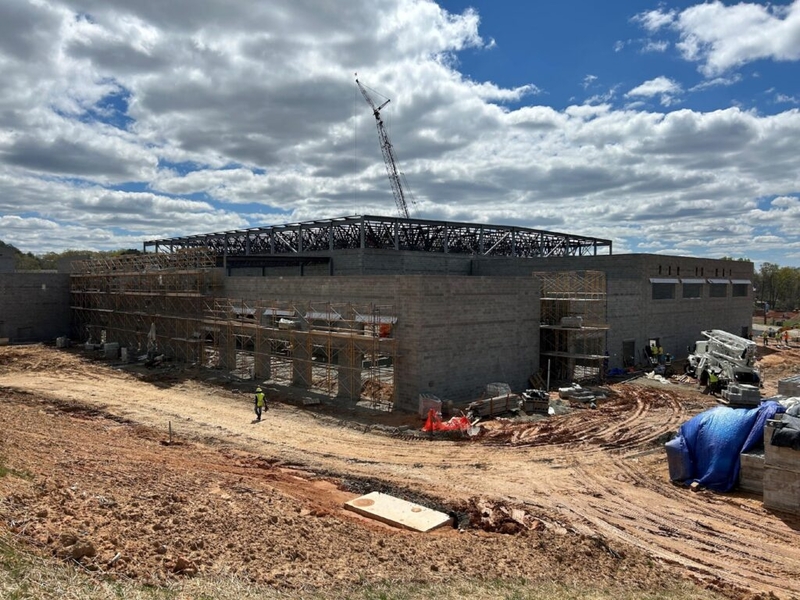
An early view of the school construction work in Halifax County. (Photo courtesy of Halifax County Public Schools)
On Election Day, out of 47 Virginia localities, about 30% authorized their governments to collect a 1% sales tax to address rising school construction costs, while about 70% did not.
In June, state lawmakers authorized localities, pending voter support, to raise revenue for school construction and modernization with a 1% sales tax. The state estimates over 1000 school buildings are more than 50 years old, and would take $25 billion to rebuild or improve.
House Education Committee Chair Sam Rasoul, D-Roanoke, and Sen. Jeremy McPike, D-Prince William, proposed the idea last January. Both measures were ultimately added to the state’s budget.
“School construction is a critical need,” said McPike ahead of the results. “This is a direct question to the voters in the form of a referendum, and it’s up to the voters to decide how they want to fund school construction.”
Tuesday’s results are expected to help 14 localities move the needle on school modernization, while leaving questions about the 33 that rejected the opportunity and what comes next.
Rasoul said the idea was to help address billions in school construction needs in the commonwealth. But citizens have raised concerns about tax increases, a point former Gov. Glenn Youngkin raised in previous years
Mecklenburg, one of the nine localities with state-approved authority, has not put the matter to voters since receiving authorization, largely because it opposed raising taxes, according to Board of Supervisors’ records in 2021.
Mecklenburg estimated it would need about $6 million per year in debt payments to move forward with new school construction, which ultimately dampened interest in adding the option to ballots.
In addition, the county had already invested in newer additions to the three elementary schools.
No action has been taken since former state Sen. Frank Ruff successfully proposed the change in 2020.
In 2019, Halifax County became the first locality to receive authority from the state, which is required since Virginia is a “Dillon’s Rule” state, meaning local governments can only exercise powers granted by the state legislature.
Localities can adjust property tax rates, but they need General Assembly approval to change sales taxes.
With the election’s results, the list has grown from the original nine — city of Danville and the counties of Charlotte, Gloucester, Halifax, Henry, Mecklenburg, Northampton, Patrick and Pittsylvania — to 23 locations.
Rasoul acknowledged that, while he championed the bill, it is not a long-term solution to the state’s school construction needs. Additional support, particularly at the state level, will be necessary to help struggling school divisions, he said.
“This isn’t going to be able to build all the schools that need to be built,” Rasoul said. “So there’s a lot more that needs to be done … even at the state level to help struggling school divisions.”
McPike said upcoming discussions with his colleagues on the Commission on School Construction and Modernization should focus on analyzing the referendum results once they are available, evaluating long-term funding structures for school construction and reviewing stabilized projections over time.
The commission and all state lawmakers will return to Richmond on Jan. 13, 2027 to discuss future legislation and budget amendments.
Richmond, VA