Democrat Phil Weiser elected Colorado governor
Nov 03, 2026 | 9:16 pm ET
Description
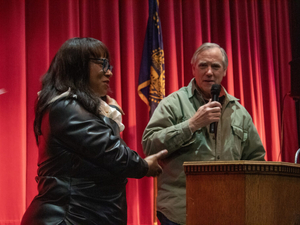
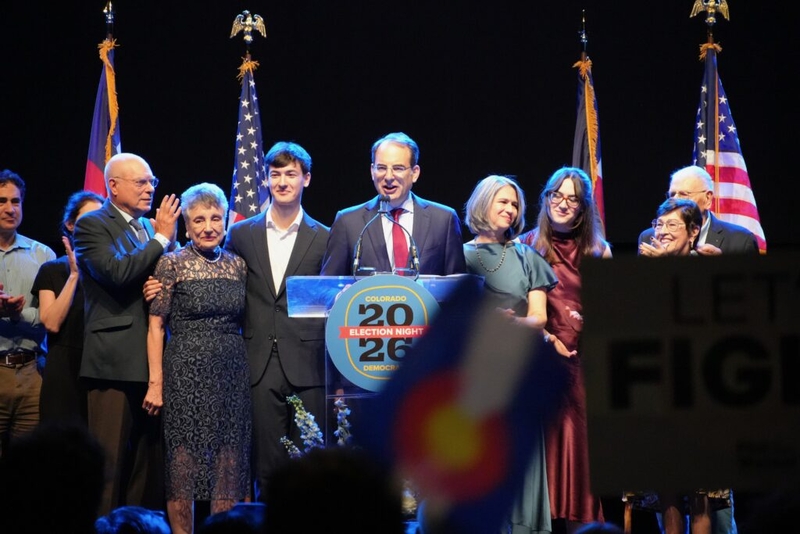
Colorado Attorney General Phil Weiser addressed the crowd at a Colorado Democratic Party watch party after his election as governor on Nov. 3, 2026. (Photo by Chase Woodruff/Colorado Newsline)
Colorado Attorney General Phil Weiser was elected the state’s 44th governor, defeating Republican Victor Marx and independent candidate Greg Lopez.
As of 9 p.m., Weiser led the race with nearly 62% of the vote, with Marx winning just under 33% and Lopez trailing with less than 3%. The Associated Press called the race minutes after polls closed at 7 p.m.
“At a time of rising fear and cruelty, Colorado’s answer is rising hope and compassion,” Weiser told cheering supporters at Colorado Democrats’ election night watch party in Denver. “Let us together build a future based on the values that make Colorado special, and meet the urgency of this moment by making long overdue changes.”
“It’s time to deliver housing and healthcare that Coloradans can afford,” he continued. “It’s time to build a stronger economy that works for all of us and a brighter future for our kids and grandkids. It’s time to protect our freedoms, to protect the safety of our communities and our precious land, air, and water.”
Weiser will be inaugurated on Jan. 12, 2027, succeeding Democratic Gov. Jared Polis, who is term-limited. A former dean of the University of Colorado School of Law and Justice Department antitrust attorney under two Democratic presidents, Weiser was elected attorney general in 2018 and reelected in 2022.
Though heavily favored in the general election, Weiser entered 2026 as the underdog in a head-to-head gubernatorial primary with U.S. Sen. Michael Bennet. Touting the dozens of lawsuits he has filed against the Trump administration as Colorado’s attorney general, Weiser billed himself as a “fighter” who would stand up to Trump’s attacks on immigrants, social spending programs and the rule of law.
That message resonated in a state where Trump remains deeply unpopular, and Weiser overcame Bennet’s financial advantage and widespread establishment support to win the June primary by a comfortable 14 percentage points.
“We launched a campaign that many people didn’t think we could win,” Weiser told the crowd Tuesday night. “All the way through, we believed in each other, and the people of Colorado.”
Marx, a first-time candidate and self-described “high-risk missionary,” became a target of national ridicule when he struggled in interviews and debates to answer for sensational claims he has made about his personal background and work overseas. During the general election, he continued to face scrutiny over multiple alleged campaign finance violations, his views on abortion and past comments in which he recalled “grabbing (his wife) and slamming her into our front door.”

Marx declined to debate Weiser and appeared on stage with him just once, at a Colorado Chamber of Commerce event during which Marx appeared to read prewritten responses to questions he had been provided in advance. Marx’s two GOP primary opponents, who labeled him a “con man” and “grifter,” declined to endorse him, while Weiser won the backing of prominent Republicans including former U.S. Rep. Ken Buck.
Marx announced ahead of Election Day that he would not hold a public watch party event. As of 9 p.m. on Tuesday, he had not yet released a public statement about the election results, and his campaign did not immediately respond to requests for comment.
“I view this election as a clarion call to the Colorado Republican Party,” Weiser told reporters after his victory speech. “If you’re going to nominate someone who is not serious about showing up for debates, about developing real solutions and whose views on things like domestic violence are abhorrent, you’re going to lose elections.”
“I want a serious Republican Party,” he added. “I didn’t get that this election.”
Lopez, who served a six-month stint as a GOP member of Congress in 2024, had unsuccessfully sought the party’s nomination for governor in both 2018 and 2022. He initially tried a third time before announcing in January that he would instead run as an unaffiliated candidate, and secured his spot on the ballot through petition signatures.
Lesley Dahlkemper, a Jefferson County commissioner, will serve as Weiser’s lieutenant governor, succeeding Lt. Gov. Dianne Primavera, who has served under Polis in the post for two terms.
Other statewide offices
Colorado Democrats were also on track to win the three other statewide executive posts up for election Tuesday, prolonging the party’s control of the offices of attorney general, secretary of state and treasurer.
Democratic Secretary of State Jena Griswold, the state’s top elections official since 2019, will succeed Weiser as attorney general, according to The Associated Press. As of 8 p.m., she led with 59.5% of the vote, well ahead of GOP El Paso County District Attorney Michael Allen.
Democrat Amanda Gonzalez, the Jefferson County clerk and recorder, defeated Republican James Wiley in the race for secretary of state, according to The Associated Press. As of 8 p.m., she led with over 60% of the vote.
Preliminary results also showed state Sen. Jeff Bridges, the Democratic candidate for treasurer, was well ahead his GOP opponent, former state lawmaker Kevin Grantham.

With Democrats also expected to easily hold on to their majorities in the state Legislature, the party is poised to extend its eight-year spell in full control of state government — the longest period of one-party rule in state history — for at least another two years.
Democratic tensions
As governor, Weiser will preside over a Democratic coalition that, even as it has cemented its grip on Colorado politics, has strained under the weight of internal conflicts and ideological divides.
Polis has clashed throughout his tenure with fellow Democrats in the Legislature and angered many in the party’s progressive wing with his moderate, business-friendly views on fiscal and regulatory issues. Those tensions have boiled over more frequently during his second term, as lawmakers largely rebuffed a sweeping package of housing reforms championed by the governor, and Polis issued record numbers of vetoes — including of the Worker Protection Act, a bill to ease union formation that has been a top priority of Colorado labor groups.
Polis’ standing within his party collapsed further in May, when he commuted the remainder of the prison sentence handed to Tina Peters, the Trump ally and former Mesa County clerk convicted for her role in a 2021 breach of her office’s secure election equipment in a failed attempt to uncover evidence of fraud in the 2020 election.
The decision earned Polis a formal censure from the Colorado Democratic Party, which barred him from participation in party events. The two-term governor, reelected four years ago by a nearly 20-point margin, was almost entirely absent from the 2026 campaign trail, aside from a handful of media appearances in which he urged Colorado voters to reject Amendment 87, a progressive income tax measure. He wasn’t present at Colorado Democrats’ election-night watch party in Denver.
Though he harshly criticized Polis’ grant of clemency to Peters, Weiser has otherwise been circumspect about how his administration might differ from the current one on specific policy matters.
During the primary, he declined to endorse the Worker Protection Act, preferring an unspecified compromise instead. And he has suggested state government should be more, not less, responsive to the concerns of the business lobby than it has been under Polis — a view starkly at odds with the one held by many liberal and progressive activists, who for years have seen their policy goals blocked by Polis’ veto pen or inaction by his regulatory appointees.
Late Friday, Weiser announced that he, too, opposed Amendment 87, an unwelcome surprise for some progressives who had backed him during the primary. He had previously declined to take a position on the measure, first because it had not been formally certified for the ballot and then because it was the subject of ongoing litigation. Bennet endorsed the amendment shortly before Weiser’s announcement.
Weiser said during an event last month that amid looming conflicts among state policymakers over the Worker Protection Act and other issues, he will aim to ensure all Coloradans are “at the table” and feel “listened to.”
“There are going to be a lot of decisions that I make, that people are like, ‘I’m really disappointed in that decision,'” Weiser said. “To which I’ll say, ‘I understand. I’ve listened to you. I’ll keep listening to you. You’re not going to like all of my decisions, but you’re going to know that I care about you. I listen to you. I’m going to be transparent.'”
Denver, CO