Alaska election shenanigans date back to territorial days
Nov 03, 2026 | 2:00 pm ET
Description
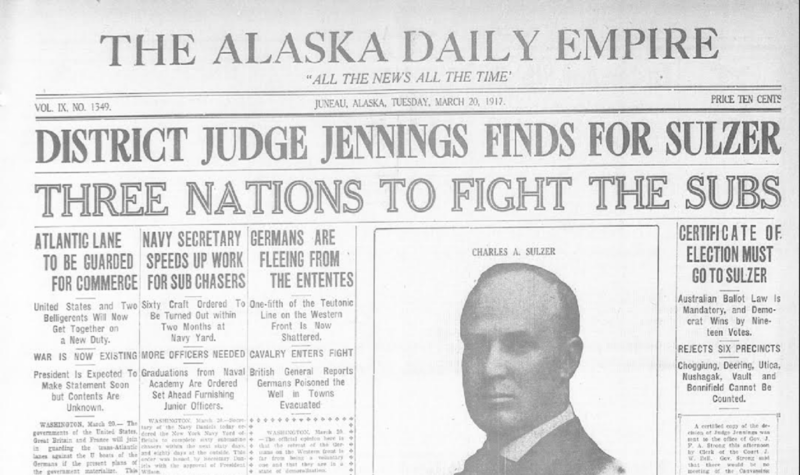
Historical front page.
The 1910s were a momentous period in Alaska history, marked by major expansions in education, self-governance, and infrastructure development, including the creation of what is now the University of Alaska system, the Alaska Legislature and the Alaska Railroad. They also show that tumultuous elections are nothing new in Alaska.
James Wickersham (1857-1939) was the territory’s longtime delegate to Congress and he used his pulpit to advocate for those lasting institutions. Yet, some of his later elections were mired in controversy, and in one case he contested an outcome until after his opponent’s death. Amid the turmoil and death, there was an epidemic, socialist challengers, anti-immigrant sentiments, a fraudulent governor, non-secret ballots, partisan antics, electioneering and racism. In other words, it was the usual election shenanigans up north, back in those pioneering days.
Wickersham served throughout the decade, except after the two elections he lost. On both occasions he was reconsidered as the winner. There was the candidate who won but died before he was later announced as the actual loser. There was another election in which Wickersham did not participate. On that occasion, the results were voided in his favor.
On September 30, 1918, Wickersham held his first public meeting in Anchorage, the territory’s still-new railroad hub. Around 800 voters packed the Empress Theatre for his two-hour campaign speech. Like politicians before and since, he pandered to area interests, noting his strenuous support for the Alaska Railroad. Indeed, his five-hour speech in the House of Representatives on January 14, 1914 was a key moment in the passage of the Alaska Railroad Act. At that time, it was also the longest speech in House history.
Like politicians before and since, he maligned his rivals, whom he described as being in the pockets of corporate interests, the Guggenheim Syndicate specifically. And he praised his allies, including J.F.A. Strong, the disgraced governor who was ousted earlier that year after revelations about a falsified background. Rather than a Kentucky veteran of multiple wars, Strong was a Canadian bigamist with no military experience. Wickersham declared, “It is much better to be a Canadian than a German.” World War I was nearing its conclusion, with Germany as the central opponent, and Wickersham’s campaign opposite just happened to be the son of German immigrants.
As he had in five previous elections, Wickersham strove to become Alaska’s delegate to the House of Representatives, the territory’s only Congressional representative from 1906 to statehood in 1959. While the position was accorded no vote, it was a powerful platform from which to argue on behalf of Alaska interests. Alaskans first voted for senators and a voting representative in 1958, and for president in 1960.
With relatively little trouble, Wickersham successfully won campaigns in 1908, 1910, 1912 and 1914. The issues truly began with the 1916 election, which was also notable for the participation of socialist candidate Lena Morrow Lewis, the first woman to run for an Alaska-wide position.
Socialism was then a popular cause among Alaskan laborers, miners and fishermen. The election was moved from August to November as of 1914, and poll taxes on male workers were established in 1913. By coincidence perhaps, both actions undercut the socialist vote. Many laborers had left the territory for the season by November, and the $4 poll tax was a heavy burden for the average worker. Lewis tallied 1,340 votes, more than 9% of the turnout, and finished third.
The leading candidates were Wickersham and Charles A. Sulzer (1879-1919), that son of German immigrants. The latter managed a copper mine at Sulzer, a long-since abandoned community on Prince of Wales Island. The town was apparently named for Sulzer’s brother William, who founded the mining company and was a notable New York politician with his own skeletons. William served less than ten months as Governor of New York in 1913 before he was impeached and convicted for campaign finance fraud. These charges, however true they may have been, could more accurately be read as punishment for publicly breaking from the Tammany Hall political machine.
Before airplanes, snowmachines and even a limited road system, Alaska was a difficult, time-consuming territory to traverse in winter. The election results took months to gather. It was a narrow race, and newspapers alternated stances, declaring one or the other winner as a dozen votes here, a dozen votes there, were added to the totals. A supposedly final tally in early March found Wickersham the winner by a mere 31 votes. More surprising for modern Alaskans, residents also voted by a two-to-one margin to ban alcohol in the territory.
However, immediate concerns arose over the returns from six districts. Secret ballots, that is, voting as people today would understand the process, was still such a sufficiently new and foreign concept then that it was widely referred to as the “Australian ballot.” And in those six districts, there were no official, secret ballots. Instead, there were partisan ballots listing only one candidate. On March 20, 1917, Judge Robert W. Jennings ruled that those districts should be disregarded, flipping the outcome to a 19-vote win for Sulzer, who was duly seated.
With the onset of the 1918 election cycle, Wickersham was still officially contesting the 1916 results. A House investigation sided with him, and he was formally seated on January 7, 1919, even as votes were being counted in the sequel. He served the final two months of the term.
The 1918 election was more of the same, only faster and more intense. The worldwide influenza pandemic, often referred to as the Spanish Flu, peaked in Alaska right around the election. Public gatherings were banned in several towns, meaning a surcease of sorrow from overabundant campaign speeches and rallies. Police shut down one illicit Wickersham rally during a quarantine. In some places, voters took their turns while wearing masks.
And the result was a seeming 33-vote Sulzer win, then reduced to a 31-vote margin, which Wickersham naturally contested. Once again, allegations swarmed, a mass of accusations all tinged with mud and flying in all directions. Both sides accused the other of illegally convincing Alaska Natives to vote, of distributing paper or cardboard cutouts that allowed illiterate voters to identify the desired candidate on the ballot. Opponents later charged pioneering Tlingit lawyer and politician William Paul of similar tactics.
In public, Wickersham vehemently opposed Alaska Native suffrage except as allowed by the stringent requirements of the 1915 Alaska Native Citizenship Act, the 15th Constitutional Amendment notwithstanding. Under the act, only Alaska Natives who “severed all tribal relationships,” “adopted the habits of a civilized life,” and passed “an examination by a majority of the teachers” from a presumably “civilized” school could legally vote. The Alaska Native right to vote was subsequently clarified by the 1924 Indian Citizenship Act and the 1965 Voting Rights Act, though inconsistently enforced.
Stakeholders, witnesses and members of Congress repeatedly debated the meaning of the law, of the words in the law, to the point of literal distraction. As Representative Carl R. Chindbloom of Illinois later wearily concluded: “Take this record, and you will find the evidence is so inconclusive, so hazy, so misty, that it is impossible for anybody to reach any definite conclusion in respect to the Indian vote.”
Wickersham also accused Sulzer and his allies of stacking election officials with fellow Democrats, “that in each precinct the said Democratic commissioner appointed two Democrats and either a Republican opponent of contestant or a Socialist as the three election judges and clears of said election in said precincts, and thereby the whole election machinery.”
Among his more specific and colorful anecdotes, Wickersham charged William Mahoney, the Democratic commissioner for the Ketchikan recording district, with personally rounding up the sex workers in town—”sporting gals” in the parlance of the day—and escorting them to the polls. The ladies had presumably been financially coerced into gracing the polls with their presence and political preferences. And there were plenty of such women to influence. Ketchikan then possessed an earned reputation as the “Wickedest Town in the West.”
Given the position in dispute, the detailed accusations and accompanying testimonies are preserved within the Congressional Record and other government documents. This includes Wickersham’s complaint of Mahoney “himself hauling a big, fat [Black] prostitute to the polls in his carriage,” words spoken aloud in Congress and separately published in 1920.
The most consequential argument revolved around where voters were required to vote. Alaskan law required voters to vote in their town of residence, where they were registered essentially. For example, Sulzer should have voted in Sulzer. In reality, many settler towns of the era were ephemeral, and quite a few more remotely situated Alaskans voted within their division but not their precise precinct, as frequently permitted by election officials. Sulzer voted in Ketchikan and, therefore, his vote should technically have been disqualified.
By this point, Sulzer and Wickersham had dominated Alaska political news for years, and many observers were tired of the repetition. From the Seattle Post-Intelligencer: “It might be better for Alaska if both Mr. Sulzer and Mr. Wickersham should withdraw from politics and give their supporters a chance to start anew. There must be other men in Alaska as competent as they are, without their personal following and personal enemies.”
Sulzer had little opportunity to speak on the allegations. On April 15, 1919, he died while traveling on a steamship from Sulzer to Ketchikan. Because Wickersham had not yet proven his case, Sulzer was considered the official incumbent, and a special election was held on June 5 to choose his replacement. Wickersham refused to participate. As he saw it, the legitimate winner was still alive, and no successor was needed. Attorney General George Grigsby (1874-1962) instead carried the day and was formally seated that July.
In his lengthy legal career, Grigsby earned his own crooked reputation, from his choice of defendants to his shady methods. As Alaska legal historian Pamela Cravez noted, “It wasn’t unusual for evidence to magically appear or disappear at one of Grigsby’s trials. Witness stories changed, and his final arguments were always entertaining if not always accurate.”
The House of Representatives collectively dragged its feet on the issue, finally addressing the issue more than two years after the election. The Republican-slanted House then favored the Republican Wickersham. Returns from several isolated precincts, including Chicken and Cache Creek, each favoring Sulzer, were thrown out. Meanwhile, other questionable returns that favored Wickersham, such as soldiers voting in Fairbanks, were allowed to remain. These choices gave Wickersham a 37-vote win.
On March 1, 1921, the House voted 182 to 162 in favor of removing Grigsby and 177 to 162 in favor of seating Wickersham in his stead. The former judge surely enjoyed the rest of his term, the following two days.
Grigsby believed Wickersham was primarily concerned about the paycheck. “This is nothing but an attempt to grab off salary and allowances of $21,000 for Wickersham on a technicality,” Grigsby told the Alaska Daily Empire. Wickersham indeed received all due payments for the entirety of the two-year term, not just his three days actually in office. After accounting for inflation, $21,000 in March 1921 is roughly $390,000 in 2026 dollars. This was politics as the pioneers played the game.
Juneau