Here are five things to watch as Georgia voters head to the polls on Election Day
Nov 03, 2026 | 4:00 am ET
Description
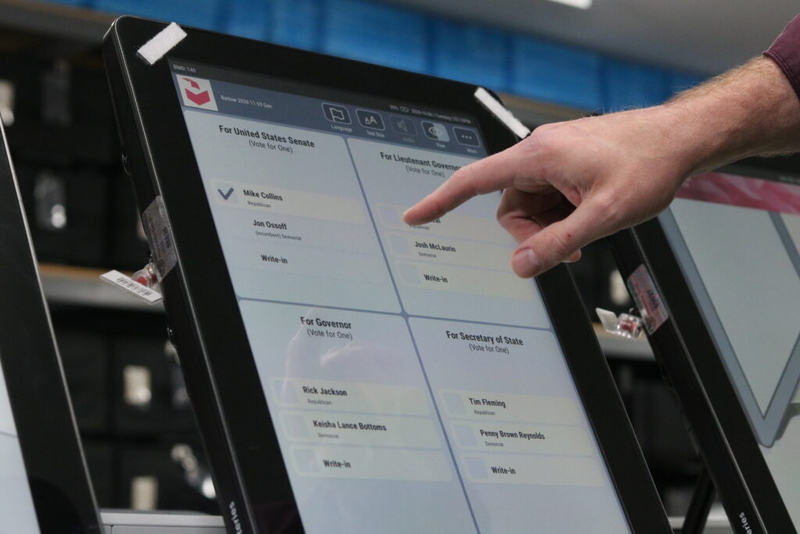
Georgia's ballot marking devices display the candidates and ballot questions for the Nov. 3 midterm elections. Election workers in Bartow County, Georgia conducted their pre-election tests of the voting equipment on Oct. 6, 2026. Maya Homan/Georgia Recorder
Who will be Georgia’s next governor? Will Republicans overcome the apparent Democratic lead built up during early voting? Which party will run state government starting next year?
And when can Georgians expect to learn the answer to these questions and others?
This year’s ballot is packed with a nationally watched U.S. Senate race and competitive statewide contests as both parties battle for control of four open seats, including the governor’s office.
Here’s what some of Georgia’s political experts are watching, and what they say Tuesday’s election results could reveal about the state of Georgia politics.
Anticipating results
Expect voters and candidates alike to be eagerly awaiting results once the polls close Tuesday night.
For some initial results, Georgians likely won’t be kept waiting long. At a Monday press conference, Secretary of State Brad Raffensperger said that he expected the absentee and early voting results to be finalized within an hour of polls closing, as is required by Georgia law.
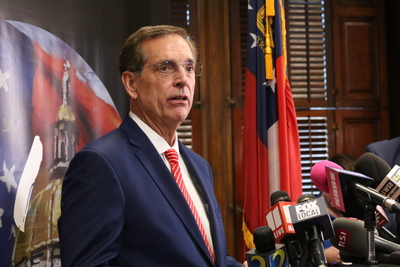
“I like to go to bed early, so I want to be done before midnight,” he said. “We did that in 2024. There’s no reason why we won’t do it here tomorrow.”
But while Raffensperger said he is hoping Georgians will be able to know the full results before bedtime, it may take longer to determine the winner in races where only a small margin separates the winner from the loser, which could happen with hotly contested state House races.
Early results can also be misleading, said Gbemende Johnson, an associate professor of political science at the University of Georgia. Johnson cautioned against what she called an election “mirage,” which can lead voters to think that a certain candidate is further ahead than they are before results are fully tallied.
“If the areas that are reporting initially and the quickest tend to favor one candidate or the other, it can give you the sense that oh, that candidate is going to take it home,” she said.
She said voters should stay mindful of which areas the results are coming in from and how many votes there are left to tally from elsewhere.
“There’s always the question of where are they coming from? Are they areas that are traditionally red, traditionally blue, or maybe there’s a hue of purple?” she said. “That is why you want to be careful about early assessments.”
Voter turnout
Jazzed by the prospect of registering their discontent with the Trump administration at the polls, Democrats appear to have built a solid lead during early voting. A key question going into Tuesday is whether Republicans can get enough voters to the ballot box on Election Day to overcome that lead.
What early voting can – and can’t – tell us about Georgia’s midterm election so far
Unlike in some states, Georgia voters do not indicate their party affiliation when registering to vote, which makes predicting the outcome of a race based on early voting an inexact exercise. Pundits must instead rely on data like voters’ race and age and turnout levels in heavily Democratic or Republican areas.
Based on that limited information, Republicans have been sounding alarm bells about lower turnout in rural parts of the state fertile with conservative voters and higher turnout in metro areas thick with liberals.
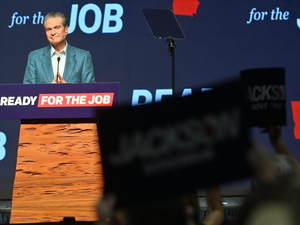
“There’s no sugarcoating it, the Democrats have been working hard,” said outgoing Gov. Brian Kemp stumping for Republican candidate for governor Rick Jackson at a Cherokee County diner Monday morning. “They’ve been motivated. They outpaced us in early voting. But you know what? This situation is no different than it was in 2018. And if we have a big turnout tomorrow, we are going to win this race.”
In 2018, Kemp was narrowly elected governor during what was the first midterm election of the Trump era, although Georgia Democrats also made significant gains in the Legislature that year.
An imbalance in early voting turnout inspired the University of Virginia-based election forecaster Sabato’s Crystal Ball to shift the race Monday from a toss-up to slightly favor Democrats.
The polling prognosticators found that Black voters made up nearly 32% of Georgia’s early voters, up from 26% in 2024 and 29% in 2022. In Georgia, Black voters tend to favor Democratic candidates while white voters skew more toward Republicans.
A statewide temperature check on Trump
In visits to Georgia and other states, Trump has urged voters to “pretend” he’s on the ballot and campaigned with candidates in an effort to energize the president’s supporters to vote for Republican candidates.
Voters in midterm elections identify a culprit for rising cost of living: Trump’s tariffs
But voters are increasingly blaming Trump policies for issues like the rising cost of living, and his approval rating has hit a record low of 33%. Polling from the Atlanta Journal-Constitution showed that both Keisha Lance Bottoms, the Democratic nominee for governor, and incumbent Democratic U.S. Sen. Jon Ossoff had an edge with likely independent voters. Given those factors, some experts question whether steadfast supporters of the president will be able to deliver Republican candidates a victory in a state like Georgia, which Trump narrowly lost in 2020 and won in 2024.
“The MAGA coalition is still pretty intact,” said Emory University political science professor Andra Gillespie. “But I think it becomes a question of, can you rely on the MAGA base alone to be able to win an election in a year that is going to be hard for Republicans?”
The role of split ticket voters
Independent and split-ticket voters played a crucial role in the 2022 midterms, when Georgians reelected Kemp, a Republican, and U.S. Sen. Raphael Warnock, a Democrat, during the same cycle.
Emory University political science professor Bernard Fraga said that although split-ticket voting used to be quite common in Georgia, the majority of voters these days tend to vote strictly along party lines.
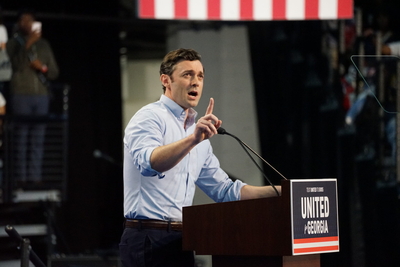
“I think this year the big question is how large the magnitude of that effect will be,” he said. “Because it looks like Ossoff’s lead is so large that you’d have to have historically super high levels of split-ticket voting for Bottoms to not get over the top.”
Fraga added that he will also be paying close attention to the results from precincts in Atlanta’s Buckhead neighborhood, where Bottoms was relatively unpopular during her time as mayor of Atlanta and where he says split-ticket voting is still somewhat common.
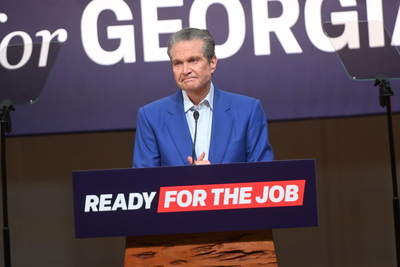
But he said there is a key difference between the 2022 midterms and this year’s election: Kemp was running as an incumbent candidate and was able to rely on his political record to entice Democratic-leaning voters. Jackson, in contrast, has never held political office.
“Rick Jackson is not a known quantity in the same way for people who would otherwise be drawn to vote for the Democrats,” Fraga said. “So I think that’s a big question.”
The next class of political leaders
Regardless of who ascends to Georgia’s top political offices this year, the state’s next slate of leaders will look different.
That’s because a number of statewide offices — including governor, lieutenant governor, secretary of state and attorney general — are wide open.
All four seats are currently held by Republicans. Kemp, who is nearing the end of his second term as governor, is term-limited and prevented from running again. Lt. Gov. Burt Jones, Attorney General Chris Carr and Raffensperger, the secretary of state, all launched their own bids for governor but lost to Jackson.
A slew of candidates, including many who are currently members of the state Legislature, are competing to fill those seats. Candidates hoping to fill their vacant seats in the state House and Senate will also likely bring a new set of faces and names into the mix when the new session starts in January.
Alan Abramowitz, a professor emeritus of political science at Emory University, said that in addition to being crucial constitutional offices, downballot positions could offer a glimpse into the future of Georgia — and national — politics. Kemp spent eight years as secretary of state before running for governor. The late President Jimmy Carter also served as a state senator before he became governor of Georgia.
“Watch the secretary of state, lieutenant governor, attorney general,” Abramowitz said. “Those are the offices that tend to produce candidates for governor, candidates for U.S. Senate.”
Atlanta, GA