New Hampshire Democrats face an uphill battle to win control of state Senate
Nov 03, 2026 | 5:00 am ET
Description
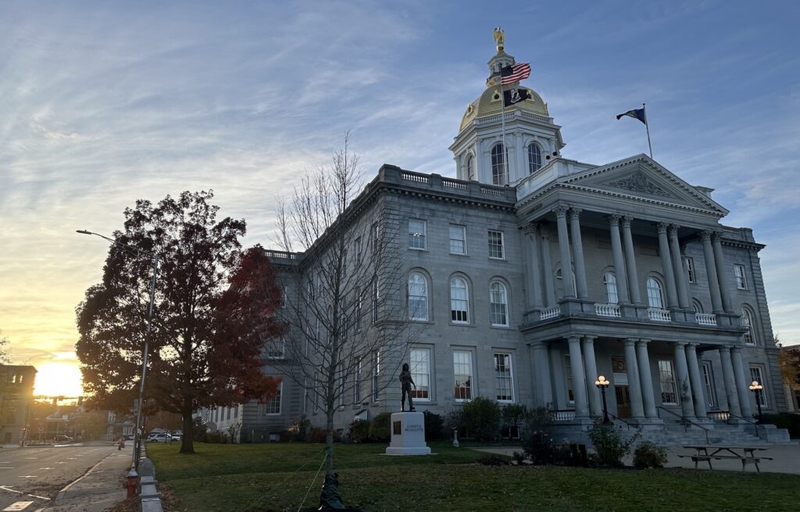
The sun sets behind the State House on Nov. 2, 2026, the eve of an election that will decide which party controls the New Hampshire House and Senate for the next two years. (Photo by Dana Wormald/New Hampshire Bulletin)
As voters fan out to polling places and newsrooms prepare all-night coverage, much of the attention today will focus on control of the U.S. House and Senate.
But what about New Hampshire’s legislative chambers?
Recent state polls favoring Democrats and Democratic advantages in candidate recruitment this year suggest the New Hampshire House is in reach for a Democratic flip.
The Senate might be a different story.
While the New Hampshire House and Senate have stayed under single-party control for every election since 2012, Republicans have historically had a better chance of holding the Senate than the House. Since 2001, Republicans have won the House in nine of the 13 elections, but have won the Senate in 10.
And the Republican-led redistricting in 2022 has resulted in a state Senate map that has helped Republicans win more seats than the statewide voting percentages would predict.
Republicans currently control 16 of 24 seats; to win back a 13-seat majority, Democrats, who currently have eight, would need to take back five of those seats. To win a tie, they will need four.
But Democrats have a margin problem too: Of the five sitting Republican incumbent senators who won with the smallest margins in 2024 — and who are in theory the best targets for Democrats — only three of the five won with tight margins. In 2024, Democrats lost to Republican Sens. Tim McGough by 1.86%, Victoria Sullivan by 2.89% and Denise Ricciardi by 3.06%. But Democrats lost to the next two most-vulnerable Republicans — Sens. Daniel Innis and Kevin Avard — by more than 11%.
The takeaway, says Anna Brown, executive director of the Warren B. Rudman Center for Justice, Leadership & Public Service at the UNH Franklin Pierce School of Law, is that Democrats have an uphill battle.
“Democrats don’t just need to get 51% statewide,” Brown said in an interview Monday. “They need to have an incredible performance. They need to have huge voter turnout in these Republican-heavy districts as well.”
Here are five races to watch tonight that could determine control of the state Senate.
Tim McGough vs. Shannon Chandley
In Senate District 11, which comprises Amherst, Merrimack, Milford and Wilton, McGough, of Merrimack, is facing a rematch. Former Democratic Sen. Shannon Chandley is trying again to retake her seat. Chandley, who served as a senator from 2018 to 2020 and from 2022 to 2024, lost to McGough two years ago by 673 votes.
Aside from the potentially high name recognition in the race, the contest features another quirk: McGough was ousted from his committee by Republican Senate President Sharon Carson after allegations that he had been abusive to employees in the State House.
Victoria Sullivan vs. Leonard Bell
Another hard-fought race to watch is in District 18, which covers Litchfield and Manchester Wards 5, 6, 7, 8 and 9.
Sullivan, a former state representative and current director of a nonprofit employment organization, who narrowly ousted former Democratic Senate President Donna Soucy in 2024, is now defending that win. Her challenger is Democrat Leonard Bell, an adjunct faculty instructor at Southern New Hampshire University.
The race has been anything but civil. “I live in that district, and it has been nasty,” Brown said. “The mailers for that district are nasty, nasty, nasty, nasty, and in a very expensive race as well.”
Denise Ricciardi vs. Matt McLaughlin
Also closely defending her seat is Ricciardi, a state senator since 2020 and a retired former owner of a Medicare insurance company, who has made education a central focus of her tenure.
Ricciardi’s District 9, which comprises Bedford, Fitzwilliam, Greenfield, Hinsdale, Jaffrey, Lyndeborough, Mont Vernon, New Boston, Richmond, Sharon, Temple, Troy and Winchester, is one that was heavily changed in the last redistricting. But Ricciardi has not always toed the Republican line; for instance, in 2025, she voted against Senate Bill 101, an “open enrollment” public school bill, though she did support a subsequent bill, House Bill 751.
Ricciardi is in another rematch. Her Democratic opponent, Matt McLaughlin, lost to her by 1,024 votes. McLaughlin, a retired commercial airline pilot and U.S. Navy pilot, is from Bedford, like Ricciardi. He has criticized Ricciardi for support of education freedom accounts and for voting absences the senator says were health-related; Ricciardi has argued McLaughlin would raise taxes.
Daniel Innis vs. Rebecca Harned
Sen. Dan Innis, who represents District 7, has a more comfortable 2024 margin to defend: 11.01%. As a farm owner and professor of marketing and hospitality management at the University of New Hampshire, Innis has represented a district that includes Alexandria, Andover, Boscawen, Bradford, Bridgewater, Bristol, Danbury, Franklin, Goshen, Grafton, Hebron, Henniker, Hill, Hillsborough, Newbury, Orange, Salisbury, Sutton, Tilton, Warner, Webster and Wilmot.
His Democratic challenger, Rebecca Harned, is a principal research scientist at UL Research Institutes, and previously served as the senior adviser to the U.S. Fire Administration. She has advocated for more state spending toward public schools, and for partially reversing state business tax cuts to help pay for that. Innis has criticized Harned for that tax position, and has argued she supports unsustainable increases to public school budgets that harm taxpayers.
Kevin Avard vs. Carryl Roy
Avard, the owner of a small cleaning business, won his 2024 election by 11.82%. But District 12, which comprises Brookline, Greenville, Hollis, Mason, New Ipswich, Rindge, and Nashua Wards 1, 2, and 5, has flipped in the past.
Carryl Roy, the Democrat challenging Avard, is the owner of an event-DJ business and a Hollis School Board member. She has sought to argue that low state funding of public schools under Republicans has increased property taxes and has pushed for more clean energy in the state. Avard has said he stands for school choice and strong public school investment, but has criticized the increases to state education advocated by Roy.
Structural problems for Democrats
To have any chance of winning back the state Senate Democrats must clear a structural barrier: The current state Senate districts favor Republicans.
In 2024, 51.33% of people voted for a Republican state Senate candidate across the state, compared to 48.6% for Democrats. Yet Republicans won 16 of the 24 seats of the chamber, or 66.66%. That overrepresentation occurred to a lesser degree in 2022, when 50.5% of New Hampshire voters picked a Republican state Senate candidate compared to 49.5% a Democrat, but Republicans took 54.16% of the seats (13 of 24).
Both of those elections came after the then-Gov. Chris Sununu signed into law a new state Senate district map passed by Republican lawmakers, in 2022, as part of the once-a-decade redistricting process mandated by the state constitution.
An analysis of that 2022 map by New Hampshire Public Radio, produced as part of a partnership with the Bulletin, found that the distribution of voters in the map meant Democrats would need to win 54% of the statewide popular vote in order to win a majority of seats, 13.
That 2022 NHPR analysis, which used an “efficiency gap analysis” deployed by political scientists, drew upon voter registration data from the 2020 presidential election.
“In many ways, it looks like a best-case scenario for Democrats would be even getting to a tie: 12 seats,” Brown said. “As opposed to flipping the Senate, which would require not only amazing Democratic turnout but also probably poor Republican turnout, and then a lot of independents swinging more left as well.”
Concord, NH