Oklahoma high court questions why Secretary of State hasn’t shown its work
Nov 02, 2026 | 6:01 pm ET
Description
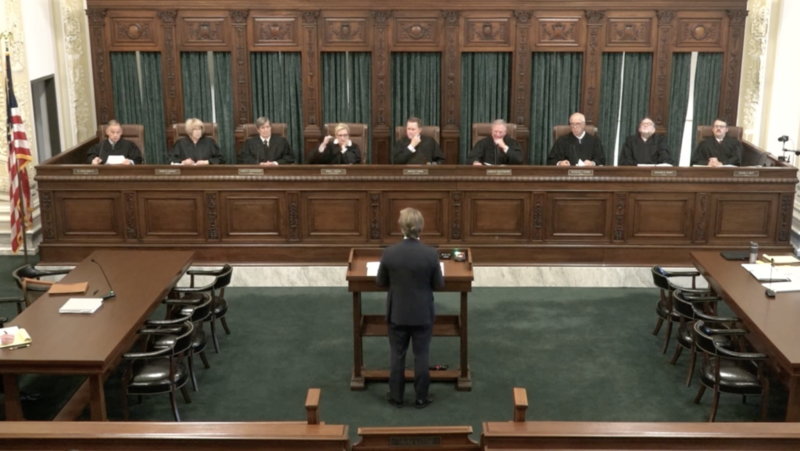
Cedric Bond, an attorney representing Oklahoma Secretary of State Benjamin Lepak, argues to the state Supreme Court over a challenge to disqualified signatures for an initiative petition on Nov. 2, 2026. (Screenshot)
OKLAHOMA CITY — Some Oklahoma Supreme Court justices seemed skeptical Monday about the process the Secretary of State’s Office used to strike tens of thousands of signatures from a citizen-led initiative petition.
They questioned why the agency has been unwilling to explain why each of the more than 57,000 signatures were rejected if artificial intelligence technology and human error played a role in the process.
The state’s high court heard nearly two hours of oral arguments that could determine not only the fate of State Question 836, which proposes changing the state’s primary system, but also how the Secretary of State’s Office handles signature verification efforts moving forward. The court did not immediately rule Monday.
An attorney representing Oklahoma Secretary of State Benjamin Lepak argued the state had complied with a new law passed in 2024 that increased the number of data points a signature must meet to be considered valid. But those challenging the office’s rejection of what they say are tens of thousands of legitimate voters’ signatures argued Lepak’s office unlawfully placed the burden of proof on proponents of the state question.
State Question 836 would place all candidates on one primarty ballot, allowing voters to select any one candidate – regardless of their party affiliation. The top two voter getters would advance to the general election. Oklahoma law currently bars independent voters from voting in partisan primaries unless the party files paperwork to allow it.
Supporters of State Question 836 said they collected more than the number of signatures state law required to place items on a future ballot.
But in March, Lepak rejected the open primaries initiative petition, saying it fell short of the required number of valid signatures. The office reported that only 142,567 of the more than 209,000 submitted signatures were valid. This was met with two separate legal challenges in June, which asked for Lepak’s office to point out which signatures were rejected and explain why.
Vice Chief Justice Dana Kuehn and Justice Noma Gurich both questioned why Lepak’s office hadn’t provided the report in response to requests from proponents of the state question.
“I always didn’t like it when my math teacher told me I had to show my work,” Kuehn said. “I just wanted to write the answer, and you had to take me for my word that I knew how to do the math. So why don’t you all want to show your work? Can you show your work?”
Cedric Bond, an attorney representing Lepak, said the office does not object to providing a report of which specific signatures were rejected if the court orders it, nor does it object to allowing the proponents to review individual signature data.
He said some older artificial intelligence technology was used to help verify signatures, but the process had human oversight at “every step of the way” and still couldn’t match 57,841 signature lines with 80% confidence.
State law requires that at least 4 of 5 voter data points be verified for a signature on an initiative petition to be considered valid. Those include legal first name, legal last name, zip code, house number, numerical month and date of birth.
“I would also like to point out here that the secretary is not the protestant to this initiative petition,” he said. “The secretary does not oppose this, it’s not a policy preference question in this at all. The secretary has a ministerial role, and that role is given by the Legislature, which was acting under its constitutional mandate.”
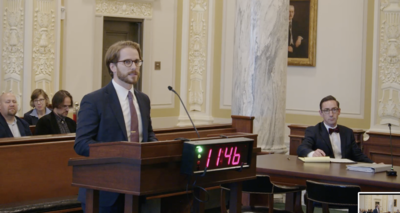
Frederic Dorwart, an attorney representing proponents of the state question, said Lepak’s office has unlawfully burdened the proponents with proving the validity of signatures and has not provided “competent evidence” of the reason for rejection 29% of the submitted signatures.
“If it were 5%, we probably wouldn’t be here,” he said. “If it were 5%, we would probably live with the result. But it was 29%, and that is an implausible number to think that those 57,841 people were not legal voters when they signed that petition.”
Each signature sheet has bold, oversized letters that tells people it’s a felony to sign if they’re not a valid, legal voter, Dorwart said. It’s not plausible that so many people were not valid voters, he said.
Oklahoma City, OK