Jared Polis’ final budget request as Colorado governor seeks to limit Medicaid growth
Nov 02, 2026 | 6:55 pm ET
Description
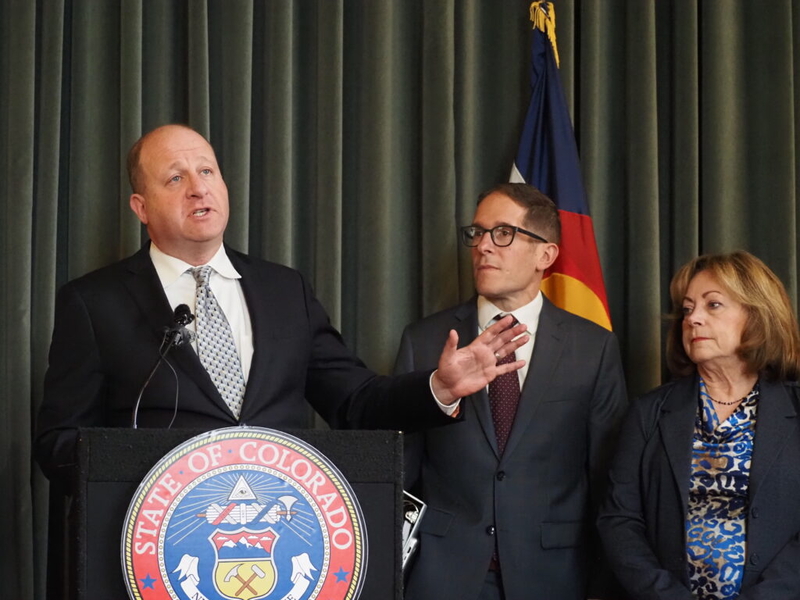
Colorado Gov. Jared Polis presents his budget request for the 2027-2028 fiscal year in his office at the state Capitol in Denver on Monday. (Photo by Sara Wilson/Colorado Newsline)
Colorado Gov. Jared Polis released his final budget proposal on Monday, once again calling for the Legislature to significantly restrict Medicaid growth in the state.
The Democrat, who is in his last few months as governor, wants to limit program growth to 4.3% during the next budget year, compared to an expected 15% with current spending trends. Medicaid costs have more than doubled since the 2021-2022 fiscal year and could soon eat up around 40% of the state’s entire general fund. It is propelled in part by rising healthcare costs and an aging population that needs more services. The health insurance program for low-income people serves around 1 in 5 Coloradans.
“Absent changes, Medicaid growth will crowd out everything else, including education,” Polis told reporters. “That would be unsustainable. Based on what I’ve seen, I don’t believe low-income Coloradans would be any healthier under this scenario.”
A 4.3% growth would match the rate that state spending is allowed to grow under the state’s Taxpayer’s Bill of Rights. That rate of increase is based on inflation and population growth.
Polis’ proposal includes a $250 million general fund increase for Medicaid, but he also outlines almost 30 program cuts and other actions to save around $988 million in total spending and $290 million in general fund spending. That includes the entire elimination of adult dental benefits, reductions for long-term services and supports, reinstatement of prior authorization for behavioral health, and lower hospital medical education payments.
“We oppose any way to reduce Medicaid expenditures by throwing people off of Medicaid,” he said. “That’s not what this is about. We actually want to protect and get even more people who are eligible to access Medicaid. That’s a basic value.”
Critics were quick to push back on the changes in the budget proposal. Adam Fox, the deputy director at the Colorado Consumer Health Initiative, said in a statement that the plan puts “the health of vulnerable Coloradans at risk.”
Absent changes, Medicaid growth will crowd out everything else, including education ... That would be unsustainable. Based on what I've seen, I don't believe low-income Coloradans would be any healthier under this scenario.
The Health Initiative supports Amendment 87, a ballot measure that would establish a graduated income tax and could raise much more revenue for the state to spend, depending on what other measures pass on Election Day. Polis is opposed to Amendment 87, as is the Democratic nominee for governor, Attorney General Phil Weiser.
“Polis, who has passed pro-consumer healthcare policies and expanded access to Medicaid, is now proposing more cuts to lifesaving programs rather than supporting a viable solution,” Fox said. “Cuts aren’t a solution for Coloradans struggling to afford healthcare or other basic necessities.”
The explosion of Medicaid spending has been a driving force in Colorado’s perpetual budget shortfalls the last few years. A 10-member commission has met throughout the summer and fall to consider policy changes that could make the program more efficient. Next year, lawmakers will need to solve another $1 billion-plus gap between the amount the government can spend under the Taxpayer’s Bill of Rights and how much it would cost to keep program funding steady.
This final budget request of the Polis administration is for $18.9 billion in general fund spending, up 2.6% from the current budget. The general fund is where Colorado has its discretionary spending.
In the proposal, Polis also suggests the Legislature refer a ballot measure next year to pay for food and nutrition assistance. Under the federal One Big Beautiful Bill Act last year, states have to pay more into the Supplemental Nutrition Assistance Program. That’s expected to be about $100.5 million for Colorado. The state already keeps some tax revenue for the universal school meal program, and Polis wants voter permission for the state to retain more to partially cover those SNAP costs.
Responsibility will pass to new governor
The budget would also increase per-pupil funding by $488 for public education, and continue to put money towards a new school finance formula passed in 2025. Polis also called for $16.8 million to hire more nurses and clinical staff in prisons across the state and $12.4 million to reopen part of the private Huerfano County Correctional Center in Walsenburg.
Polis’ proposal is a starting point for the bipartisan Joint Budget Committee’s work to craft a balanced state budget for the entire Legislature to vote on, usually in late March.
But Polis, who is term-limited, won’t actually be around for all that. His successor will be elected Tuesday, and after he submits a revision in January for this budget proposal, the responsibility will pass to the next governor. The governor’s request is always due Nov. 1, election year or not.
“Obviously, if a governor doesn’t bring Medicaid spending in line with growth, then there would be cuts to K-12 or higher education,” he said. “But I believe that they would share the same values of funding our schools and and not throwing people off of Medicaid.”
Denver, CO