Growing scrutiny of the bench shadows Arizona’s judicial retention vote
Nov 02, 2026 | 5:50 pm ET

Description
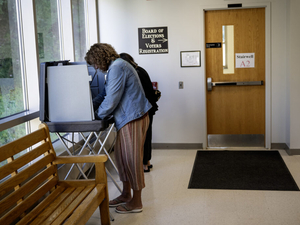
A campaign sign outside of a Phoenix-area early voting location urging voters to remove five family court judges from the bench. (Photo by Marjorie Perry/Arizona Mirror)
Nestled on Arizona ballots below the big-ticket races like governor and congressional representative, but before the ballot propositions that aim to change the state constitution and impose new laws that the legislature either can’t or won’t approve, sit the names of dozens of judges.
The jurists aren’t on the ballot as candidates, and they don’t run campaigns where they work to curry favor with voters. Rather, voters are tasked with a choice: keep this judge on the bench or boot them to the curb. And this year, unlike in most past elections, there are concerted efforts to get voters to choose the latter.
Driving down the road in the Phoenix area, one passes by a flurry of fonts and a confetti of colors with campaign signs urging passersby to reject a list of judges, part of a growing national and local push for judicial accountability.
This year there are a total of 49 Maricopa County Superior Court judges up for retention. The Maricopa County Republican Committee identified 24 judges they think voters should reject. Civic Engagement Beyond Voting, a nonpartisan liberal organization, recommended voters remove seven judges from office. The only overlap between the lists was that both suggested voters reject Judge Julie Mata.
Since 1974, when Arizonans elected to fundamentally change the way judges became judges and adopted the merit selection process, just six judges have been removed from the bench in an election.
Greater attention on judges
While judicial retention elections have typically taken a backseat to issues that voters perceive as more pressing, in recent years, interest in judicial performance has increased.
Doug Cole, vice-chair of the Commission on Judicial Performance Review, recently gave an interview with the Citizens Clean Elections Commission, a nonpartisan group that supports voter education.
“There has been heightened scrutiny on the judiciary — we see that across the country, from the U.S. Supreme Court justices going through their confirmation process… it’s trickled down to Arizona, so people are paying more attention,” he said.
In Arizona, the performance of family court judges in particular has come under greater scrutiny following the 2024 deaths of Alec and Lydia Mater at the hand of their father, Brock Mater. Despite a mental health crisis in which Brock absconded with the children and then called 911 on himself, telling police that he “believes his kids are to be sacrificed by him,” the family court judge granted Brock unsupervised parenting time, over the objections of Hope Hooton, their mother.
Six months later, Brock shot Alec and Lydia before turning the gun on himself.
Abuse claims often aren’t believed by judges
Studies have shown that, when mothers try to flag safety concerns, they are met with skepticism from judges and, oftentimes, counter-allegations of coaching from the father.
In a 2019 study, researchers analyzed 4,300 family court cases across the U.S. and found that, when mothers report experiencing domestic violence, less than half are believed. For claims of child physical abuse or child sexual abuse by a father, family court judges reject those allegations at higher rates. Over 80% of child sexual abuse claims and 70% of child physical abuse claims made by mothers were rejected by courts.
Similar concerns have been voiced in Arizona. As an example, one can read a complaint submitted to the Commission on Judicial Conduct alleging such behavior, written on law firm letterhead. The CJC is tasked with assessing complaints against judges who are accused of violating the Code of Judicial Conduct. The first cannon states that a judge shall “uphold and promote the… impartiality of the law;” the second cannon reiterates that a judge must “perform the duties of judicial office impartially.”
Many of the complaints connected to family law matters allege judicial bias and unequal application of the law.
One complaint states that the judge applied “drastically heightened scrutiny” of the mother’s claims, whereas the father should be allowed “to do whatever he wants.”
“The (judge’s) in-court conduct…made clear that it did not matter how bad Respondent’-Father’s conduct was or what the law required; Petitioner-Mother was going to lose. The court did not follow the law…did not review or consider any exhibits or pleadings, but instead imposed the decision it arbitrarily determined was best,” the complainant wrote.
But the complaints rarely lead to any discipline: Over the past 15 years, according to ABC15, 97% of complaints have been dismissed.
Alec and Lydia are not the only children who have been murdered at the hand of a parent, often in the context of a custody dispute, where one party (often the mother) alleges there was domestic violence.
Andre Leteve, for example, purchased a gun the day his wife, Laurie, filed for divorce. In a note typed in days prior to the murders of Alec, 5, and Asher, 1, Andre wrote: “this should f**k you up for a good long time to come” and “I wonder if you’ll understand what price you’ll have paid for your freedom?”
According to the Judicial Performance Review and Commission on Judicial Conduct, neither has a system of review for such cases, where a custody decision places the child in the care of a parent who kills them.
High scores for judges
The Arizona Judicial Performance Review was created in 1992 through an amendment to the state constitution giving the public access to data regarding a judge’s performance. According to a previous JPR report, they have “the duty to provide meaningful and accurate information to (help) the public (make) informed decisions regarding…judges.”
The surveys for this retention election were distributed between February and September last year. Surveys are distributed to those who may interact with a judge regularly, such as an attorney who frequently has cases on a judge’s docket, as well as to those who may have a limited scope of interaction with the judge. Survey respondents may include attorneys, litigants, witnesses, peer judges and appellate judges.
The surveys include five categories of evaluation:
- Knowledge of substantive law and procedure (represented as “legal ability” on survey results)
- Impartiality (integrity)
- Clarity of oral and written communications (communication skills)
- Judicial temperament and professionalism
- Administrative and case management skills/ work ethic (settlement activities)
The majority of judges routinely score high marks based on the JPR survey. This year, for the 83 judges up for a retention vote, all of them met standards.
JPR Chairman William Arthur recently commented on why this might be the case. In a Bench Talk AZ conversation with Arizona Supreme Court Chief Justice Ann Scott Timmer and Arthur, he stated: “These are high-performing people… That is why we see routinely high-performing judges, time after time, cycle after cycle, they have excelled in everything they have done up to the time of their appointment and their goal is to excel (as a) judge.”
On rare occasions, judges have been labeled as not meeting standards after the surveys. In 2024, JPR announced that Judge Jo Lynn Gentry had not met standards. That same year she received a public reprimand from the Commission on Judicial Conduct regarding the delayed response time in a criminal case.
This story was supported with funding by the Fund for Investigative Journalism.
Phoenix, AZ