South Dakotans set to decide races for governor, Congress, Legislature and 4 ballot questions
Nov 02, 2026 | 4:35 pm ET
Description
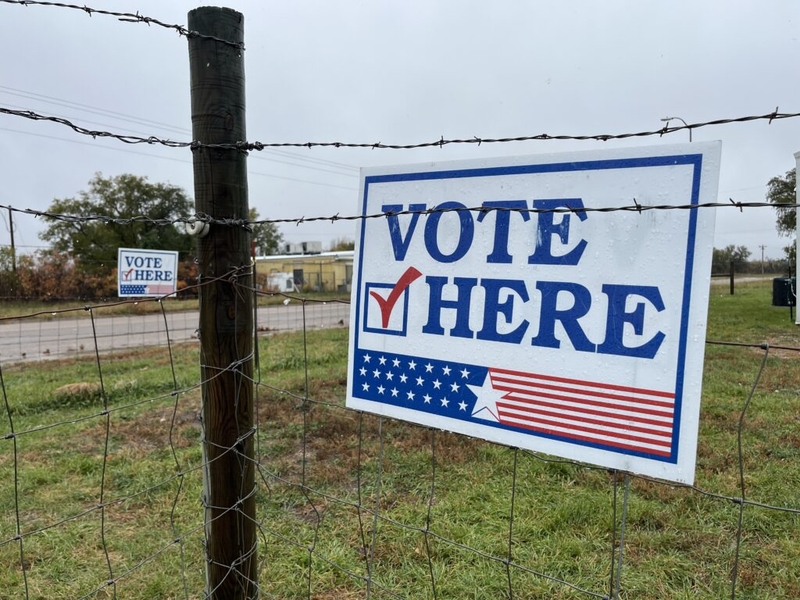
Signs identify a polling place in Wanblee, part of Jackson County, ahead of South Dakota's 2026 general election. (Photo by Makenzie Huber/South Dakota Searchlight)
Tuesday is Election Day in South Dakota, with races for state and legislative offices, four statewide ballot questions, and a variety of local races and questions.
Nationally, control of both chambers of Congress is up for grabs, with implications for South Dakota Republican John Thune’s status as U.S. Senate majority leader.
Voting and results info
Polls are open from 7 a.m. to 7 p.m. local time. Voters can check their registration, locate their polling place and view a sample ballot in the state’s online Voter Information Portal at vip.sdsos.gov.
Identification is required to vote. Acceptable forms include a South Dakota driver’s license or non-driver ID card, a passport or other picture ID issued by the U.S. government, a tribal photo ID, or a current student photo ID issued by a South Dakota high school, college or university.
The South Dakota Secretary of State’s Office will begin reporting results online at electionresults.sd.gov after 8 p.m. Central, 7 p.m. Mountain, when the final polls close in the Mountain time zone on the western side of the state. South Dakota Searchlight’s journalists will report on election returns as they come in throughout the evening.
Statewide races
Democrats, plus an independent and a Libertarian, are trying to break an 18-year streak of Republicans winning every statewide elected office in South Dakota.
The last Democrats to win statewide elections in South Dakota were U.S. Rep. Stephanie Herseth Sandlin and U.S. Sen. Tim Johnson, who each won reelection in 2008. Herseth Sandlin lost her next reelection campaign to Republican Kristi Noem in 2010, and Johnson’s seat was won by Republican Mike Rounds when Johnson chose not to seek reelection in 2014.
This year’s statewide candidates are:
- Governor: Republican Gov. Larry Rhoden and Democratic nominee Dan Ahlers
- U.S. Senate: Republican incumbent Mike Rounds and independent candidate Brian Bengs
- U.S. House: Republican Attorney General Marty Jackley and Democratic nominee Nikki Gronli
- Attorney general: Republican Lance Russell, unopposed
- Secretary of state: Republican Heather Baxter, Democrat Terrence Davis and Libertarian Tamara Lesnar
- Public utilities commissioner: Republican Don Haggar and Democrat Frank Kloucek
- State treasurer: Republican Melissa Hull and Democrat Margaret Kuipers
- State auditor: Republican Catherine Barranco and Democrat Tom Cool
- Commissioner of school and public lands: Republican incumbent Brock Greenfield and Democrat Raeann Mettler
Legislature
All 105 seats in the South Dakota Legislature are up for election — 35 in the state Senate and 70 in the state House. Voters choose one senator in each district, two representatives in each regular district, and one representative in each of four split House districts. State lawmakers serve two-year terms.
Listen again: All of Searchlight Report’s candidate and ballot-question interviews
This year’s partisan split in the Legislature is 97 Republicans and eight Democrats. That’s the lowest number of Democrats since 1953, when there were two. At least 52 seats are already guaranteed to be held by Republicans in 2027 due to a lack of opposition: 21 seats in the Senate and 31 in the House.
There are 11 independents running for Legislature this year, which is an unusually high number. At least one is guaranteed a state House seat in District 27, a vast area including the Pine Ridge Reservation, where the ballot has four independents and one Republican vying for two seats.
That will be the first independent elected to the South Dakota Legislature since 2010. If multiple independents serve in next year’s Legislature, it’ll be the first time that’s happened since the 1920s.
Statewide ballot questions
The four statewide ballot questions are all proposed state constitutional amendments that lawmakers placed on the ballot. Voter approval is required to amend the constitution.
Amendment I would repeal the expanded Medicaid eligibility requirement in the state constitution if the federal government’s share of funding for the expansion drops below 90%. There’s a dispute about whether the amendment would trigger an immediate termination of expanded Medicaid under that scenario, or whether the amendment would merely give lawmakers the opportunity to consider eliminating the expansion in the event of reduced federal funding.
Amendment J would add language to the state constitution specifying that people who are not U.S. citizens are disqualified from voting. The state constitution already includes citizenship as a voting eligibility requirement.
Amendment K would allow a trust fund containing proceeds from unclaimed property — including abandoned cash, stocks, bank accounts and more — to be managed by the state Investment Council, like other funds such as the retirement pool for public employees. People could still claim their unclaimed property at any time, but the Investment Council would manage the fund for higher returns, generating more interest to be used in the state budget.
Amendment L would raise the bar for passing state constitutional amendments. If it passes, future amendments would need 60% support from voters, rather than a simple majority.
Thune’s position, control of Congress
Thune — who is not up for reelection until 2028 — has been traveling the country this fall campaigning for Republican U.S. Senate candidates in an effort to protect the body’s Republican majority. Senate Republicans elected Thune as majority leader two years ago.
Inside Elections, a nonpartisan forecaster, projected Thursday that Democrats would gain enough seats to reach at least a 50-50 split Senate, ranking Michigan, New Hampshire, Ohio and Texas as tilting Democratic. In a 50-50 Senate, Republican Vice President J.D. Vance would be the tiebreaker in his role as president of the Senate.
Major forecasts and pollsters more strongly favor Democrats to take the U.S. House, though some experts observe that years of gerrymandering, including Republicans’ mid-decade redistricting, combined with entrenched polarization could stunt the crest of a so-called blue wave.
High turnout expectations
Turnout — the percentage of registered voters who cast a ballot — is typically higher in South Dakota than the national average. This is a “midterm” election, because it falls in the middle of President Donald Trump’s four-year term. National turnout for the last midterm election in 2022 was 69.9% in South Dakota and 46.2% nationally.
Statistics are indicating a high turnout for this election. Nationally, voters crossed the high-water mark of 52.7 million early votes cast on Saturday, surpassing the midterm record set in 2022.
South Dakota is also ahead of its advance voting pace from 2022. There were 78,778 ballots cast in the state by Friday, which was more than the 55,377 ballots received through the same period in 2022.
States Newsroom’s D.C. Bureau contributed to this report.

Pierre, SD