School counseling becomes issue in Alabama state school board races
Nov 02, 2026 | 6:01 am ET
Description
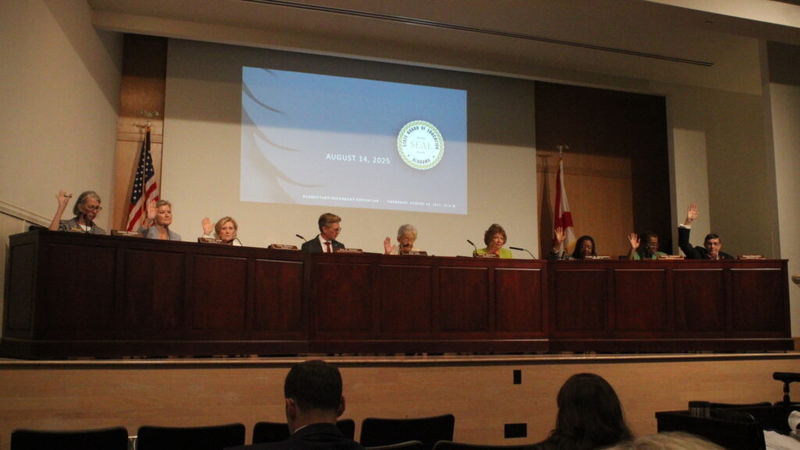
The Alabama State Board of Education votes on a resolution at the board meeting in the Gordon Persons Building in Montgomery, Alabama, on Aug. 14, 2025. Two Republican candidates for the board have called for limits to social-emotional learning in schools, which aims to teach learners compassion and community participation. Their Democratic opponents support the measure. (Anna Barrett/Alabama Reflector)
Two Republican nominees for Alabama State Board of Education have called for changes to the state’s school counseling program.
Cathi Bradford, the GOP nominee for Alabama State Board of Education District 6, and Emily Jones, the Republican nominee for Alabama State Board of Education District 8, have both called for limits to a process known as social-emotional learning.
Advancing Students Forward, an organization working to give underserved students access to education and academic success support, describes social-emotional learning as a process where students learn “how to manage emotions, problem solve, and create positive relationships with others.” According to the United Nations Education, Scientific and Cultural Organization, SEL aims to allow learners to process emotions effectively, develop compassion, form a sense of identity and become engaged members of society.
Jones said in a recent interview that she thinks SEL has a space in certain educational areas but would place limits on it.
“It does not need to be integrated into science class, history class, whatever it is,” Jones said. “We need academic courses to focus on academics, and SEL does not have a space there, but if it’s a counseling class, I think that’s kind of the expectation, and parents can decide that.”
Multiple messages seeking comment from Bradford were left unanswered. According to her website, Bradford opposes “expanding classroom-based social-emotional learning frameworks that move schools beyond their core mission— to educate.”
Angela Morgan, the Democratic nominee for State Board of Education District 6, said in a recent interview that some students need social-emotional learning because of their environment outside of school.
“I taught high school, and I had a lot of students that had really tough home life,” Morgan said. “You can’t say that education is only about teaching arithmetic and English and history. Education is also teaching about hope. And there are children who come to school traumatized because life is beating them down. And if you’re not there to give them support the way they need it, then I do not think you’ve done your job as an educator.”
Shatika Armstrong, the Democratic nominee for State Board of Education District 8, said in a statement Thursday afternoon that social-emotional learning does have a space in classrooms.
“We cannot expect students to perform at their best academically if they do not know how to manage emotions, resolve conflicts, communicate effectively, or make responsible decisions,” Armstrong said. “As a parent and someone who has worked in education, I understand that children bring more than backpacks into our classrooms. They bring real life experiences and challenges.”
The Alabama School Counselor Association Leadership Team said in a statement lat week that school counselors are “student advocates, and they are important partners in empowering students to become successful civic citizens.”
“School counselors provide counseling, crisis intervention, and collaborative services, which are all designed to help create an equitable and accessible world in which all students thrive, regardless of their background or circumstance,” the statement said. “School counselors work in tandem with teachers, administrators, and parents/families to improve access to opportunity and achievement for students and also to address foundational wellness challenges.”
Jones said she thought the plan needed to be “looked at, revamped, brought up to speed” and many of her concerns predated the new counseling plan.
“There were a lot of things in there that I thought needed to be removed,” she said. “So that’s really the big thing with getting the standards updated to be more reflective of the times that we’re living in.”
The counseling plan was last updated in 2003. The Alabama State Board of Education voted in March to update the Comprehensive School Counseling Program Model for Alabama Public Schools.
Under the new counseling plan, sensitivity — which includes collaboration with parents and guardians to “ensure students’ continued success, promoting accessibility, transparency, and advocacy” — is considered a foundational skill. The model also states that transparency is key for establishing and maintaining relationships with families.
The ALSCA said because the updated plan is new, the full benefits have yet to be seen.
“As school counselors across the state become more familiar with the model through professional development and implementation, its positive impact is expected to grow,” the statement said. “Ultimately, the model is intended to strengthen the effectiveness of school counseling programs and ensure that students, families, and school communities better understand and benefit from the services that school counselors provide.”
Some of the benefits the ALSCA said benefits they anticipate seeing are “greater clarity regarding the role of the school counselor within the school, stronger collaboration between school counselors and other school professionals and increased parental involvement and family engagement in the comprehensive school counseling program.”
One issue Jones had with the previous code was language it used surrounding gender identity.
Under the new model, students in public K-12 schools have foundational and wellness standards which include teaching children to identify and respect differences among others. Jones said if the new standards start “breaching beyond that” into gender identity, there could be an issue with not following state law.
“So there was some stuff in the prior standards that had talked about, … just kind of (being) open and accepting,” she said. “Well, Alabama law’s changed on a lot of these things. Alabama law defines sex as male and female, and it cannot change. So we need to make sure that the standards we have, especially around these topics, are in line with that.”
Jones and Armstrong agreed on the need for communication and transparency between counselors and parents.
“Schools should clearly communicate what counseling services are available, what requires parental consent, and how families can ask questions or review information,” Armstrong said. “At the same time, we must make sure students have access to appropriate support when they need it. Communication and trust between schools and families are essential.”
Montgomery