In an Alaska House district known for low voter turnout, the candidates present stark contrasts
Nov 01, 2026 | 10:00 am ET

Description
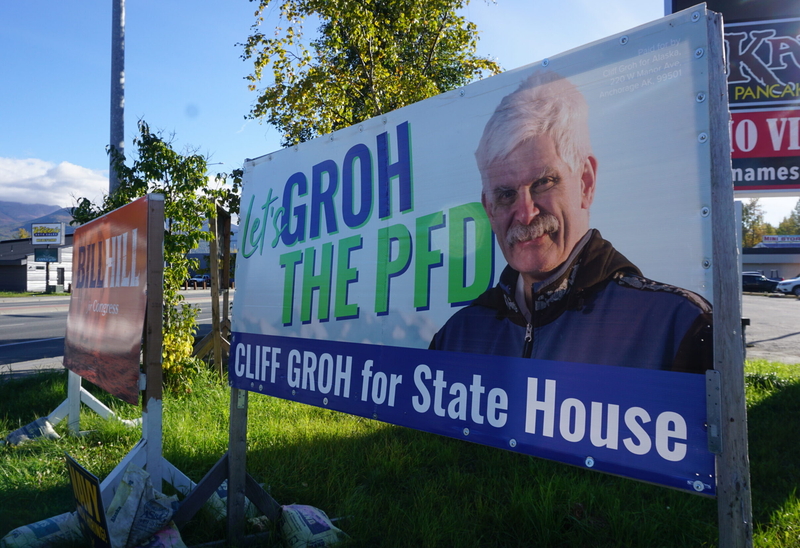
A Government Hill Elementary School student walks on Oct. 29, 2026, on the overpass adjacent to the school and near the Government Hill gate of Joint Base Elmendorf-Richardson. Federal law prohibits candidates from campaigning on military bases, but many candidates, including House District 18 hopeful Cliff Groh, have posted signs in strategic spots near the base. (Photo by Yereth Rosen/Alaska Beacon)
In the Alaska House district with chronic low voter turnout and high resident turnover, how do legislative candidates connect with voters?
Democrat Cliff Groh and Republican Dan Sager are trying to answer that question in the race to represent House District 18.
The vast majority of the territory in the district spans Joint Base Elmendorf-Richardson, or JBER, and more than half of the voters are listed as base residents. Federal law prohibits campaigning on military bases, so Groh and Sager are using phone calls, texts and online communications to try to reach them.
It is not an easy task, according to Groh, who represented the district in the state House in 2023 and 2024 and hopes to return to the seat.
Military personnel around the country vote at lower rates than the U.S. average, he noted, and the JBER residents fit that pattern. Additionally, some voters considered JBER residents are not actually in Anchorage when he tries to contact them.
“That’s because some of the people who have addresses on JBER wake up every morning in Germany or Alabama,” Groh said. “I have called Hawaii, California, Rhode Island, Texas. I’ve called for people, I think, in Turkey and South Korea, too.” Some have not answered, but he has reached people all around the country who are absentee voters, he said.
Sager, who is running for the seat for the first time, also faces the challenge of JBER voter lists that quickly become obsolete.
Sager said the transient nature of military service quickly makes JBER voter lists obsolete. He mentioned his last list. “I got it, and then they said, like, “‘Don’t even contact numbers, you know, 700 through whatever because we already know that they’ve moved on,’” he said.
Like other candidates, he has chosen some strategic and eye-catching sites just outside JBER’s gates to post campaign signs.
The low voting propensity of enlisted personnel and their family members shows up in election statistics.

The district has been at the bottom in turnout in other years. In the 2022 general election, in which Groh beat then-incumbent Republican David Nelson, turnout was just 18.7% in the district, compared to the statewide rate of about 44%, according to state records.
It is not just JBER that is transient and less politically engaged than Alaska as a whole – or less accessible to door-knocking candidates.
The district includes a slice of downtown Anchorage, mostly with industrial properties along Ship Creek, and a piece of the Muldoon neighborhood in the northeastern part of town.
Overall, House District 18 ranks near the bottom in the state for household income, and many residents have difficulty affording even the substandard housing that is available to them, Groh said. They are also coping with underfunded schools, among other issues that give them little time to engage with candidates and voting options, he said.
“There are a number of working families in this district who don’t feel like they have the luxury to follow politics,” Groh said. “They’re often hard-pressed and struggling.”
Off-base, Groh and Sager noted, many residents live in buildings with locked entries, either apartments or senior housing, posing another challenge to on-the-ground campaigning.
There is one part of House District 18 that is stable, easily walked by candidates and home to some of the city’s more economically comfortable residents: Government Hill. As Anchorage’s oldest neighborhood, it has tight community ties and strong civic spirit. For the most part, however, district residents face difficulties, Groh said.
Groh and Sager both live in Government Hill; Sager said he was drawn to the neighborhood by its “charm,” and he and his wife enjoy the easy access to parks, trails and the city’s downtown district.

Groh, 72, is a lifelong Alaskan with decades of experience in politics and government policy. His father, also named Cliff, served as a Republican state senator in the 1970s. In the 1980s, the younger Cliff was a legislative aide — and specifically worked on the legislation that created the wildly popular Alaska Permanent Fund dividend. His campaign website features a photo of him with former Gov. Jay Hammond, an Alaska political icon generally credited with creating the dividend program.
Groh holds a bachelor’s degree from Harvard, and after receiving a law degree from the University of California Berkley, he returned to Alaska and worked as a prosecutor and municipal attorney in Sitka and Anchorage, as well as in private practice. He has also worked as a special assistant in the Alaska Department of Revenue. He has authored academic books and articles about Alaska policy issues, taught about public policy at the university level and, since the 1990s, served on the board of Alaska Common Ground, a non-profit civic organization.
This is his third time running for the House seat. After he beat Nelson in 2022, during the first election season under Alaska’s ranked-choice voting system, he lost to Nelson in 2024 by a mere 23 votes.
Groh said he is excited about the opportunity to be in a legislative majority with a potential Democratic governor. When he served previously, he was in the minority. A victory by him could boost the ranks of the now-slim bipartisan House majority.
“I very much hope that there can be what is called a ‘trifecta’ of a good House majority, a good Senate majority, and that my preferred candidate, Jonathan Kreiss-Tomkins, wins the governorship so that we can make some progress in the state on a whole host of issues for which we have stagnated,” Groh said, naming the Democratic candidate for governor.
For Sager, who has been a participant in the Government Hill Community Council since he bought a house in the neighborhood in 2020, this is his first attempt at elective office.
He is 39, the new father of a 5-month-old girl named Liberty and has lived in Alaska for 13 years. He campaigns in between his duties taking care of his daughter while his wife is at work and attending to his own job as a territorial sales manager in the building materials industry.
Sager stepped into the race after Nelson, the incumbent representative, mentioned that he would not be seeking reelection. Sager said he tried to talk others into running to represent a Republican viewpoint.
He said he entered the race after failing to convince anyone else to do it. The prospect of serving in the legislature turned out to be unappealing to those he tried to convince to run, he said.
“You’re away from home for, you know, five to six months. And it’s just a hard job,” he said.
District problems and common concerns
Despite their philosophical differences, Groh and Sager are in agreement on some of the problems and needs in the district.
There are some common citizen concerns, such as education and public safety, they said. But in the Muldoon part of the district, residents regularly bring up some hyper-local and immediate problems.
Sager said he learned that when he was door-knocking there. “Everything was sidewalks and speed bumps. That’s what everybody wanted to talk about,” he said.
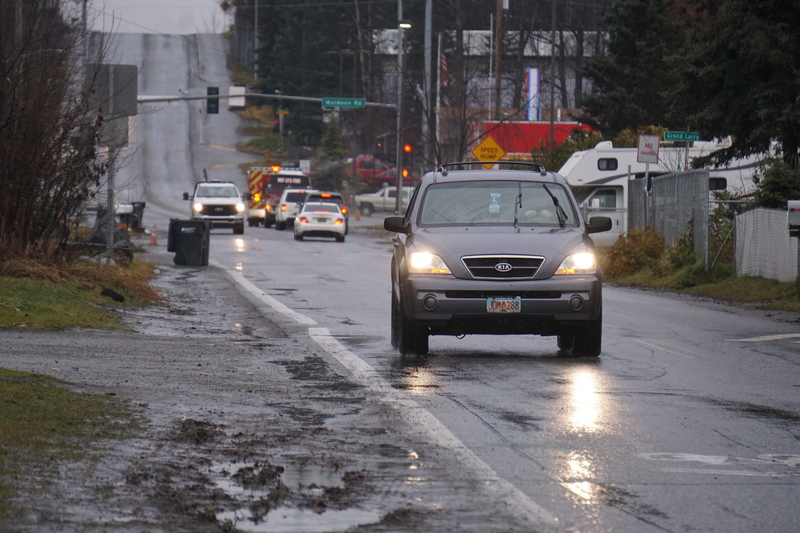
A particular trouble spot is Duben Avenue, a thoroughfare on the Muldoon edge of the district that Groh dubs “Dangerous Duben.” Pedestrians, including children attending Muldoon Elementary School, have to navigate Duben, but there are no sidewalks.
Sager said he has seen the problem firsthand. “I’d go knock on people’s doors and they’d be talking about it, and then a car would fly through,” he said.
Groh, who believes he was the first legislative candidate this cycle to start door-knocking, has also seen the traffic problem firsthand.

Groh said residents call on him to help them in other ways, and he is able to tap into his long years of government and public policy experience.
One example is his work with people struggling to find or keep homes. “A substantial percentage of the homeless population in Anchorage wake up every morning in my district, and there’s a number of people also in my district who are on the cusp of homelessness who slip in and out of it,” he said.
He has kept in contact with district residents he met as far back as 2022 who are struggling with homelessness, he said.
This year, even in struggling House District 18, residents cannot help but be aware of the ongoing election. Sager said he has encountered some people who are disengaged, mostly young military people, but only a few people who say they definitely will not vote.
The downside of that awareness is the dominance of the federal elections in Alaska, particularly the U.S. Senate race between incumbent Republican Dan Sullivan and Democratic challenger Mary Peltola. It is considered one of the races that will decide the control of the Senate. That U.S. Senate race has drawn national attention and massive amounts of money for a small-population state like Alaska.
“The federal (election) is taking a lot of the oxygen out of the room,” Sager said.
That leaves state legislative candidates much overshadowed, he said
“So then all us House and Senate people are just fighting for, like, ‘Hey, don’t forget: We actually affect you a little bit more than that, you know. More directly anyway,’” he said.
Juneau