In volatile Tarrant County, both political parties are on the prowl for moderate Republicans
Nov 01, 2026 | 6:00 am ET
Description
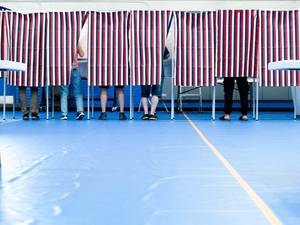
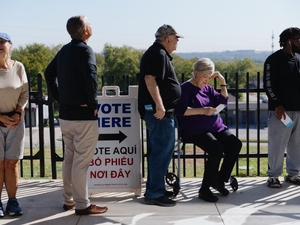
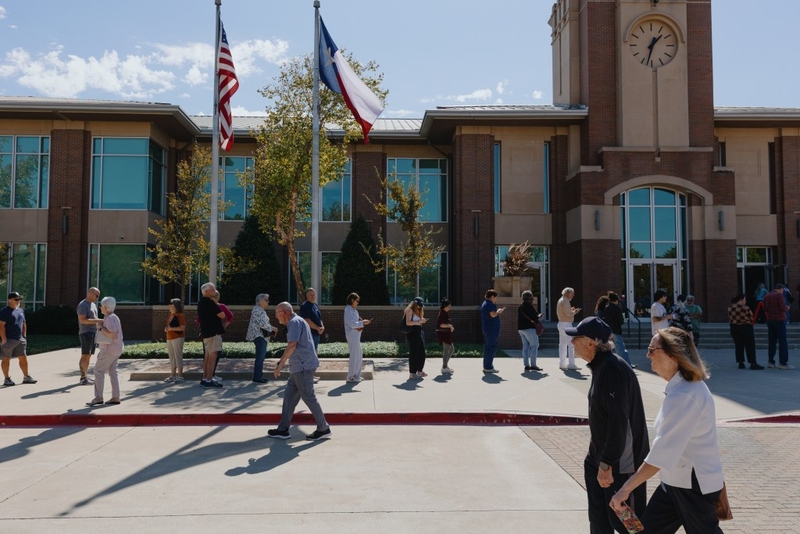
Voters wait in line during early voting at the Keller Town Hall polling site in Keller on Oct. 21. (Shelby Tauber for The Texas Tribune)
FORT WORTH — A lifelong Republican, Fort Worth Mayor Mattie Parker embodies the type of voter who may decide the direction of the state’s largest GOP county — and perhaps the entire state — in Tuesday’s midterm elections.
Parker said she planned to vote for two Democrats running for statewide office in this year’s unusually competitive midterms. But in the race for Tarrant County judge, Parker backs Tim O’Hare, a far-right conservative who oversees the Tarrant County Commissioners Court.
Parker believes she’s not alone in splitting her ticket.
“I think there’s a lot of people that feel that way,” Parker told NBC 5 and the Dallas Morning News.
Parker is exactly the kind of voter Republicans and Democrats are desperately courting: a moderate Republican who still supports the party yet is willing to break ranks for certain candidates.
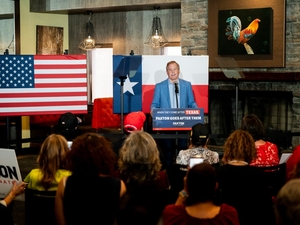
Democrats see a chance to pick off traditional GOP voters turned off by candidates like Ken Paxton, beset by accusations of corruption and infidelity, and Bo French, the Railroad Commission nominee with a history of racist social media posts.
Republicans, saddled with a bad national environment for the GOP, aim to minimize defections by moderates who may not be enthusiastic about some of the party’s candidates but harbor doubts about Democrats.
In Tarrant County, the thinking goes, there are a lot of moderate Republican voters — making the county a mother lode of potential swing votes that could decide the election.
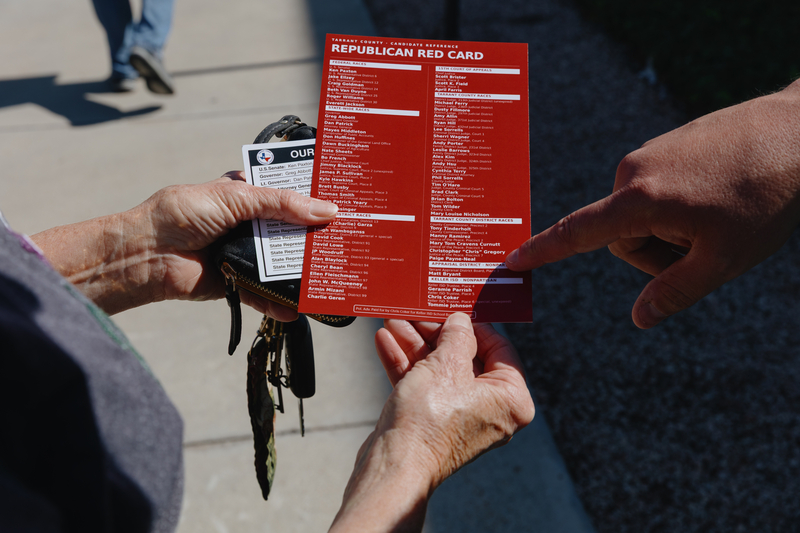
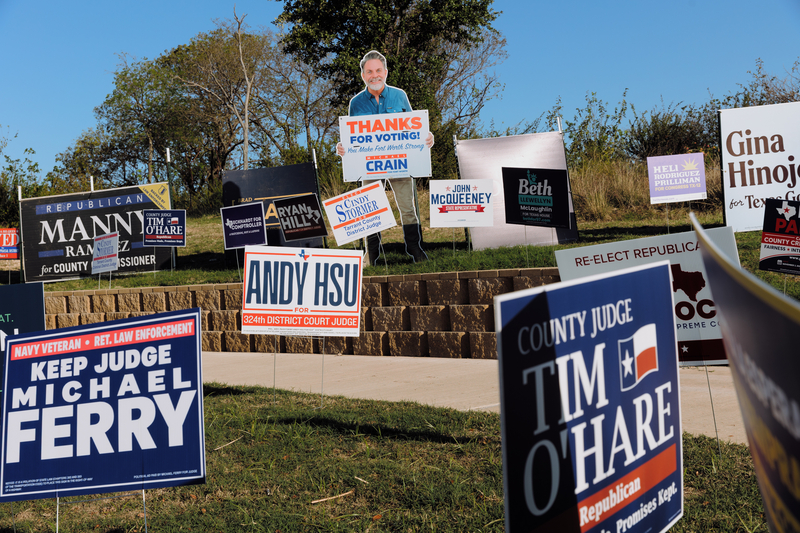
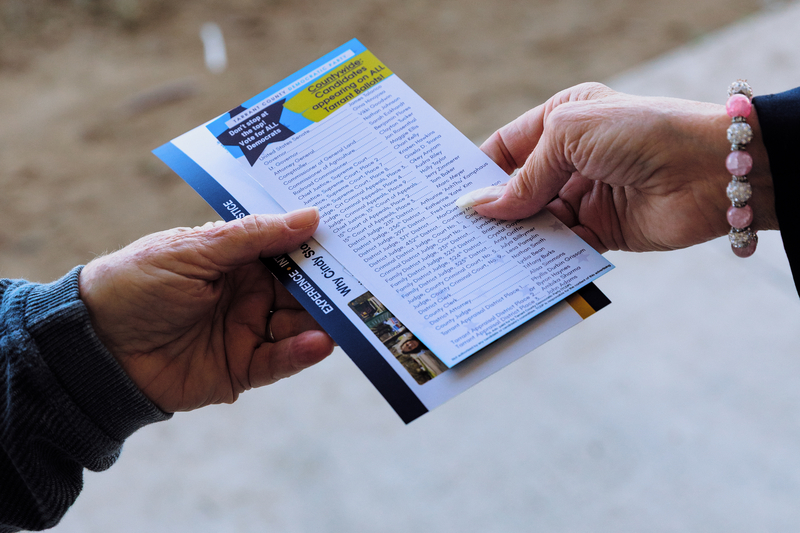
“There is a significant proportion of Republican voters in Tarrant County who are dyed-in-the-wool moderates, and who have been more willing to cross over and vote for Democrats when they believe that the Republican candidate is too far to the right,” said Mark Jones, a political scientist at Rice University.
Republicans weren’t always fighting for votes in Tarrant. Once solidly red, the state’s third-largest county has morphed into a purple battleground over the course of the Trump era — a fast-growing area where support has pingponged between Republicans and Democrats at the top of the ticket. That volatility has all eyes on Tarrant in an election that could crack Republicans’ three-decade hold on Texas politics — or dash Democratic dreams of statewide relevance.
Republican advantages include a 3-2 majority on the county commissioners court that could grow to 4-1 after GOP commissioners fortified their position by redrawing district maps last year.
Money is another strong suit. In the 11 Texas House districts that include Tarrant County, GOP candidates have raised four times more money than Democrats since July, boosting the Republican message up and down the ballot.
Tarrant voters have occasionally gone for Democrats at the top of the ticket, but those swings haven’t translated into success for the party’s statewide or countywide candidates.
Even so, Democrats say they have the wind at their back.
“Republicans always have the money, they’re always going to be able to buy more TV ads, but we have the people power,” said Allison Campolo, chair of the Tarrant County Democratic Party.
“Despite all these bad maps, our voters are so motivated and they can outvote those voter suppression systems,” Campolo said. “I think that will indicate to the Democrats here how powerful they are and what they can do in 2028.”
In a state President Donald Trump carried by 13.7 points in 2024, more Texas voters now disapprove of Trump’s performance than approve, polls show. During early voting in Tarrant County, turnout by presumably Democratic voters has surpassed Republicans. And Democrats see the seeds of backlash after the GOP-dominated commissioners court redrew district boundaries to favor Republicans and cut 92 Election Day polling places and three early voting locations this election cycle.
What’s more: in a January special election runoff, Democrats flipped a key state Senate seat in a district Trump won by 17.4 points. Now, Sen. Taylor Rehmet is fighting to prove the victory wasn’t a fluke by holding the seat against Republican Leigh Wambsganss, whose campaign has spent more than $3.5 million since July — nearly 10 times more than Rehmet.
Several Tarrant County voters, including disaffected Republicans, said their support for Democratic candidates was motivated by a desire to cast out Texas Republicans after decades in power and deliver a rebuke to Trump.
Bryan Brazelton, a 47-year-old business development manager for a water management company, described himself as a lifelong Republican but voted straight Democratic in part because he feels the current crop of Republican leadership isn’t focused on improving Texans’ lives.
“Honestly, I just think we’re ready for a change,” Brazelton said. “You can’t blame the Democrats for 34 years where you’ve been in power. You have no one to blame but yourself.”
Concern over the rising cost of housing, gas, groceries and healthcare also is driving turnout.
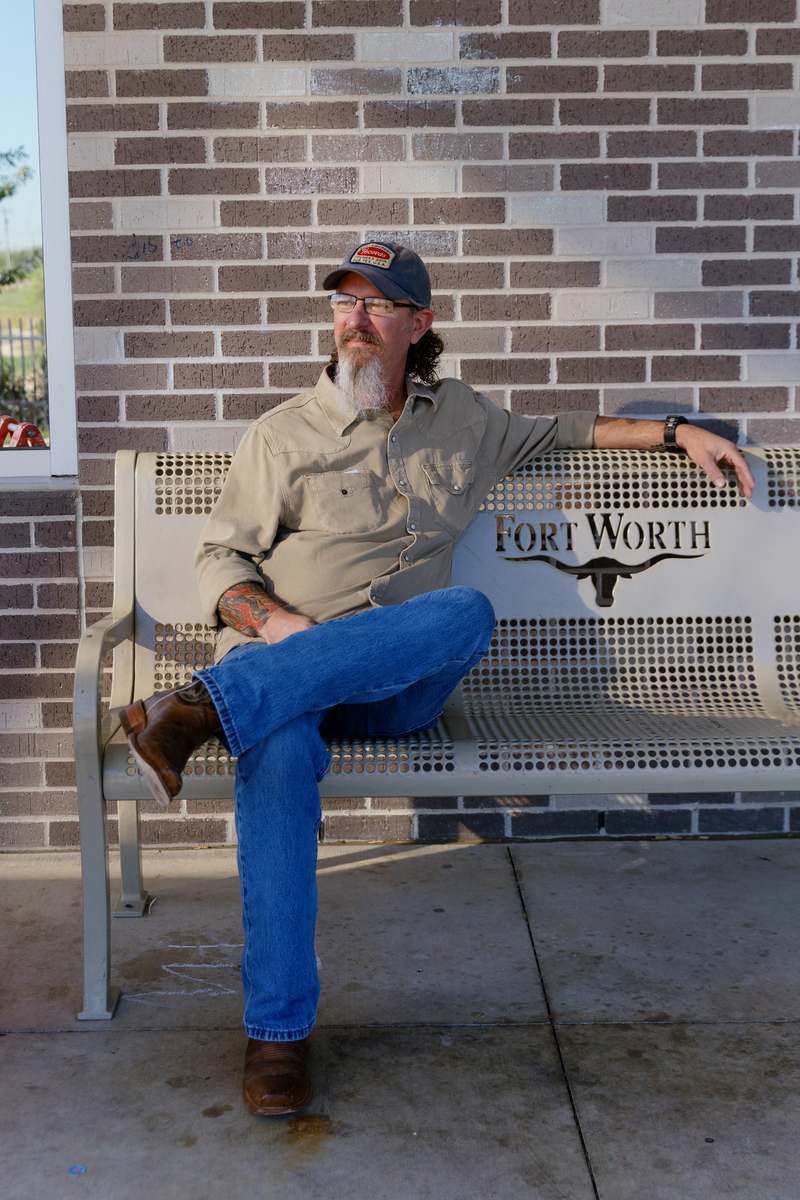
Patric Bennett, a 52-year-old bootseller in Fort Worth, said the high cost of living and dissatisfaction with decades of Republican leadership prompted him to vote for the first time this election.
“Sometimes you’ve just got to clean house, and that’s what we’re doing,” Bennett said.
Tarrant Republicans, long dominant in the county, are projecting confidence.
“I think our folks are going to win in Tarrant County, and we will always be a right-of-center county,” said Tim Davis, Tarrant County GOP chair. “People are excited to support those values.”
Republican turnout is motivated in part by a desire to keep the state in GOP hands.
“Texas is the last real bastion of conservatism,” said Paul Vandewater, a 52-year-old Fort Worth resident who runs a roofing company. “We need Texas to stay red in order to keep the country balanced, or everything’s going to be liberal.”
Losing a county that embodies the cowboy frontier brand of Texan identity would be a considerable blow for Republicans.
“There’s a phrase, ‘As goes Tarrant County, so goes Texas,’” said Jeremy Bradford, former chair of the Tarrant County Republican Party and a GOP strategist. “And as goes Texas, so goes the country.”
Split GOP priorities add to the volatility
Tarrant County has long been a crucial source of Republican voters to balance Democratic strength in the other urban areas, particularly Harris, Dallas, Bexar and Travis counties.
But if Tarrant Republican voters don’t turn out in large enough numbers, the path to statewide victory becomes much narrower for GOP candidates, Jones said.
A key factor in GOP turnout will be business-oriented Republicans who focus more on economic growth than culture war issues. These chamber-of-commerce Republicans have struggled for dominance with the party’s far-right flank, making it more difficult to consolidate the Republican vote, observers said.
“Republicans like me, who I would call common sense conservatives … have been told to take a backseat and let the kind of extremes of our party run around here,” said former Southlake Mayor John Huffman, an unsuccessful GOP candidate for the Texas Senate.
Split priorities among GOP voters also could impact the U.S. Senate contest between Paxton and Democrat James Talarico. Tarrant is home to about 38,000 voters who supported U.S. Sen. John Cornyn over Paxton in the primary runoff.
Brazelton said he would have voted for Cornyn in the general election but supported Talarico over scandal-prone Paxton. Party leaders should not have asked voters to choose partisanship over character, he said.
“I’m not going to do that,” Brazelton said.
Republicans willing to test the water with a Democratic candidate or two may not be primed to completely abandon their party.
In a notable move, Parker endorsed O’Hare, who in a testy GOP primary four years ago defeated Parker’s mentor Betsy Price, the former Fort Worth mayor and emblem of the county’s business-friendly conservative guard.
Parker said O’Hare earned her vote by rigorously supporting law enforcement compared with his Democratic challenger, Alisa Simmons, a county commissioner.
“At the end of the day, what’s most important to voters in Tarrant County and Fort Worth? It’s a foundation of public safety and support for law enforcement in our communities,” Parker said in the NBC interview.
But in the race for railroad commissioner, a position that regulates the state’s oil and gas industry, Parker backed Jon Rosenthal, a Houston Democrat, over French, a far-right online provocateur, unsuccessful candidate for the Texas House and former head of the Tarrant County GOP. Last year, Parker called on French to resign as county Republican chair after he posted an online poll asking whether Jews or Muslims were “a bigger threat to America.”
Parker also endorsed state Sen. Nathan Johnson, a Dallas Democrat, over state Sen. Mayes Middleton, R-Galveston, in the race to replace Paxton as attorney general.
“I’ve worked with [Johnson] as a state senator for years and thought he was wonderful,” Parker said in the NBC interview. “No disrespect to Mayes Middleton. I just haven’t worked with him as much.”
In the marquee U.S. Senate race, however, Parker hasn’t said whether she supports Paxton or Talarico, expressing frustration with both candidates.
Ross Hunt, a GOP strategist, doesn’t expect too many Republican voters to defect to Talarico or skip the Senate race on the ballot.
“There is a significant silent segment of the Republican electorate out there that I think is going to hold their nose and vote for Paxton at the end of the day because the alternative is so much worse,” Hunt said.
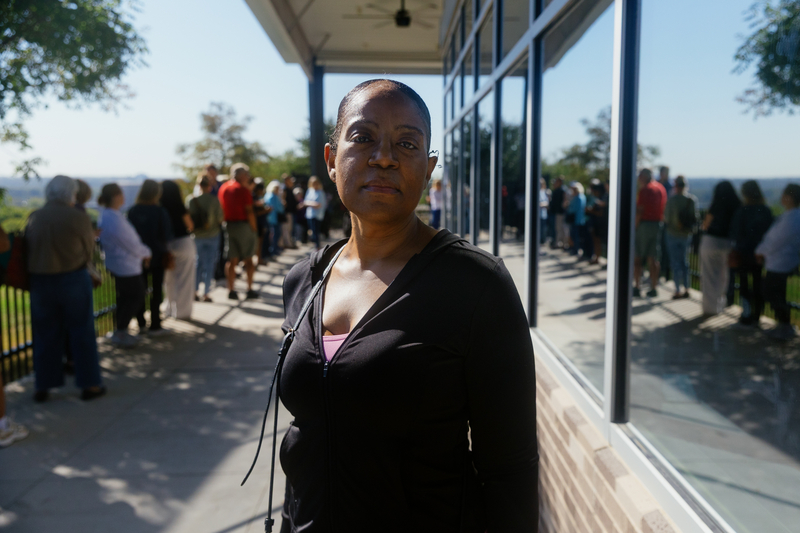
Selina Hill, a 48-year-old Fort Worth resident, said she considered voting for Talarico but soured on him owing to his “God is nonbinary” statement during a House debate on a bill limiting transgender student athletes. Hill said despite reservations about Paxton, including concerns about infidelity, she ultimately voted for him because he aligned with her conservative principles.
“I’m voting on his capabilities,” Hill said.
Predictions are hard for a county that went Trump-Biden-Trump
After supporting Trump by 8.6 percentage points in 2016, Tarrant County voters narrowly backed Joe Biden in 2020 before swinging back to Trump four years later. They also favored Ted Cruz in the 2012 race for U.S. Senate before shifting to Cruz’s foe, Democrat Beto O’Rourke, in 2018.
Voters also have shown a penchant for ticket splitting, with a majority favoring Cornyn and Biden in 2020, followed four years later by breaking for Democrat Colin Allred for Senate while supporting Trump’s return to the White House.
The back and forth has made Tarrant County unusually hard to predict.
Part of that comes down to the county’s partisan split. While it’s the state’s largest county controlled by Republicans, there’s a roughly even share of Republican and Democratic voters, Jones said. In every other large urban county, Texas Democrats have a decisive majority. That close division, paired with the considerable number of moderate Republicans, helps drive that volatility, Jones said.
Former Tarrant County Judge Glen Whitley, a Republican who backs Talarico, said Tarrant voters have long had a reputation for judging individual candidates rather than relying solely on partisan identification.
“They’re not just going to say, ‘Well, I’m just going to vote for everybody that’s got an R beside their name or a D,’” Whitley said.
Patricia Cross-Brooks, 57, said she used to consider herself a moderate Republican but has grown disillusioned with the party under Trump, particularly on matters of corruption and economic inequality.
Also top of mind is the state’s abortion ban. As a labor and delivery nurse, Cross-Brooks said she’s “seen terrible things” as a result of the ban.
“I would never believe in 1,000 years that my daughter would be at risk of not having that choice,” Cross-Brooks said.
Tarrant’s dramatic population growth is another wild card. The county has added about 130,000 people since 2020, while Fort Worth surpassed 1 million people this decade, becoming the nation’s 10th largest city.
That growth was largely driven by new Latino, Black and Asian residents — which Democrats hope will help bite into the Republican vote.
Texas Latinos broke decisively for Trump in 2024. But polling indicates a significant swing back to Democrats this cycle, fueled by affordability concerns and anger over the Trump administration’s mass deportation campaign.
That shift in the Latino vote was seen as crucial in Rehmet’s victory over Wambsganss in January, setting up a rematch Nov. 3. Precincts with a majority of Hispanic residents swung on average 34 percentage points toward Rehmet compared to the Democratic vote in the 2022 election, the last time the seat was on the ballot.
The trends fuel Democratic hopes for future elections.
“I think they’re ready to vote,” Campolo said of Latinos, adding that Republican support for immigration crackdowns by ICE, coupled with affordability issues, are driving voter enthusiasm.
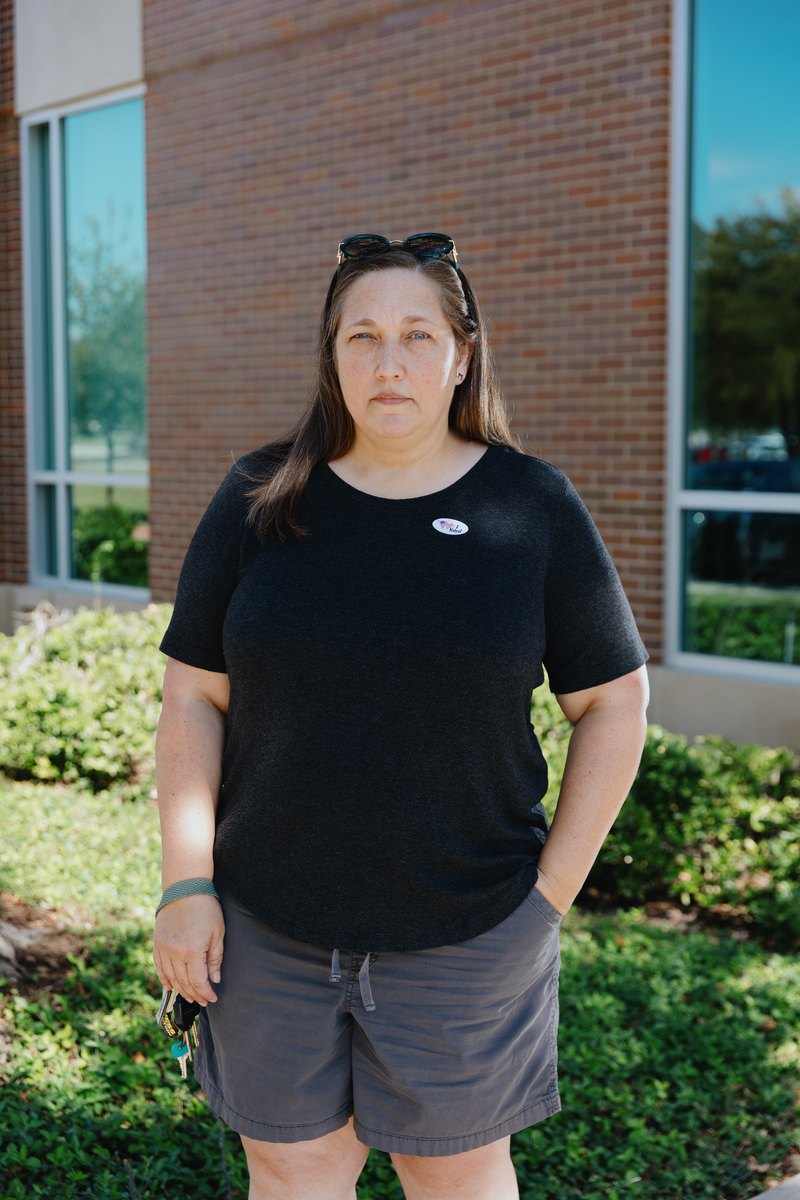
Even in a favorable political environment, Democrats are approaching Election Day with a mix of hope and trepidation, knowing past predictions of a blue wave fizzled as votes were counted.
“I let myself get my hopes up a couple of times already, and we didn’t quite get there,” said Erica Watkins, a 48-year-old nurse from Watauga. “But maybe we will this time.”
Disclosure: Rice University has been a financial supporter of The Texas Tribune within the past five years. The Texas Tribune is a nonprofit, nonpartisan news organization that is funded in part by donations from members, foundations and corporate sponsors. Financial supporters play no role in our journalism. Find a complete list of them and more information about our financial and disclosure policies here.
Austin, TX