Rob Sand says he’d be ‘hesitant’ to use no-bid procurement contracts
Oct 27, 2026 | 4:55 pm ET
Description
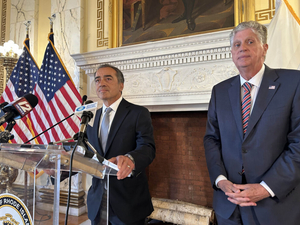
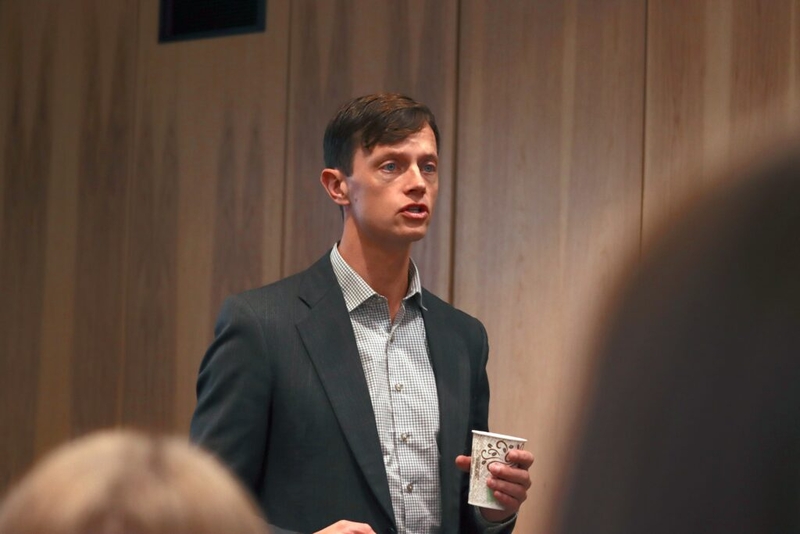
Democratic candidate for Iowa governor Rob Sand speaks Oct. 27, 2026 at the Greater Des Moines Partnership candidate forum. (Photo by Cami Koons/Iowa Capital Dispatch)
Democratic gubernatorial candidate Rob Sand, speaking Tuesday at a business forum, said he was in favor of more “traditional” procurement practices rather than securing state work contracts without competitive bidding.
The forum, hosted by the Greater Des Moines Partnership, fell one week before Election Day. Sand, the state auditor, is running for governor against Republican Zach Lahn.
Lahn participated Oct. 13 in the partnership’s forum, where he also answered questions from members about economic development in Iowa.
Sand said he was “hesitant” to use an exception to the traditional procurement process that allows the state to avoid receiving competitive bids from companies under certain circumstances.
Gov. Kim Reynolds used the no-bid process in 2021 to select the company Workday for the state’s accounting and human resources system. The contract was controversial at the time, in part because of the state’s use of federal pandemic-era funds, and the contract was terminated in 2023.
Sand said he believes that relying on bids that are part of a multijurisdictional agreement or compact, rather than soliciting bids, can lead to some issues if the bids aren’t specific to Iowa, or are possibly outdated. Plus, he said he thinks it’s important to have a preference for Iowa-based companies that put in bids for state contracts.
“Trust in how we handle our tax dollars is one of the most important civic trusts that exists,” Sand said. “Every time somebody pays taxes, that’s their blood, that’s their sweat, that’s their time away from their family … if we don’t take that seriously in our system of self-governance, then we lose trust from people very, very quickly.”
Sand said that while he doesn’t like the no-bid practice, he wasn’t committing to never using the process if elected.
The Greater Des Moines Partnership represents chambers of commerce throughout the greater metro area, including smaller rural communities like Madrid or Van Meter. Sand said investing in Iowa-based businesses and in Iowa communities is the best way to create jobs and sustainable growth for the state.
Sand said the state has had economic development plans offering millions of dollars in tax credits to out-of-state businesses while Iowans are “crossing our fingers,” hoping that the jobs from the development stay in Iowa.
“What we should be doing is making investments in Iowa-based businesses, but also in our communities,” Sand said.
He emphasized the success of the early 2000s Vision Iowa program that provided cost-share grants and loans to communities to develop tourism and recreational opportunities.
“The whole point was, we want to take our small communities across the state of Iowa and our larger ones too, and make sure that they can add the kinds of amenities that make them attractive places to live,” Sand said. “Because if you are a small business owner, you’re going to be more likely to decide to start a business in a place that you want to live in.”
Sand said more people mean more small businesses, more jobs and more employees to pick from.
During Lahn’s candidate forum, according to reporting from Radio Iowa, the Republican businessman also said he wanted to prioritize Iowa-owned businesses.
Recently the state approved an up to $1.4 billion tax incentive package for an India-owned company seeking to build a $15 billion steel mill in southeast Iowa.
The project, and associated tax incentives have come up during debates between the candidates with both saying the negotiated deal needs to benefit Iowans. The two acknowledged the deal would be beneficial to Iowa’s economy.
Sand also talked about the role of artificial intelligence in the state and said he sees the potential for AI use in K-12 educational settings and in workplaces, though he emphasized his opinion that data centers should not receive tax deals and should have certain limits.
“There are probably places in this country where AI is more threatening to jobs, but we need people here,” Sand said. “If we’re having a hard time getting the people here, then helping the people who are here get more work done is a pretty good – a different – solution to that issue.”
Sand and Lahn are slated to face off in their final debate Tuesday on KCRG-TV9 at 6:30 p.m.
Des Moines, IA