Return of the lame-duck session with RI General Assembly set to reconvene after November election
Oct 27, 2026 | 5:47 pm ET
Description
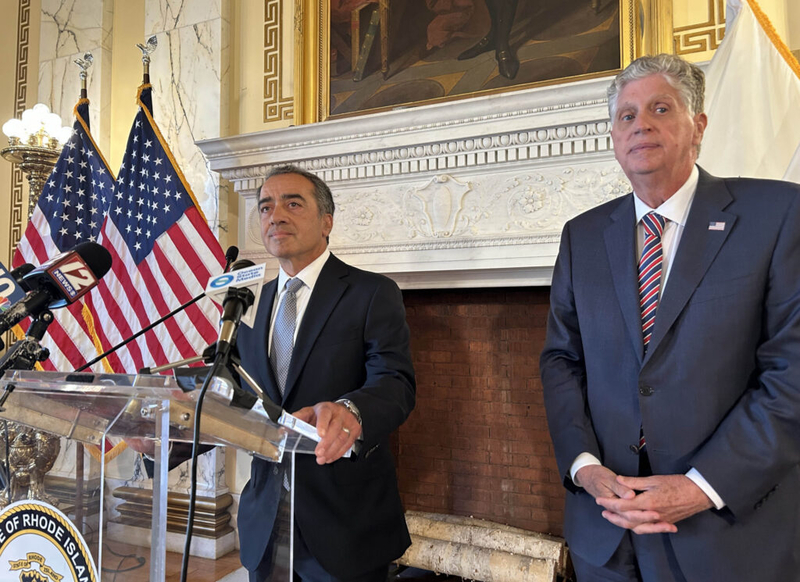
Rhode Island Superior Court Associate Justice Luis Matos stands alongside Gov. Dan McKee during an Aug. 12, 2026, news conference announcing his nomination to the state Supreme Court. McKee has yet to formally submit the nomination to lawmakers for advice and consent. (Photo by Nancy Lavin/Rhode Island Current)
For the first time in six years, state lawmakers are set to reconvene after the Nov. 3 election to consider the appointments of five magistrates and potentially four other judges, including Gov. Dan McKee’s pick for the Supreme Court.
Superior Court Presiding Justice Joseph A. Montalbano last week recommended Timothy G. Healy and Kara Hoopis Manosh for magistrate positions in the state’s highest trial court, subject to advice and consent from the Senate. All Rhode Island magistrates serve 10-year terms unlike judges who serve lifetime appointments.
Also up for consideration are Robert A. Ragosta and Therese M. Picard, who Family Court Chief Judge Michael Forte recommended for appointments to become magistrates in August. In addition, Forte recommended the reappointment of Traffic Tribunal Magistrate Erika Kruse Weller in January.
Senate spokesperson Greg Paré confirmed Tuesday that the chamber has received all five nominations.
“We anticipate potentially receiving (other) appointments from the governor and the judiciary,” Paré wrote in an email to Rhode Island Current Tuesday.
McKee in August nominated Superior Court Judge Luis Matos to fill the vacancy created on the state’s high court by Justice Maureen McKenna Goldberg’s retirement in the spring. The governor lost to Democratic rival Helena Bounnano Foulkes in the Sept. 9 primary.
Foulkes faces independent Ken Block, Republican Aaron Guckian and two other independent candidates in the Nov. 3 general election.
State law requires the governor to formally transmit a Supreme Court nomination to both the House and Senate before lawmakers can provide advice and consent. But McKee has not yet done so, despite praising Matos as the most qualified of five candidates he interviewed — including former House Speaker K. Joseph Shekarchi — during an Aug. 12 press conference.
“The governor has not forwarded a name to the House for a Supreme Court appointment, so there is no return date for the House,” chamber spokesperson Larry Berman wrote in an email to Rhode Island Current.
McKee also has yet to announce his decision to fill two Superior Court vacancies from a total of eight candidates recommended by the Judicial Nominating Commission on Aug. 12. The pair of vacancies opened when Montalbano became presiding justice and Jeffrey Lanphear retired.
The governor is also considering five candidates for a District Court chief judge recommended by the Judicial Nominating Commission on Friday. The vacancy was created by the Oct. 9 retirement of Jeanne E. LaFazia, who stepped down after 16 years on the bench.
The governor’s shortlist includes former state Sen. Stephen Archambault and District Court judges James Caruolo, Mary McCaffrey, J. Patrick O’Neill and Debra Saunders.
McKee’s office did not respond to requests for comment on the status of his judicial picks.
Paré said the Senate may also consider three additional Traffic Tribunal magistrates selected by its chief judge.
When will they meet?
State law requires a seven-calendar-day waiting period after lawmakers receive a nomination before they can consider it. The House and Senate must separately confirm Supreme Court nominees within 60 days of submission, while the Senate has 90 days to confirm other judicial nominees.
If lawmakers fail to meet those deadlines, the governor must submit another nominee.
Senate President Valarie Lawson outlined five meeting dates in an Oct. 21 email to senators, opening with a reminder that the chamber was “anticipating receipt of judicial appointments” requiring lawmakers’ advice and consent.
The full 38-member Senate is scheduled to meet Nov. 5 to formally receive appointments and refer them to the Judiciary Committee, which is scheduled to hold hearings Nov. 17 and 18. The Senate is set to consider nominations on Dec. 1, with a second session the following day if needed.
Lawmakers last reconvened following a summer recess in December 2020, when the COVID-19 pandemic prompted an unusual lame-duck session at Rhode Island College to pass a state budget and consider judicial nominations, including those of Supreme Court justices Melissa Long and Erin Lynch Prata.
“We’ve gotten used to a legislature that once they go home in June they don’t come back,” John Marion, executive director of Common Cause Rhode Island, said in an interview.
Marion said these sessions were more common when turnover in the judiciary created more vacancies or lawmakers returned to override vetoes by Republican governors.
“It’s certainly not without precedent to see lame-duck legislatures do this,” Marion said. “It’s not mischievous — this is their duty under the way the law reads.”
All 38 senators face reelection. Nine House lawmakers chose not to run again for a seat in the chamber.
Providence, RI