The Democrat daring to defy the odds and flip Tennessee’s 3rd District blue
Oct 27, 2026 | 6:00 am ET
Description
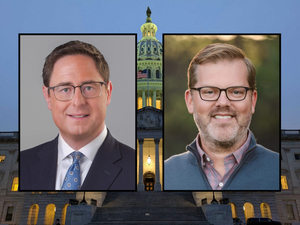
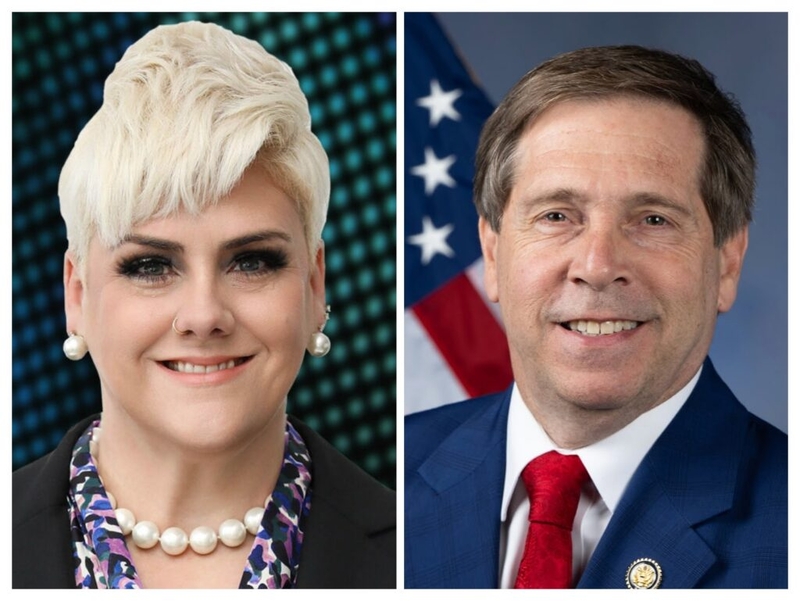
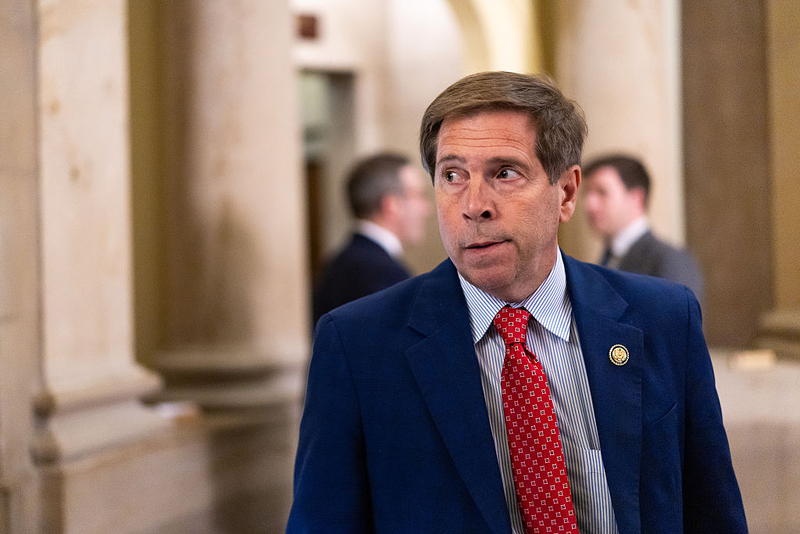
Anna Golladay, left, the Democratic nominee for the 3rd Congressional District, is challenging GOP U.S. Rep. Chuck Fleischmann, who has held the seat since 2010. (Photos: Golladay from annagolladay.com; Fleischmann from Congressman Chuck Fleischmann Facebook)
Anna Golladay, the Democratic candidate for Tennessee’s 3rd Congressional District, is no stranger to politics. She first ran for elected office in 2025 for a seat on the Chattanooga City Council, losing in a runoff by 256 votes.
Beyond politics, Golladay, a United Methodist pastor, has a history of using her faith to advocate for social justice — at a personal cost. In 2018, she was fired from Chattanooga’s St. Marks United Methodist Church for officiating a same-sex wedding.
From preaching in the pulpit to running for local office, Golladay is now vying to take her message to the U.S. House.
“When I lost in that runoff, I knew I would run again,” Golladay said in an interview. “I did not know for what, and I certainly did not expect it to be for federal office.”
For Golladay to win, it will be no easy task. Republican incumbent Chuck Fleischmann has represented the district since 2011, winning with a commanding 67.5% of the vote in 2024. Holding the seat for over three consecutive decades, the GOP has maintained margins well over 20 percentage points each election cycle since the turn of the century.
It would really take a lot of Republicans staying home or changing their minds for that district to do anything but go Republican. However, it’ll be a closer race than I think the congressperson in that district is used to.
Fleischmann also has a significant financial advantage, outraising Golladay, per the latest Federal Election Commission filings from mid-October, $2.7 million to $165,000 — a difference by a factor of over 16.
Still, in a midterm projected to be favorable for Democrats, Golladay sees an opportunity to overcome the odds.
“It’s the perfect storm of things colliding at the same time,” Golladay said. “We are watching not only the dismantling of democracy and the norms we have seen in Washington, but we’re also watching a radically corrupt administration and a Congress that has absolutely no backbone to do anything to mitigate it.”
Golladay sees an inactive and absent Fleischmann as part of the problem.
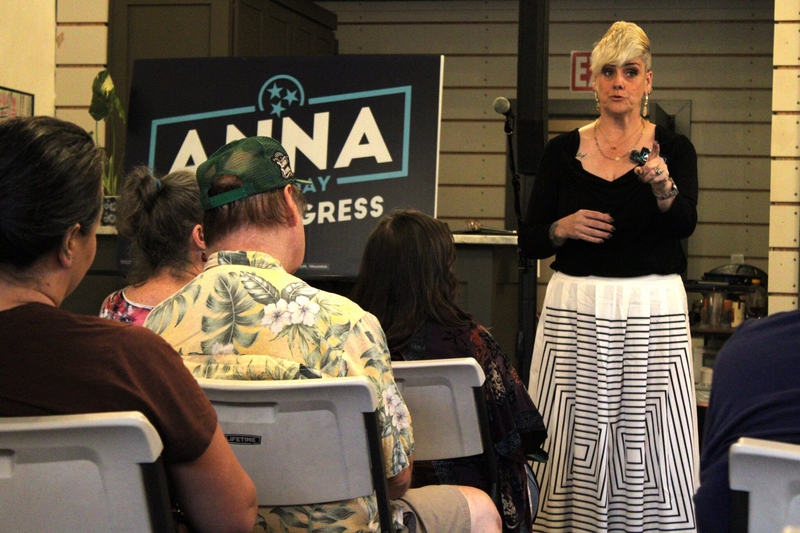
“We’ve got a significant number of people in this district who want more out of Fleischmann,” said Golladay, whose website has a ticking counter since Fleischmann last held a town hall — over 5,500 days dating back to 2011 during his inaugural term. “He is not accessible. He is hiding from his constituents.”
Fleischmann, who told the Chattanooga Times Free Press last year that he would “never” hold a town hall, calling them “left-wing bait,” did not agree to an interview with the Tennessee Lookout, but his office did email some written answers to questions.
“Woke Democrats can accuse me of whatever they want, but the fact of the matter is that East Tennesseans know what I stand for and the results that I deliver,” Fleischmann said in an email. “That is why they continue to elect me to fight for their families in Congress year after year.”
Golladay’s pitch versus Fleischmann’s record
Golladay’s campaign focuses on lowering the cost of living, especially when it comes to high gas prices induced by the war in Iran and President Donald Trump’s tariff policy upending global trade and raising the cost of general goods and services.
Since late February, when the war began, the price at the pump has shot up, sitting at, according to AAA, an average $3.81 a gallon as of this week in Tennessee — well above the sub-$3 before the fighting started.
According to a joint congressional committee, the average U.S. household paid more than $1,700 in tariff costs over Trump’s first year in office.
“This district is in shambles and really does not know how they are going to feed their families and put gas in their car,” Golladay said. “Chuck Fleischmann has voted against the provisions that would assist District Three residents.”
The representative has continually voted against a war powers resolution that would rein in the president’s authority in Iran. Fleischmann voted against blocking Trump’s tariffs on Canadian imports; he told the Chattanooga Times Free Press that he “wanted to give President Trump as much support as possible in his overall negotiations on tariffs.”
The representative voted for the president’s One Big Beautiful Bill Act, which made massive cuts to Medicaid and the Affordable Care Act, spiking health care costs for millions.
The bill also gave U.S. Immigration and Customs Enforcement, ICE, $75 billion, making it now the highest-funded law enforcement agency in the country with a budget at its disposal higher than that of many industrialized nations’ militaries.
The administration’s immigration policy, particularly in Minneapolis earlier this year when federal agents shot and killed two Americans, is what led Golladay to run for Congress.
“I watched Alex Pretti and Renee Good be murdered in the streets of Minneapolis, and it all changed for me,” Golladay said. “We have a representative that is consenting to this kind of terror and is not speaking out against it.”
To remedy an inactive Congress, Golladay is part of the Take BAC Congress initiative, a group of over 150 candidates across 40 states pushing for political reforms such as instituting congressional term limits and overturning Citizens United, among others.
Despite Fleischmann’s loyalty to an unpopular president — one of his only notable breaks from the president was his vote against the administration’s cuts to federally-funded cancer research — the representative sees his record as supporting East Tennesseans.
“As a conservative, I will continue working to curb our government’s massive unproductive spending, cut taxes, uphold the values that we were founded on, and champion America’s energy dominance,” Fleischmann said in an email. “I have had the privilege to live the American dream, and I want every Tennessean to have that same opportunity.”
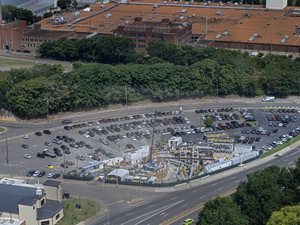
The representative, chair of the Energy and Water Development subcommittee, often touts the amount of federal dollars he brings into his district, such as the $213 million that recently went to the ongoing lock replacement at the Chickamauga Dam on the Tennessee River in Chattanooga.
That earmark Fleischmann secured for the lock project, the largest nationwide, is part of its ballooning costs over the past 20 years, something Golladay said voters should keep in mind as the representative cites it as a positive mark of his record in Congress.
Starting in 2004 to replace the deteriorating lock, which is used to safely manage water levels, the project had an initial estimated cost of $267 million.That amount has risen to over $1.5 billion.
“Quite frankly, if I were the congressman, I’d be embarrassed that it’s taken this long to still make nothing happen,” Golladay said.
Even with any shortfalls voters may see in the GOP, Fleischmann said his party is better than the alternative.
“The radical left has gone too far, and Republicans offer a clear vision for an America that is free, safe, and strong,” Fleischmann said in an email.
The odds of a Democratic victory
Back in May, given clearance to do so by the U.S. Supreme Court’s Louisiana v. Callais decision, the GOP supermajority in the statehouse split the lone Democratic, Black-majority district centered around Memphis three ways — a gerrymander meant to produce a completely Republican congressional delegation in Tennessee.
The redistricting required Republicans to redraw the state’s entire map, including the 3rd District. Portions of Campbell, Scott and Morgan counties near the Kentucky border were cut and replaced with Rhea and Meigs closer to Chattanooga.
With the new map, Golladay said the district, with the campaign based in Chattanooga, is “more accessible for us.”
“That will, I think, shift the tone of this race, and we believe will shift in a way that accelerates our possibility to win and make this race much closer than any Republican is going to tell you,” Golladay said.
While the redrawn district does consolidate more around Chattanooga, the broader picture of the electorate remains almost exactly the same.
We’ve got a significant number of people in this district who want more out of Fleischmann. He is not accessible. He is hiding from his constituents.
In 2024, Trump won the 3rd District — in either the old or new map — with over 65% of the vote. It’s similar for the state’s other districts; Trump would have won every district by at least 20 points.
But in a year where the national environment is favorable for Democrats, the party in each of these races, even if it doesn’t win outright, could pull much closer than expected.
“It would really take a lot of Republicans staying home or changing their minds for that district to do anything but go Republican,” Samuel Wang, part of the Gerrymandering Project team at Princeton University, said of the 3rd District. “However, it’ll be a closer race than I think the congressperson in that district is used to.”
Golladay is concerned that many will chalk up any Democratic success next week, particularly in the South, to a short-term reaction to the Trump administration and not the start of a more long-term shift.
“I think that there will be a tendency to say we won because things are so out of control,” Golladay said. “They also need to be saying we won and we’ve gained momentum and we made some races really close that have not been close in a generation because we recruited candidates and we had people doing this hard work in the South.”
Nashville, TN