Alabama Democrats highlight decades-long effort to repeal grocery tax
Oct 27, 2026 | 6:01 am ET
Description
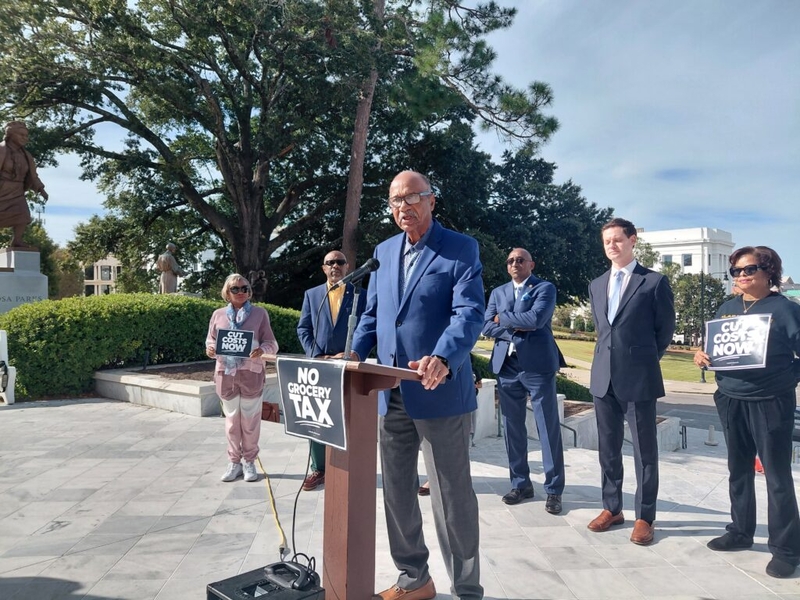
Former House Ways and Means General Fund Committee John Knight, D-Montgomery, speaks to reporters on Monday, Oct. 26, 2026, at the Alabama Capital to urge lawmakers to repeal the state’s grocery tax. Knight, who served in the Alabama House from 1993 to 2018, led efforts over several decades to repeal the state's grocery tax. (Ralph Chapoco/Alabama Reflector)
Democratic candidates for state office Monday highlighted their party’s decades-long efforts to repeal the state sales tax at a press conference where they pushed their affordability message a week before the general election.
The press conference featured former Rep. John Knight, D-Montgomery, a former chair of the House Ways and Means General Fund committee, who for decades sponsored legislation to repeal the tax.
“I think more people are coming together to realize that they are suffering,” Knight said during the news conference. “Even though you may try to hurt a certain segment of the population, when you pass taxes that are not fair and unequal across the board, you are hurting more than just the Democrats in the state of Alabama.”
The conference came as the eight-decade tax has come under fire as the cost of living dominates political campaigns in Alabama and around the country.
“Everywhere I have been, Alabamians are hurting,” said Rep. Phillip Ensler, D-Montgomery, the Democratic nominee for lieutenant governor. “They are struggling to pay their grocery bills, they are struggling to pay for their prescription drugs, they are struggling to pay for health insurance, they are struggling to pay for these high gas prices that have been caused by (President) Donald Trump’s war overseas.”
Alabama until 2023 imposed a 4% state tax on groceries. Combined with local levies, it could amount to a 10% tax on food in some areas. The state was one of only three states to tax groceries fully, and remains one of only eight states to impose the tax.
Efforts to repeal the tax languished because of arguments over whether and how to replace the lost revenue, which could add hundreds of millions of dollars to the Education Trust Fund, which pays for most public education in the state. Knight for years sought to repeal the grocery tax and make up the revenue by repealing a 1965 constitutional amendment allowing residents to deduct federal taxes paid from their state income taxes, an arrangement that tends to favor the wealthy. The proposals did not move.
In the 2023 session, the Republican-controlled Legislature passed legislation to reduce the grocery tax from 4% to 3%.
In 2025, lawmakers passed legislation to cut the state tax to 2%. The Legislature this spring also approved a two-month grocery tax break in May and June, coinciding with primary elections and runoffs.
“Don’t misunderstand me, I am glad families got a break,” said Rep. Penni McClammy, D-Montgomery, who has sponsored legislation to eliminate the grocery tax. “But why didn’t we get a break when the election ended, when families are getting out of school with their kids, when they have summer food and programs to pay, and then the tax increases?”
Democratic gubernatorial nominee Doug Jones has also called for a repeal of the grocery tax. U.S. Sen. Tommy Tuberville, R-Alabama, the Republican nominee for governor, and Republican legislative leaders have said elimination of the state grocery tax would be the first priority of the 2027 legislative session.
The grocery tax was one element of the platform on affordability that Democrats unveiled at the news conference. They also proposed a $15-an-hour minimum wage; expanding Medicaid to improve public health and address the solvency of rural hospitals; and reducing the sales tax on farm equipment.
“There are ways to look at the tax structure and look at where there are exemptions and handouts being given to big corporations and big companies who can afford to do it,” said Ensler. “We are also big proponents of a state lottery and the lottery revenue. We are missing out on hundreds of millions of dollars that would come into the state so we can cut expenses for working people while bringing in revenue without raising their taxes.”
Corey Hill, the Republican nominee for Commissioner of Agriculture and Industries, and Ron Sparks, the Democratic nominee for the office, both support elimination of the 1.5% sales tax on farm equipment.
Montgomery