Democrats ask TV stations to take down James ad amid campaign finance allegations
Oct 26, 2026 | 4:40 pm ET
Description
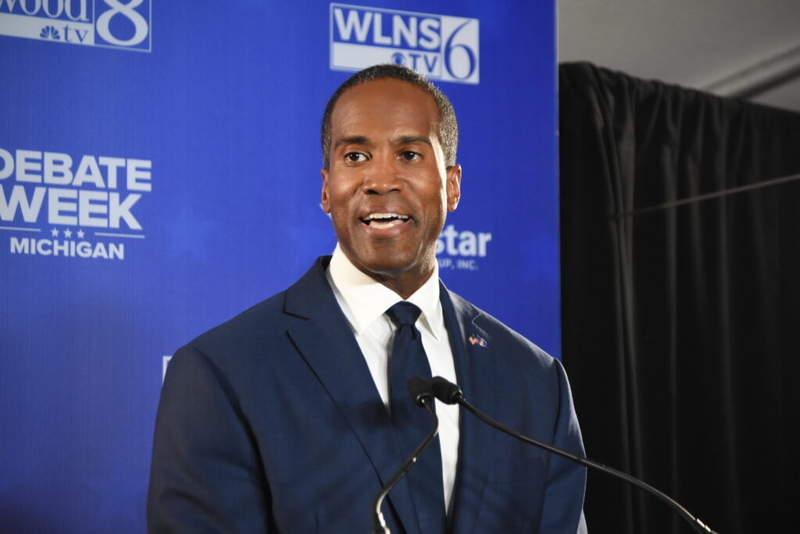
Republican gubernatorial nominee and U.S. Rep. John James talks to reporters following a debate in Grand Rapids on Tuesday, Oct. 6, 2026. (Katherine Dailey/Michigan Advance)
Michigan Democratic Party Chair Curtis Hertel is asking television stations around Michigan to stop airing an ad from John James’ gubernatorial campaign paid for by the Michigan Republican Party — using funds that a campaign finance complaint from Hertel and the Democrats say violate campaign finance laws.
The money in question comes from a $1.8 million in-kind donation from the Michigan Republican Party, which was listed in James’ pre-election campaign finance filing as for “media placement media production.”
The donation far exceeds the contribution limits cited in both the complaint and on the Department of State’s website.
But the James campaign argues that a June 2026 U.S. Supreme Court decision, NRSC v. FEC, allows the spending after the court struck down a federal law that limited the amount of money that national political parties are able to spend in coordination with a candidate for office.
“The United States Supreme Court made clear in the NRSC decision that political parties have the constitutional right to spend unlimited funds in coordination with their candidates,” Alyvia Bailey, a James campaign spokesperson, wrote to the Michigan Advance. “No scare tactic is going to stop our momentum. Support across Michigan for John James is surging at the right time and we look forward to victory come November 3rd.”
Asked in a press conference if he believed the NRSC decision made it so decisions like these would be legal, Hertel said that Michigan law is currently clear and does not permit this.
“Michigan law is clear: anyone who’s running for governor in the state should follow it, and they are obviously not doing that,” he said. “If this was legal, this is what they’re trying to claim is now legal, it would create a completely Wild West situation where any one person could contribute unlimited dollars and get the issue ad rate afterwards. There is no way that that is a reasonable interpretation of what the Supreme Court said, and this should be adjudicated in the courts before we ever get to this point.”
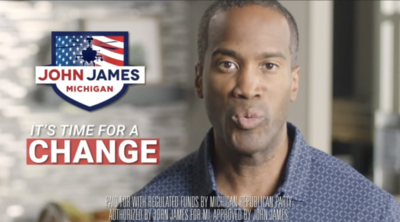
The ad contains three written disclosures — “Paid for with regulated funds by Michigan Republican Party,” “Authorized by John James for MI” and “Approved by John James.”
The campaign finance complaint from the Michigan Democratic Party, filed on Friday with the Michigan Department of State, says that those three statements indicate that the ad was paid for with money governed by the Michigan Campaign Finance Act, and it was run in coordination with and authorization by the James campaign.
The Michigan Democratic State Central Committee and election lawyer Mark Brewer, a former Michigan Democratic Party chair, are asking TV stations across Michigan to stop running the ad, given that it is a part of an active Michigan Campaign Finance Act complaint.
If stations will not remove the ad entirely, the letter sent by Brewer asks that stations stop giving it the “preferential candidate rate treatment,” a lower amount charged for candidate ads, and instead charge them the rate for “non-candidate political advertisements.”
“This course of action ensures that the station’s treatment of the advertisement is consistent with the facts presently known and avoids preferential candidate rate treatment to James where entitlement to that treatment is, at best, uncertain, and more likely illegal,” Brewer writes in the letter, which was sent on Monday morning.
Hertel told reporters Monday afternoon that no station had yet indicated that it would stop airing the ad or change the rate for it.
A decision on the campaign finance complaint is unlikely to come before the Nov. 3 election. But Hertel said the likelihood of a post-election decision is precisely why stations should act on Monday’s letter, instead of waiting for an official decision.
“What I would argue is that that’s why the station should take this seriously,” he said. “They are literally giving preferential treatment under something that is a violation of Michigan campaign finance law, and there is nothing that’s been done in the courts that would suggest that what they’re doing is correct. So each of them are making a decision right now to honor this rate, even though it is patently illegal under Michigan law.”
Lansing, MI