What happens when Kentuckians have the chance to work through their differences?
Oct 26, 2026 | 5:30 am ET
Description
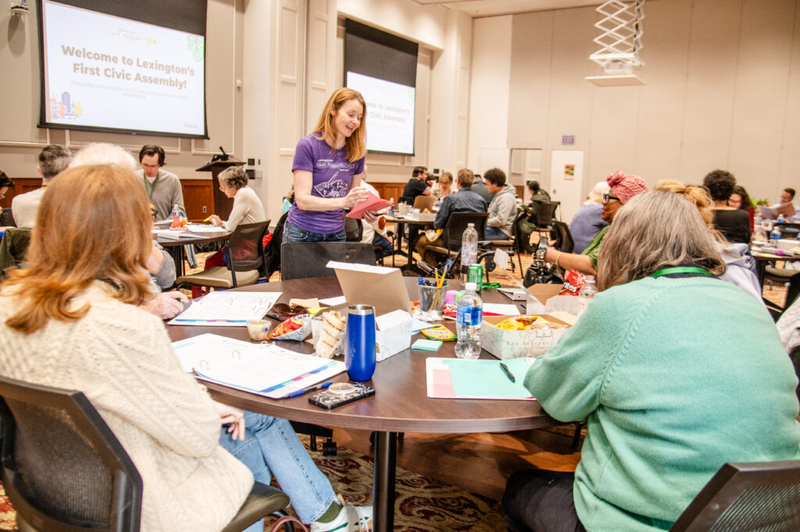
Last March, CivicLex organized the first Civic Assembly in Lexington to review Lexington's merged government charter. (Photo courtesy Brandon Turner, Unsung Hero Media)
Earlier this year, 30 Lexington residents, selected at random, spent more than 30 hours together talking about something that most of us don’t think about at all: the rules that underpin our local government.
These residents were Republicans, Democrats, and independents. They were younger and older, from different socioeconomic backgrounds. Some followed local issues closely. Others came knowing absolutely nothing about local government. And yet, after seven sessions of learning, discussion, and plenty of debate, they reached 85% agreement on three recommendations to change Lexington’s city charter.
At a time when much of our national conversation focuses on how divided we are, Lexington’s First Civic Assembly shows that real people can still come together and solve real problems.
This process was organized by CivicLex, the nonpartisan nonprofit that I run. A few years ago, members of Lexington’s Urban County Council approached us about reviewing Lexington’s charter, the document that lays out the basic rules for our merged city-county government. The last comprehensive review of the charter took place in 1998, and the only recommendation to reach the ballot then – a measure to expand council terms to four years – was soundly defeated.
We knew charter reform would be difficult. Most residents don’t have the time or inclination to study such a complicated document. But, we believed decisions about the basic rules of government shouldn’t be left entirely to elected officials or appointed “experts.”
In looking around at potential examples for tackling an issue like this, we learned about citizens’ assemblies, which bring together residents selected by a representative lottery to learn about an issue, deliberate, and develop recommendations.
We thought this could be the perfect solution. So, we spent three years organizing one in Lexington.
We mailed 10,000 invitations to randomly selected Fayette County addresses. From those who applied, we used a software to select a randomized group of residents that closely reflected our community across political registration, age, race, income, education, and more to be our Assembly. Throughout March, participants learned about local government, heard from experts, debated different solutions, and developed their own recommendations. You can watch recordings of these sessions online.
This is quite different from the way we typically ask people to participate in government. Most public meetings give residents a few minutes at a microphone to share opinions, often about decisions already largely developed.
The Assembly was a big ask. Residents spent evenings and weekends learning about the complicated ins and outs of local government. They built new friendships with people they’d just met and who came from vastly different life experiences. They found points of disagreement and compromised, merging together the proposals they generated into ones that could pass the voting threshold they themselves set: no recommendation would be adopted without 80% support.
One question they had to answer was whether Lexington should change Urban County councilmember salaries. On one hand, low compensation can make public service difficult for people who can’t afford it. On the other, asking residents to support higher pay for politicians is…a difficult proposition.
After weeks of deliberation, the Assembly arrived at a recommendation that 85% supported: raising Council salaries from roughly $42,000 to $59,987, the average annual wage in Lexington, beginning in 2031. The Assembly also recommended public attendance and accountability standards for councilmembers, which received 89% support.
The third recommendation? That Lexington adopt the very process they were going through as a way to review the charter on a fixed schedule, every eight years. This recommendation also received 89% support.
These weren’t unanimous decisions. Some of the participants disagreed — but everyone agreed that the process itself was a success. An independent evaluation by an organization called FIDE found that participants’ knowledge of the issues nearly doubled. Seventy-four percent of participants said their views on council compensation changed during the Assembly, while 65% said the same about charter review. Perhaps more interestingly, the percentage of participants who believed ordinary residents could develop strong policy recommendations rose from 60% to 83%. And 96% said they gained a sense of community through the process.
In so much of our political discourse, it feels like people just show up with their preexisting opinions and defend them. In our Assembly, participants were listening and reconsidering what they thought. People actually changed their mind — in opposite directions — when receiving new evidence. They debated respectfully and found common ground, all while building bonds with those they disagreed with.
The process wasn’t perfect. Some participants wanted more time, and 30 Lexington residents certainly haven’t solved political division in Kentucky, much less America.
But I wonder how much of our difficulty working across differences has to do with the way we ask people to participate in public life. What happens when we give people time to really wrestle with local civic issues, equip them with good information, let them build relationships, and give them the real responsibility to develop something together?
In this case, their three recommendations are now on the November 3 ballot, where Fayette County voters will have the final say.
We won’t always agree about what our communities should do. Nor should we expect to! But maybe we can do a better job of creating opportunities for Kentuckians to take on difficult questions together.
Frankfort