Ohio Crime Statistics dashboard shows 9 convictions for illegal voting in 35 million ballots cast
Oct 26, 2026 | 4:00 am ET

Description
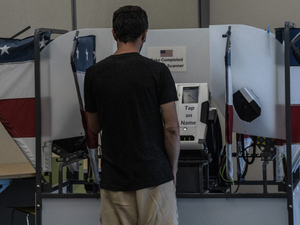
Early voting in Ohio at the Franklin County Board of Elections. (Photo by Megan Henry/Ohio Capital Journal)
The latest evidence challenging Ohio Secretary of State Frank LaRose’s repeated demands for more voter fraud prosecutions comes from an unlikely source: fellow Republican Dave Yost, the state’s former attorney general.
The information is found in a new online database — Ohio Crime Statistics Dashboard — that shows for the first time how many of the more than 1,200 cases LaRose referred for investigation since taking office in 2019 have resulted in felony convictions.
The dashboard’s answer: no more than 16 — nine for illegally voting and seven for illegally registering to vote.
If LaRose were a baseball player and convictions were hits as a fraction of his referrals, his batting average would be a minuscule .013.
Baseball doesn’t have enough decimal places to illustrate the vanishingly small share — 0.00003 percent — of the nine convictions for illegal voting among the more than 35 million ballots cast in Ohio in the decade covered by Yost’s dashboard, which was opened to the public in June.
The attorney general’s news release unveiling the dashboard cautions that its data may not be complete because it “relies on self-reported data from hundreds of agencies.” That said, the dashboard is the only tool available to the public that allows statewide counts of convictions for specific crimes.
LaRose, who is barred by term limits from seeking a third term and is running for state auditor in November, acknowledged “voter fraud is rare in Ohio” in a 2021 news release announcing he had referred 117 noncitizens for investigation of suspected election fraud violations.
“One of the reasons it’s rare is because we have good laws on the books,” he stated. “These are small numbers, but there is no such thing as an acceptable level of voter fraud.”
Neither LaRose nor his news media staff responded to repeated requests for comment or to detailed written questions.
LaRose isn’t the only Republican in Ohio or the nation to push hard for investigations of voter fraud.
President Donald Trump has claimed repeatedly that the 2020 election was “stolen” through widespread fraud and that “millions of people who voted illegally” cost him the popular vote in 2016.
A decade earlier, President George W. Bush’s administration fired nine U.S. attorneys, at least two of whom had declined to bring voter fraud cases for lack of evidence. A Justice Department inspector general later found “substantial evidence” that some firings were partisan.
Critics argue that Republicans fan fears of widespread voter fraud to justify tighter regulations governing elections — such as photo ID, documentary proof of citizenship and limits on mail-in ballots — that make voting harder for lower-income voters, who historically have tended to vote Democratic.
Over the last two decades Ohio has generally raised the bar to vote.
- In 2006, the same year Ohio allowed no-excuse absentee voting by mail or in person for the first time, voters were required to show identification, although utility bills and other documents were accepted.
- In 2014, three years after a referendum drive forced repeal of a law that sharply cut early voting, the legislature reduced early voting from 35 to 28 days and eliminated “Golden Week,” when people could register and vote at the same time.
- In 2023, a law took effect that required most in-person voters to show photo ID, shortened the “grace period” for accepting absentee ballots postmarked before Election Day but received afterward from 10 days to four, ended early voting on the day before Election Day and moved up the deadline to request an absentee ballot.
- This year a new law eliminates the “grace period” entirely.
While some political experts question whether Republicans benefit from lower voter turnout, some conservative strategists have long argued that they do.
“I don’t want everybody to vote,” Paul Weyrich, a founder of the Heritage Foundation, told conservative religious leaders in 1980. “Our leverage in the elections quite candidly goes up as the voting populace goes down.”
LaRose backed his zero-tolerance rhetoric with a steady stream of suspected voter fraud referrals — especially involving noncitizens — to county and state law enforcement officials, but while the number of referrals climbed, few resulted in charges.
A 2023 Ohio Capital Journal investigation found that of 641 referrals, only 18 — less than 3% — resulted in charges. Of those, 13 resulted in convictions, including several that were pleaded down to misdemeanors.
Ohio Sec. of State LaRose has flagged 641 cases of voter fraud. Less than 3% resulted in charges
Those numbers overstate the results of LaRose’s referrals, according to the Capital Journal, which contacted the 60 counties where referrals were sent and received 55 responses. A handful of the cases “likely didn’t come from LaRose’s efforts,” including several that “stem from violations between 2014 and 2016, well before LaRose took office.”
Only one of those convictions involved a noncitizen voting: a Geauga County man, adopted from the Caribbean as a child, who admitted he knew he couldn’t legally vote but cast ballots from 2014 to 2016.
The county prosecutor said the man — then 60 years old — pleaded guilty to a misdemeanor after “federal officials had suggested they’d deport” him if he was convicted of a felony. The prosecutor said another mitigating factor was that he had checked the “noncitizen” box when registering to vote. The man was sentenced to 10 days in jail.
The Capital Journal noted it was “exceptionally difficult” to follow up on the referrals because LaRose’s office doesn’t track outcomes of cases passed on to the state Bureau of Criminal Investigation or directly to county prosecutors.
Several prosecutors surveyed for the report complained that many of LaRose’s 641 referrals were examples of “mistakes or confusion — incidents like an elderly voter casting a ballot in the wrong precinct.”
One explanation for so few convictions is that many county prosecutors — Republicans and Democrats — don’t pursue cases where people make honest mistakes and do not intend to commit a crime, according to a 2014 survey by the Northeast Ohio Media Group, which was renamed Advance Ohio in 2017 and operates Cleveland.com.
“Prosecutors in counties large and small told the media outlet their investigations typically concluded that the irregularities resulted from confusion by voters or mistakes by election officials rather than from people trying to game the system,” the report stated.
Jon Husted, Ohio’s secretary of state from 2011 to 2019 and now a U.S. senator, had directed all 88 county boards to investigate fraud claims from the 2012 presidential election. The media outlet examined eight counties that had investigated at least 10 reports each; fewer than two dozen charges resulted, and Medina was one of five with none.
Dean Holman, a Democrat and the county’s prosecutor at the time of the survey, cited the case of an elderly woman who returned an absentee ballot, requested a second ballot and tried to vote on Election Day. Investigators concluded that the woman, who was dealing with the death of her husband, did not intend to commit a crime.
“Some of these people were just confused,” he said. “Those people should not be prosecuted. The criminal justice system is designed for criminal conduct.”
In an interview this week, Holman said the vast majority of illegal voting referrals he received during his 28 years as Medina County’s prosecutor “did not result in prosecutions.”
“I can’t recall every case, but I think 90 percent of the cases that were given to me to review were without merit,” he said. “And a prosecutor is ethically bound not to prosecute a case he thinks will not be won at trial.”
The 2014 report told a similar story from Ron O’Brien, a Republican who served 24 years as Franklin County’s prosecutor before losing a reelection bid in 2020.
O’Brien said “16 cases likely will be prosecuted after some further investigation.” But he added that more than 30 cases were dismissed, including “a number of elderly voters who had apparent memory issues, and while they had voted twice or attempted to vote twice, a criminal prosecution was not deemed proper.”
Most of the cases were referrals from county boards of elections, which traditionally were allowed to police their own elections. That began to change in 2016 when legislation sponsored by LaRose when he was a state senator went into effect requiring the secretary of state to check the statewide voter rolls each year for noncitizens.
In August 2024, LaRose re-referred nearly 600 cases of suspected noncitizen registration or voting, which county prosecutors had not pursued, directly to the Ohio attorney general.
“Unfortunately, many of these referrals have not been pursued by law enforcement, sometimes by choice and other times due to limited prosecutorial capacity,” LaRose stated in a news release.
“State law gives the attorney general the authority to take up these referrals if the prosecuting attorney doesn’t prosecute the violations within a reasonable time.”
LaRose complained that only a dozen of the hundreds of referrals he had made to county prosecutors over the years resulted in charges.
LaRose’s action triggered immediate pushback from Lou Tobin, executive director of the Ohio Prosecuting Attorneys Association.
“We take exception to the idea that prosecutors are not doing their job,” Tobin told the public broadcasting network’s Statehouse News Bureau. “I think the secretary of state just doesn’t like the outcome of our review and so now he is forum shopping by taking these cases to the attorney general.
“These are referrals that often lack minimal evidence necessary to pursue charges or pursue an indictment, let alone obtain a conviction.”
LaRose responded that his job wasn’t to build cases.
“What the law says is that we should report violations,” LaRose told the Statehouse News Bureau. “It doesn’t say that we’re the police department that gathers the evidence.”
In sending the cases to Ohio Attorney General Dave Yost, LaRose said, “I have full confidence that our excellent attorney general takes this seriously and is going to dig into this.”
Yost moved quickly on the referrals, obtaining indictments by mid-October — just a few weeks before the 2024 presidential election — against six noncitizens accused of illegally voting.
But at an Oct. 22 news conference announcing the indictments, Yost voiced frustration with LaRose for referring so many cases in which the only alleged offense involved registering to vote.
Of the nearly 600 referrals, 138 involved actual voting, according to LaRose’s Aug. 21, 2024, news release.
“I need to have a sit down with the secretary of state about the value of those cases where there was no voting — I think that we ought to be focusing on the voting,” Yost said at the news conference. “I don’t really want to pull people off of officer-involved critical incident investigations, child rapists, murderers to be chasing voter registration cases for past elections.”
Illegal voting is a fourth-degree felony in Ohio punishable by up to 18 months in prison. Registering to vote illegally is a fifth-degree felony carrying a maximum sentence of 12 months in prison.
So how have the prosecutions of six noncitizens fared? Nearly two years after the six indictments were filed, there has been a single conviction — and that one is being appealed.
- The indictment against Ramesh Patel, 68, of North Royalton, was dropped on Oct. 28, 2024 — 11 days after it was issued — when Cuyahoga County Prosecutor Michael O’Malley pointed out that Patel had died in 2022.
- The case against Ahmed Aden, 35 at the time he was indicted, of Columbus, was dismissed on July 17, 2026. Aden, a legal permanent resident but not a citizen, had been accused of voting in 2008 and 2020. In dismissing the case, Franklin County Common Pleas Judge Sheryl Munson ruled that the two-year gap between the closing of the investigation in 2022 and the indictment crippled Aden’s defense. By then he had moved and lost access to the witnesses and documents. The attorney general has appealed the dismissal to the 10th District Court of Appeals.
- Maria Dearaujo, then 62, of Columbus, was acquitted May 19, 2026. Franklin County Common Pleas Judge Chris Brown ruled from the bench that she had proven an entrapment defense. The 2005 voter registration form she received at the Bureau of Motor Vehicles had “YES” circled on the citizenship question, according to an Associated Press story. She testified she didn’t circle it. She also testified that in 2015 a BMV clerk told her she could vote. Under Ohio law, the state cannot appeal an acquittal, and double jeopardy bars a retrial.
- A 78-year-old Hudson woman who came to the U.S. from Canada as a 12-year-old was indicted on two counts of illegal voting and entered a guilty plea after being booked, fingerprinted and photographed at the Summit County Jail, according to a Signal Cleveland story. But Summit County Common Pleas Judge Kelly McLaughlin ruled in April 2025 that she could enter an intervention in lieu of conviction program, which allows the charges to eventually be dismissed. The case no longer appears in court records, apparently because it was sealed.
- The case against Van Thuy Cooper, 53, of Hilliard in Franklin County, is ongoing. According to news reports, she was brought to the United States in the 1970s from Vietnam by her parents. She said in court filings she believed she became naturalized when her mother did. She registered to vote in 2016. In 2020 she received notice from the secretary of state telling her she was not legally permitted to register or vote and directing her to cancel her voter registration, which she did. Local and state officials had investigated her case in 2022 but declined to bring charges.
- The only conviction so far came against Nicholas Fontaine, 32, of Kent, who came from Canada as a toddler.
Fontaine told the Associated Press in 2024 that he registered to vote while in college after registering for the draft, which permanent residents are required to do. He mistakenly assumed he could vote until a Department of Homeland Security official came to his home in 2018 or 2019 — during Trump’s first term — and told him his votes in 2016 and 2018 were illegal. He was warned not to vote again and never did.
He assumed that settled the issue and said he was shocked to be indicted so many years later. He pleaded no contest in May and was placed on probation for 12 months and fined $500 and court costs.
He has appealed his conviction to the 11th District Court of Appeals, arguing that the trial judge erred in not dismissing the case because the state failed to bring charges within the six-year statute of limitations. His no-contest plea, unlike a guilty plea, preserved his right to appeal the judge’s refusal to dismiss the case.
Yost declined to be interviewed for this story, according to a spokesperson for Alliance Defending Freedom, a Christian legal advocacy nonprofit based in Arizona. Yost became the Alliance’s senior counsel and vice president of policy innovation after leaving office on June 7 this year — two days after unveiling the Ohio Crime Statistics Dashboard.
The lack of convictions hasn’t deterred LaRose from continuing to push for more prosecutions. Last October he referred 1,084 cases involving noncitizens to the U.S. Department of Justice.
In appealing to Washington, LaRose acknowledged that many of the cases had been earlier referred to county and state officials who declined to prosecute.
“I have made numerous criminal referrals throughout my administration, with much of the evidence related to unlawful registration and voting activity,” he wrote to the Department’s Criminal Division.
“These cases have encountered varying degrees of adjudication from Ohio’s 88 county prosecutors,” he added. “We now have an executive administration at the White House and the Department of Justice that has expressed an interest in actively reviewing and potentially prosecuting evidence of federal election crimes.”
But in the year since referring the cases to the DOJ, charges have been filed against only three Ohioans, all legal permanent residents:
- Cary Ann Patterson, 59, a British citizen, was charged in a criminal complaint with illegally voting in the November 2024 federal election. Records from the Gallia County Board of Elections indicate she falsely registered as a U.S. citizen in 2005 and voted in at least 10 elections, according to a news release from the U.S. Attorney of the Southern District of Ohio.
- Arshed Zuberi, 69, a Pakistani citizen, was charged after allegedly registering to vote in 2015 and 2016 by signing a declaration claiming U.S. citizenship. Records from the Cuyahoga County Board of Elections show he voted in at least six elections, according to a news release from the U.S. Attorney of the Northern District of Ohio.
- Eliza M. Moss, 63, a citizen of the Philippines, was charged with illegally registering to vote in 2004 and 2023 and voting in several primary and general elections. Ashtabula County records show Moss stated that the person who helped her register told her she could vote despite not being a citizen, according to the Northern District news release.
The Ohio charges, announced Oct. 6, are part of a high-profile flurry of arrests in the weeks leading up to next month’s midterm elections.
“In the last five weeks alone, the department has charged 64 aliens, legal and illegal, across 17 states with unlawful voting and registration offenses,” Kiersten Pels, a Justice Department spokesperson in Washington, D.C., stated in an Oct. 7 email. “Since the beginning of the Trump Administration, DOJ has charged 104 people with voting fraud-related offenses.”
Pels said she didn’t know if any of the three Ohioans charged were among the 1,084 cases LaRose sent to the Department of Justice last year.
In a news release issued hours after the arrests were announced, LaRose stated: “I’m grateful to see justice finally being pursued in these cases, thanks to the unprecedented collaboration between my office and the federal government.”
LaRose’s office did not respond to written questions asking whether the three were among his 2025 referrals and, if not, what other “collaboration” his statement referred to, such as the voter registration data his office provided to the Justice Department in February.
David Knox is an independent journalist, former reporter at the Akron Beacon Journal and former managing editor of The (Medina County) Gazette. He can be reached at [email protected].
Doug Oplinger, a Pulitzer Prize-winning journalist and former reporter and editor at the Akron Beacon Journal, contributed to this report. He can be reached at [email protected].
Columbus, OH