Candidates running as independents don’t always seem, well, independent
Oct 25, 2026 | 7:00 am ET
Description
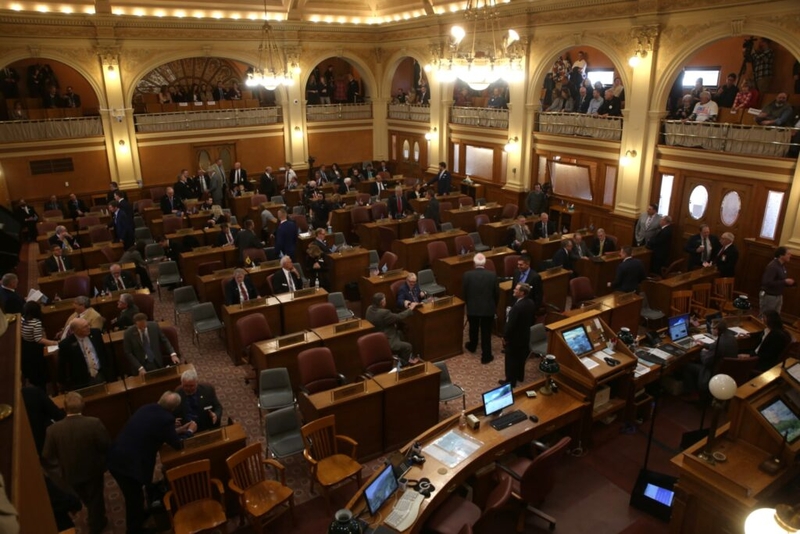
Legislators mingle in the South Dakota House of Representatives ahead of the governor's budget address on Dec. 6, 2022, at the Capitol in Pierre. (Photo by Makenzie Huber/South Dakota Searchlight)
As if South Dakota’s two-party system wasn’t weak enough, now there are a slew of independent candidates up and down the ballot. While the number of independents running for the Legislature is unusual, it’s hard to tell just how independent those candidates will be.
South Dakota’s two-party system is weak because candidates from the Democratic Party, more often than not, fail to show up. That’s the case again this year in the Legislature with the Democrats handing majorities to the Republicans in the House and Senate before a single vote is counted.
Democrats’ absence is felt elsewhere on the ballot as Republican Lance Russell faces no opposition for state attorney general. Republican U.S. Sen. Mike Rounds is facing only an independent candidate, Brian Bengs. The candidacy of Bengs has received some national attention as South Dakota is one of four states fielding credible independent candidates for the U.S. Senate.
Unusually high number of independent candidates seek South Dakota legislative seats
On a national level, some pollsters are predicting a blue wave that will give Democrats the majorities in both chambers of Congress. With the president’s approval rating at a new low, that blue wave may lift a few independent candidates as well.
It’s hard to see how that wave gains much momentum further down the ballot in deep red South Dakota. Yet, the Legislature has an unusually large number of independent candidates this year — eight in House races and three in Senate races. In the District 27 House race, an independent is sure to win election as four independents and one Republican are running for two seats. That will be the first independent to win a South Dakota legislative seat since 2010.
The cachet of running as an independent doesn’t stop at the Legislature. In Brookings County, where I live, independent candidates for county finance officer and sheriff are running against Republican candidates. There are five candidates for three openings on the county commission: three are Republicans and the other two are independents.
Voters usually have at least a vague idea of what it means when a candidate is registered as a Republican or a Democrat. A candidate who’s on the ballot as an independent is tougher to figure out. A South Dakota Searchlight story tried to get a sense of the independent candidates seeking election to the Legislature. For some of those candidates, their intentions remain vague.
Neal Tapio of Watertown, who faces two Republican challengers for two House seats, and Joe Flood, who is one of the four independents in District 27, told Searchlight that they always planned to run as independents in this election. Flood said, “I don’t think either party has covered itself in glory.”
Two candidates, District 27 Senate candidate Peri Pourier, and District 27 House candidate Evangeline Poor Bear, missed the filing deadline to run as Republicans and consequently used the later filing deadline for independent candidates to get on the ballot.
Pourier, in particular, is a political chameleon. She was first elected as a Democrat and then switched to the Republican Party. Now she’s running as a calendar-impaired independent.
For District 23 independent state Senate candidate Brian Breitling, filing as an independent was a way to avoid a primary with a popular Republican incumbent. As luck would have it, the incumbent, Tom Pischke, withdrew from the race when faced with two felony counts of filing a forged or false instrument for allegedly signing and submitting candidate nominating petitions for county party precinct positions without the candidates’ knowledge.
Now Breitling faces a replacement Republican candidate in the race, but it’s really a distinction without a difference. “I’m a Republican running as an independent,” Breitling told South Dakota Searchlight. “That’s what I tell people when I’m knocking on doors.”
No wonder it’s so tough to figure out what it means when a candidate is running as an independent. The R, D or I after a candidate’s name should be a signal to voters about what the candidate believes. At the very least, when someone is running as an independent it should mean that the candidate has a clear disdain for the two-party system. Running as an independent shouldn’t be an expedited way to get on the ballot to avoid a party primary fight or a loophole used when the filing deadline comes as a surprise.

Pierre, SD