Like it or not, Kentucky now has a school voucher program
Oct 23, 2026 | 5:30 am ET
Description
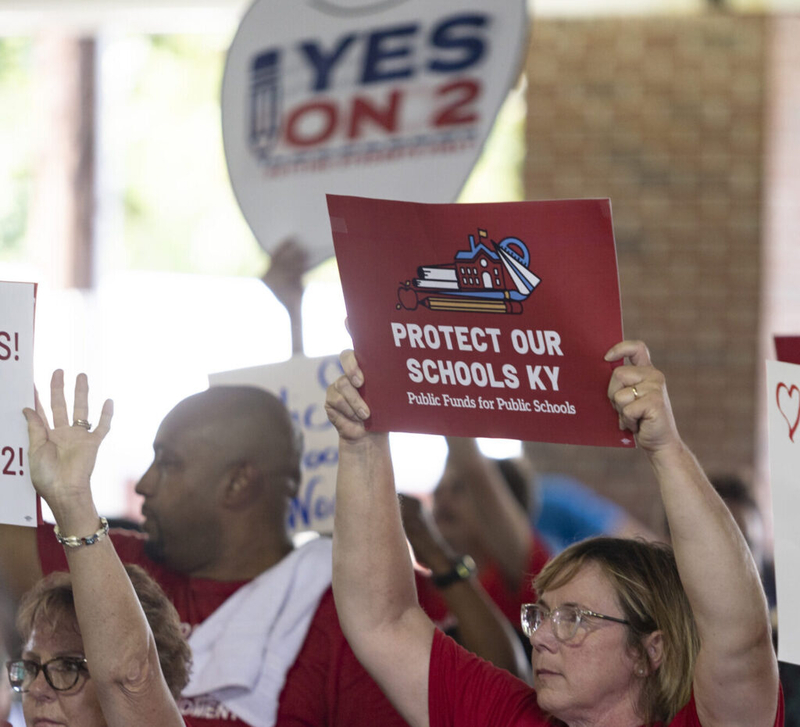
Supporters and opponents of Amendment 2 made their opinions known at the Fancy Farm Picnic, Aug. 3, 2024. (Kentucky Lantern photo by Austin Anthony)
Many of us still recall the fight to defeat KY Amendment 2, which would have allowed public funds to go to private schools. Kentuckians overwhelmingly rejected this amendment by a margin of 65% to 35%. This should have sent a clear message to our representatives.
Yet in February of 2026, the Kentucky legislature passed House Bill 1, which allows the state of Kentucky to participate in a federal school voucher program that was tucked inside the One Big Beautiful Bill. This program provides an “Education Freedom Tax Credit” up to $1,700 per year to people who donate to designated Scholarship Granting Organizations, or SGOs.
A cursory look at the federal voucher system might show that it’s a “win-win” for Kentucky. No state revenues will be used to fund the program. Public schools will also benefit. What’s not to like? Let’s take a look at the evidence.
One of the touted benefits of the federal voucher program is that public schools can apply for funds to pay for various initiatives that will support their students. The Kentucky Education Foundation has been specifically established as an SGO to administer the dispersion of federal funds in Kentucky. The organization has a regional governing structure and has pledged that all 120 counties will be provided the opportunity to benefit from the program. All of this looks promising. But there’s more.
While the information provided by the federal government states that funds can also be used for educational opportunities at public schools, it’s evident that the EFTC is largely aimed at providing school choice. A federal fact sheet states that “[t]he Education Freedom Tax Credit supports national education choice…. In participating states, more families will have access to schools that align with their values and aspirations for their own children.”
According to the federal register, one of the requirements of an SGO is that it “Spend not less than 90 percent of its income on scholarships for eligible students.”
Presumably, the remaining 10% could go to the SGO. Importantly, federal regulations do not include crucial information clarifying exactly how public school students can benefit from the program. So currently, benefits to public schools remain unclear.
Further, all families having household incomes up to 300% of the area’s median gross income are eligible for vouchers. Thus, as has been the case historically, most scholarships will go to families who already have sufficient funds to enroll in private schools. It’s worth noting that often scholarships provide only partial payment for private school enrollment, thereby eliminating students whose families cannot afford the additional tuition.
Finally, schools in Kentucky are funded based upon how many students are enrolled. When students leave public schools to attend private institutions, those schools lose money. This can cause overcrowding in public school classrooms and less money for ongoing budget items, like utilities and maintenance.
Perhaps most problematic is that states cannot enforce additional requirements for SGOs that go beyond the minimal requirements defined in the federal legislation. That is, the authority over which students receive vouchers remains solely in the hands of the SGO, leaving them free to discriminate based on a student’s race, religion, disability, sexual orientation etc. There are currently 531 operating SGOs across the nation; those that focus on nonsectarian, public school, or disabled students make up less than 2 percent.
States are also limited in their ability to oversee the quality of services provided by SGOs and to hold them accountable. Thus, if the SGO is disproportionately providing vouchers only to certain student groups or are allowing them to be spent at low-performing or fraudulent schools, the state has no authority to close the SGO
It’s estimated the program will cost taxpayers between $26B and $51B annually. And while Congress voted to fund a national voucher program, the House Appropriations Committee has recommended a 10% cut to Title I, which provides funding to lower-income schools. Every county in Kentucky receives Title 1 funds, and some of the poorest counties in Kentucky would have the most to lose. For instance, Harlan County receives $3.1M in Title 1 funds; Bell, $2.6M; McCreary, $2.5M. So while money is being allocated for a federal voucher program, cuts are being proposed to another critical program that actually helps poorer school districts.
Is the program really a “win-win” for Kentucky’s schools? As has been found with all voucher systems, it seems that the main winners will be those who already attend private schools, and the organizations that fund them.
Frankfort