Will Maine’s next governor reshape local control in education to improve test scores?
Oct 23, 2026 | 5:00 am ET

Description
Maine’s test scores remain flat in state assessments and in 2024 were the worst in three decades, according to National Assessment of Educational Progress data. (Dana DiFilippo | New Jersey Monitor)
All three candidates for governor are concerned about Maine students’ declining test scores. But not all of them are willing to change the key policy experts say is holding the state back from widespread academic reform.
Like many other states, Maine has laws enshrining local control, under which a municipality or school district is empowered to make its own rules. But unlike 43 other states, many of which consider themselves “strong local control” states, Maine has not passed any state laws mandating evidence-based learning — curricula and teaching tools backed by rigorous scientific research and data. That’s according to a study by the nonprofit Educate Maine released this year.
The Maine Department of Education last year came up with a more hands-on approach to bolster academic outcomes. But due to the lack of centralized authority, it can’t mandate that districts use these plans developed by expert advisory councils. It also can’t mandate professional development for teachers to be trained in the science of reading, or require districts to adopt the math plan that aims to incorporate the subject more ubiquitously and remove some of the common student fears associated with it.
Instead, districts are left to choose their own curriculum. Four national and Maine education experts told Maine Morning Star that while local control is important because it allows districts the choice to select materials that reflect their students, it can also create disparities when small or rural districts are not held accountable for not choosing learning materials backed by research.
“The more we keep saying ‘local control,’ the more we’re expecting small municipalities to pass muster when they don’t have the resources,” said Amy Johnson, a University of Southern Maine professor and co-director of the Maine Education Policy Research Institute.
“If the state were to screen and say, ‘Here are some curricula that we think are moving in the right direction,’ and then provide resources for those, that certainly should help improve outcomes in the districts that right now either don’t have a curriculum at all … or they’re using a curricula that has not been shown to produce good results,” she added.
The more we keep saying ‘local control,’ the more we're expecting small municipalities to pass muster when they don’t have the resources.
Dan Goldhaber, professor and director of the University of Washington’s Center for Education Data and Research, told Maine Morning Star there are no studies directly tying local control to poor educational outcomes, but there’s some indirect evidence.
Pointing to changes in the National Assessment of Educational Progress or NAEP (pronounced nape) that tracks students over time across states, Goldhaber said experts have “come to believe that it is states where there have been some state-level mandates, for instance, adopting the science of reading, that have led to changes in student achievement.”
A vast majority of those states — led by Mississippi, which experts often cite as the best example of improved statewide outcomes — have passed laws requiring professional development for educators as well as teacher preparation programs that train future educators in evidence-based practices, as well as certain interventions for students not showing progress.
Meanwhile, Maine’s test scores remain flat in state assessments and in 2024 were the worst in three decades, according to NAEP data.
The lack of a Maine law requiring science of reading instruction may be due to an adherence to local control that goes beyond state statute that puts “control and management of the public schools” in local districts’ hands.
“Some of the things that I’ve seen that were unable to get passed through the Legislature, it was more about everybody saying, ‘Well, we don’t do that because we’re a local control state,’” Johnson said. “It wasn’t that there was anything preventing them from doing it, it’s more about the shared norm among the policymakers that are sort of their guardrails.”
For example, in the Sept. 2026 study, Educate Maine found that 46 different reading programs are being used across responding districts (which represent 70% of all Maine schools). The data showed that 18% of responding districts use only science-based reading programs, while 67% use a combination of science-based and other programs. The remaining 15% use only programs that don’t align with the science of reading.
What districts chose to teach did not necessarily correlate with them being rural or small, according to Kim Russell from Educate Maine.
“The problem is lack of leadership,” she said. “When you have legislative leaders and a governor that’s fully behind it, then change will happen.”
Asked last year about the commitment to local control, Chloe Teboe, a former spokesperson for the Maine Department of Education, said that in addition to being a requirement of the Maine Constitution, local control “reflects a trust that Maine communities know how to make the best decisions for their students.”
Maine’s gubernatorial candidates agree on education challenges, but not solutions
“Local control allows communities to elect school boards that support and guide schools to tailor curricula and programs to their local students’ unique needs, while still benefiting from state standards, state-created resources, and statewide accountability systems,” Teboe said.
The Maine Department of Education did not respond to requests for updated comment.
What the next governor could do
The next governor has the potential to change how much the state helps districts, which are still recovering academically from the impact of the Covid-19 pandemic. Democrat Hannah Pingree, independent Rick Bennett and Republican Bobby Charles have all said this is one of their top priorities.
Earlier this year, Maine Morning Star asked each candidate their position on local control as it relates to schools.While none of them said they would make substantial changes to weaken local control, they all agreed that the state should play a more prominent role in guiding academic recovery. How exactly they plan to achieve that is still unclear, with Bennett being the only candidate to have released a plan with specific goals for academic achievement.
Pingree said as a former school board member she’s seen firsthand “how important it is for communities to shape schools that reflect their students’ needs.”
“Local control shouldn’t mean every district is on its own to solve big, shared challenges like literacy gaps, teacher shortages, or aging buildings,” she added. “My approach isn’t to mandate reform from Augusta. It’s to collaborate: bringing educators, school boards, and communities to the table, sharing what’s working across the state, finding more opportunities to support schools better working together, and ensuring that our schools have the funding and tools to take action.”
Goldhaber said Pingree’s response is the “most consistent” with the argument made by him and other education researchers “that local control shouldn’t mean that every district’s on their own to solve big shared challenges.”
Pingree, who previously worked under Gov. Janet Mills as director of the Office of Policy, Innovation and the Future, said during the final gubernatorial debate last week that she disagreed with the administration’s approach to educational recovery, which ultimately deferred to individual districts’ authority. “I think we need to go much bigger to ensure that every kid is learning to read and do math at grade level, especially by the third grade,” she said.
“There are schools in Maine who are implementing these programs, but we need to ensure that every school district is making it happen,” she added.
Bennett said he respects Maine’s tradition of local control, “but it works best when the state sets clear expectations, provides strong support, and is transparent about results.”
“The state still has a responsibility to lead and ensure students are being served well,” he added.
During the final gubernatorial debate, Bennett cited the lack of Maine districts using science-based reading curriculum, and said, “that is holding our kids back.”
“As governor, I’ll insist that we teach kids scientifically and get them reading before fourth grade.”
Charles said he believes local control should mean that parents have more influence on what their children learn in school.
“I believe in the concept of local control, but unlike some, I believe that this extends to the most local entity — the parents,” he said. “Control over our education policies should extend beyond the superintendents and school boards to the people who know what is best for students — their family members.”
Goldhaber said Charles is “taking the idea of local control to the extreme” and said his response seemed to indicate support for private school vouchers, which the Trump administration is offering as an alternative to public school.
During the final debate, Charles said he is supportive of “parallel tracks like private and homeschooling.”
The federal context
Local control does not mean taking agency away from districts. National education experts including Goldhaber and Vivian Wong, a professor at University of Virginia, told Maine Morning Star a majority of decisions about schools should be made at the local level, but that they need to be supported at the state and federal levels.
But the Trump administration has prioritized downsizing the U.S. Department of Education, eliminating several offices that offer support to states and districts.
How Trump’s anti-DEI shift unraveled a successful federal investment in Maine schools
“The federal system can really have a strong role in basically supporting the production of high-quality, rigorous studies that districts and states may not be able to conduct on their own,” Wong said.
“But I think what sort of gets watered down in that Trump push for local control is that for people to be able to make good decisions, they have to be able to see the same facts. Otherwise, it creates disparities between states and localities.”
One of the hardest hit federal offices within the education department was the Institute for Education Sciences, which saw 90% of its staff cut. IES is responsible for administering the NAEP test, functions as the primary education data collection entity and funds education research. Experts including Wong told Maine Morning Star the cuts threaten the ability to figure out how to improve education.
In place of federal education research, the institute now recommends state and localities establish relationships with researchers, and generate their own evidence that guides what to teach.
“That is a model that works really great for large-scale districts like Chicago Public Schools or Washington, D.C.,” Wong said. “But that type of local control model, or the pairing of local entities with researchers, it’s harder for rural districts or districts that just do not have the same capacity to be able to run basically their own in-house research firm.”
That combined with Maine’s lack of state-level educational benchmarks means districts are responsible not only for finding curriculum but also measuring their own educator effectiveness (which is also a state statute).
“To me, it’s about accountability,” Johnson from University of Southern Maine said.
“I think it’s about policymakers discussing at what point do you intervene when the local community is not able to continue to provide what they might want to provide for their kids?”
She added, “If a local community doesn’t have the capacity to continue to do what the kids need, then we shouldn’t just look aside and say, “Oh well, I guess that’s local control.’”
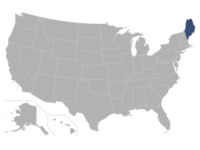
Augusta, ME