Alabama’s SNAP error rate on downward trend, preliminary data shows
Oct 23, 2026 | 6:01 am ET
Description
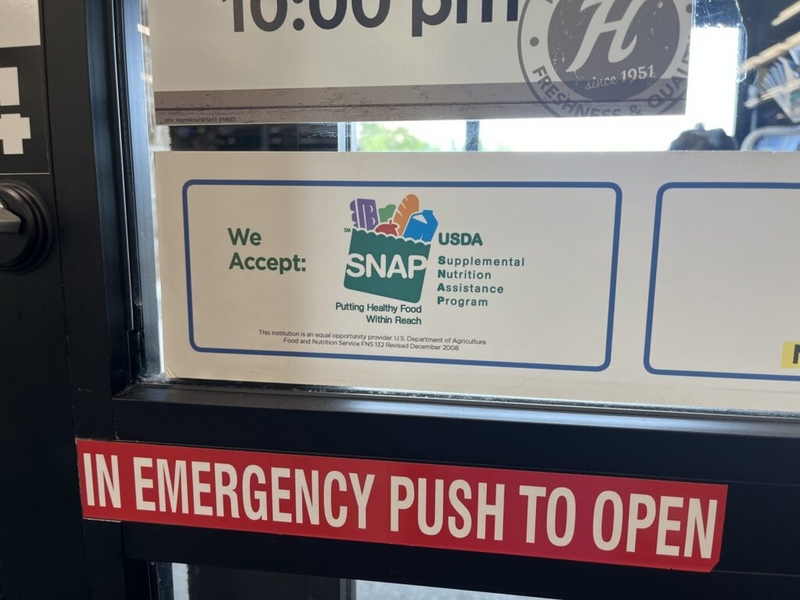
A sign advertises that SNAP benefits are accepted at a grocery store in Fargo, North Dakota, on July 7, 2026. Alabama's SNAP error rate is on a downward trend, according to preliminary state data, which could prevent the state from paying a larger penalty in 2027. (Photo by Ceilidh Kern for the North Dakota Monitor)
Alabama appears to have reduced the error rate for the Supplemental Nutrition Assistance Program (SNAP), officials said Thursday morning, which could reduce a penalty facing the state in 2027.
The One Big Beautiful Bill Act (OBBBA), passed last year, introduced a penalty for states with a high error rate in the program. Alabama’s error rate for fiscal year 2025 was 9.52%, which could have cost the state up to $174.3 million, about 10% of the state’s SNAP benefits.
SNAP Director Brandon Hardin said at a quarterly meeting of the Alabama Department of Human Resources (DHR), which administers the program in the state, that the rate for FY26 is starting to trend down after a bad start due to the 2025 government shutdown.
“It’s a vital program for the nutritional needs of Alabamians. I’ve heard from multiple advocates and grocery store people, this is an economic issue also when you’re talking about what it affects in those areas too,” Hardin said after the meeting. “Ultimately our clients need this thing. It’s up to us at DHR to try to correct those error rates, and the best we can do is to try to move those down where we can have less liability.”
Errors are not a measure of fraud. They can be on the client, the agency, or can be under-issuances or overpayments of benefits. Penalties are tiered based on the error rate.
The unofficial error rate through June is down to 7.89%, according to state data released Thursday morning. The Food and Nutrition Service (FNS), an agency within the U.S. Department of Agriculture (USDA), will finalize the year’s numbers by next summer, Hardin said. Should the rate stay under 8%, the penalty will be reduced to $87.1 million, about 5% of SNAP benefits.
“I continue to say that it’s unofficial, but this is a significant improvement. This is practically a $90 million savings if we can keep it underneath 8% going forward,” Hardin said.
Before the passage of the OBBBA, SNAP was fully funded by the federal government.
The changes to the program have pushed over 90,000 Alabamians off SNAP. Hardin said that some of those people could re-enroll in the program if their circumstances change. Most of the disenrollments are attributable to new work requirements enacted by the OBBBA.
As of September, more than 638,000 Alabamians were enrolled in the $1.7 billion program, Hardin said.
“What passed with the Big Beautiful Bill, with the increase in the able-bodied adult dependents age range and all the exemptions that went away, and the policies that we had to put in place for the payment error rate have contributed to a significant decrease in participation,” Hardin said.
In an attempt to reduce the error rate penalty, DHR has sought waivers from the federal government. One would have exempted the first three months of FY26 from the error rate penalty, which Hardin said hurts the year’s average.
“We were in a significant hole there because of the government shutdown. We had two months there that were not that great. We’re continuing to work through that piece of it, and I think it looks great,” Hardin said after the meeting.
A shutdown of the federal government in November left SNAP-recipients without benefits. The average error rate from October to November was 10.95%. The average error rate from January to June was 6.48%.
That waiver was denied, Hardin said.
In 2028, the state’s penalty is based solely on the FY26 error rate, while 2027’s penalty will be the lowest rate between FY25 and FY26. States with error rates below 6% or above 20% will not have to pay penalties. Penalties for states on the high end will have a two-year delayed implementation.
A two-year delayed implementation, regardless of error rate, was a potential solution through the Farm Bill. It has passed the House, but did not receive a vote in the Senate.
“That’s really the best plan for either this is to get a one or two-year extension,” Hardin said. “Hopefully we have some time in December at the Fed level to address this, but we still don’t have any movement on that, kicking the can down the road kind of thing.”
Commissioner Nancy Buckner said the department would request enough money from the Legislature in the spring to cover the larger penalty because the final error rate will not be determined until after lawmakers adjourn.
“Even though we know what the unofficial rate is, we’re hoping it will hold, but we don’t know for sure that it will hold until the feds give it its stamp of approval, and they’re behind,” Buckner said.
Budgeting for FY28 will be challenging. Former Finance Director Bill Poole and Legislative Fiscal Officer Kirk Fulford have repeatedly warned state agencies that budgets will need to be conservative.
Montgomery