Kansas manufacturing business responds to candidates’ conflicting accounts of tariff effects
Oct 23, 2026 | 4:50 am ET
Description
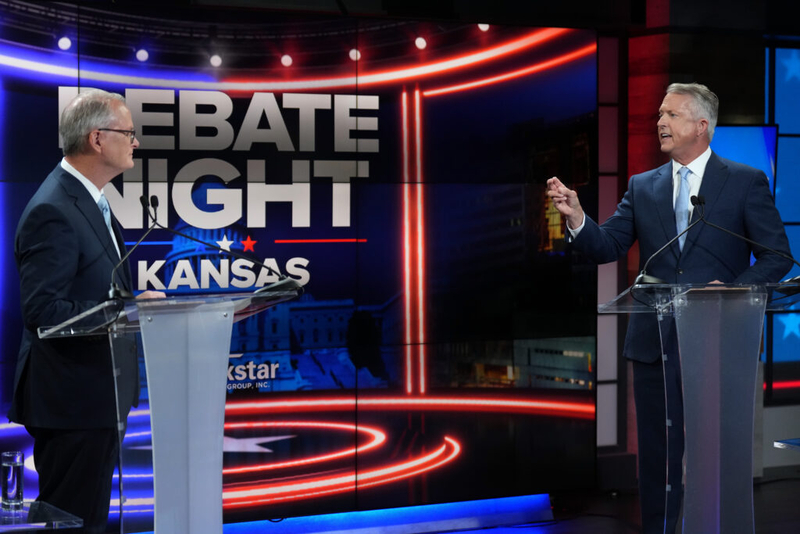
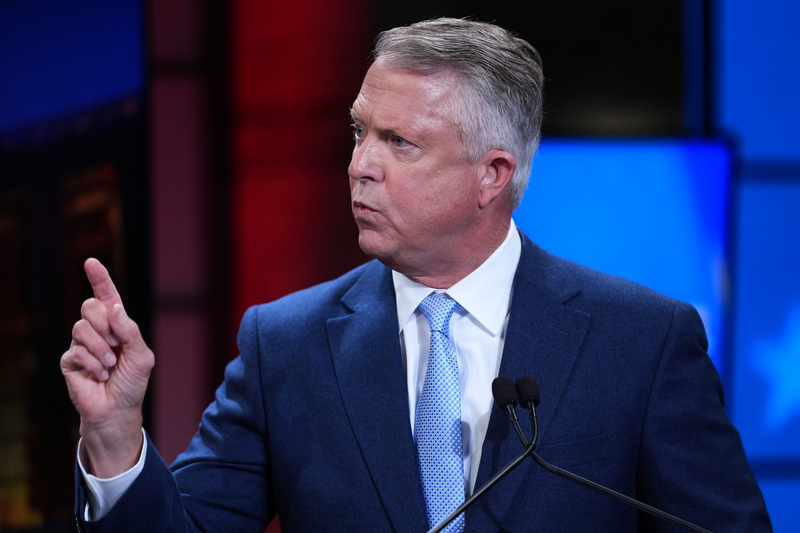
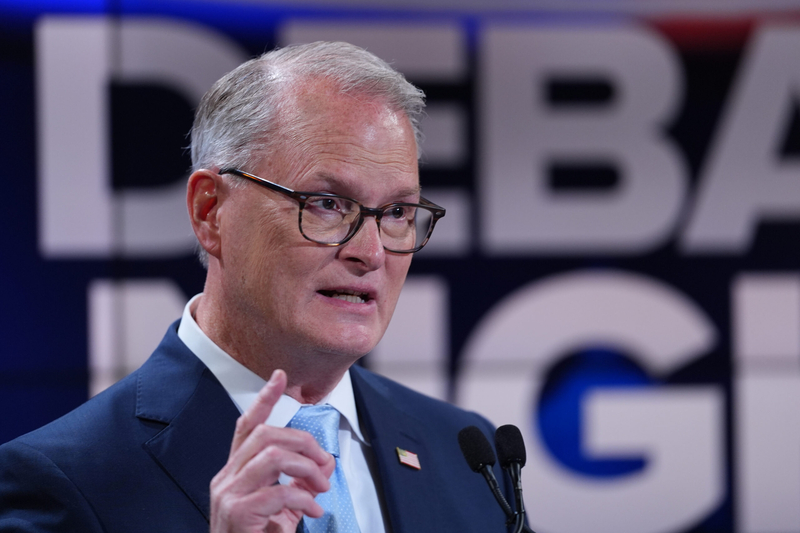
Republican Sen. Roger Marshall, right, and Democratic nominee for U.S. Senate Adam Hamilton participate in a debate at WDAF TV in Kansas City, Mo., Wednesday, Oct. 21, 2026. (Pool photo by Charlie Riedel/Associated Press)
KANSAS CITY, Mo. — The two major party candidates for U.S. Senate diverged in a debate Wednesday night on whether tariffs were helping or hurting a Salina manufacturing business they both visited.
A spokesperson for the business, however, denied U.S. Sen. Roger Marshall’s claim that tariffs were contributing to its growth.
Tim Henry, chief financial officer of Great Plains Manufacturing, said tariffs have constrained some of its competition related to one product area.
“That positive aspect, though, is not enough to offset the other burdens coming with tariffs today,” he told Kansas Reflector.
Marshall, a Republican, and the Rev. Adam Hamilton, a Democrat, highlighted their differences during their final debate before Election Day, offering conflicting views on multiple issues, including tariffs.
The two candidates viewed solutions to illegal immigration differently. They didn’t agree on the root cause of higher fuel prices. They favored different stretches of Kansas highway. They differed in opinion on food assistance funding, healthcare benefits, public safety and approaches to good governance.
John Holt, who moderated the debate for FOX4, asked the candidates about halfway through the event to name businesses they spoke with that had direct knowledge of the impact of President Donald Trump’s tariff policies. Both candidates referenced Great Plains Manufacturing, a subsidiary of Kubota, in Salina. Marshall said Kubota was growing, and Hamilton said Great Plains Manufacturing employees were worried about keeping their jobs.
Marshall said Kubota was one of three manufacturers he visited in Kansas that were positively impacted by tariffs.
“We’re seeing a manufacturing renaissance because we’re bringing these jobs back home,” Marshall said. “So the tariffs are working.”
Henry, who confirmed both the candidates’ visits, said it’s very possible that when Marshall visited, he witnessed growth at Great Plains Manufacturing.
“But that growth was not because of tariffs,” he said.
Henry said tariffs have had the most significant effect on steel and imported components, leading to higher costs for the business, the dealers it sells to and customers such as landscapers, construction companies and farmers who buy Great Plains products from dealers.
Steel prices have exceeded $1,000 per ton for the past six months. Henry said it used to be a rarity.
Great Plains Manufacturing has undergone building expansion and additions in recent months and years, Henry said, but those arose because of capacity needs and market growth, not tariffs.
Hamilton pushed back during the debate, accusing Marshall of enabling the negative effects of tariffs, particularly at Great Plains Manufacturing, where they are charging $2,000 in tariffs for one of their leading pieces of equipment.
“I did sit down with them,” Hamilton said. “You said you’ve listened in 300 campaign stops. You did not listen in 300 campaign stops. You had 300 photo ops.”
Hamilton said he spoke with Great Plains employees who were concerned about job loss, but Henry said he couldn’t speak to individuals’ concerns.
Holt, a veteran TV journalist, was a strict moderator, reigning in candidates when they exceeded their time allotments and pressing them when they strayed from the question at hand. He also asked the candidates about attack ads, foreign policy, artificial intelligence, gender politics, and social security.
Both favored
The libertarian candidate in the race, David Graham of Overland Park, was excluded from the debate. He told Kansas Reflector on Monday he is focused on issues like criminal justice reform, government transparency and running a positive campaign.
“My percentage of the electorate is greater than the difference between my two opponents,” he said. “Most of my support comes from voters who simply cannot vote for either of the other candidates.”
Marshall and Hamilton are trying to appeal to voters they are at risk of neglecting. Hamilton is courting Democrats who have become discouraged by the party, independents who aren’t sure where to turn and Republicans fed up with Trump, while Marshall must retain Republican support and curry favor among unaffiliated voters and Republicans who are dissatisfied with Trump policies.
Marshall has made a more concerted effort to campaign following the state fair debate in early September. That’s also when the race attracted an influx of outside spending and national attention. Marshall focused his attacks on Hamilton’s affiliations with national Democrats: Hamilton donated to former presidential candidate and Vice President Kamala Harris and former President Joe Biden, and also served on an advisory council during President Barack Obama’s second term.
“Adam Hamilton wants Kansans to repent for eating beef, thinks there are 125 different genders, and is a pedophile protector who would vote with Democrats like Chuck Schumer. He will never step foot in the U.S. Senate,” said Samantha Cantrell, regional press secretary for the National Republican Senatorial Committee.
Both candidates said at the debate there are two genders. Hamilton faced a question about his handling of child abuse incidents in 2005 and 2006 at a church sponsored youth camp, to which he said he used the church’s policies at the time and revised subsequent policies to better screen and train church staff and volunteers.
Marshall repeatedly sought to tie Hamilton to Schumer, D-New York, as he did at a Trump rally Monday in Park City, and said Kansas will determine control of the Senate.
Hamilton told reporters after the debate it seemed as if Marshall thought he was running against Schumer. Marshall mentioned Schumer 17 times during the debate.
Marshall left the debate immediately after its close, forgoing the TV station’s offer to appear on its post-debate show and answer questions from other reporters.
Docs on Doc
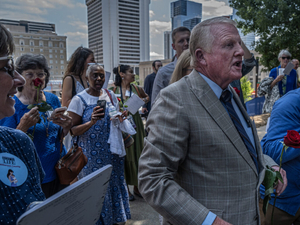
Before the debate, a handful of medical professionals in white coats demonstrated outside of FOX4’s Kansas City, Missouri, studio, holding signs that said “Kansas patients can’t afford Roger Marshall,” eliciting honks from passing cars. They were organized by a national advocacy group, the Committee to Protect Health Care.
Gary Morsch, a Kansan and former family physician and ER doctor in the Kansas City area, said he felt compelled to stand on a corner of 31st and Summit because of Marshall’s record as a doctor.
“Roger has a bad name as a doctor — not in his skill but in his M.O.,” Morsch said.
He didn’t buy Marshall’s defense of his debt collection practices. The New York Times reported in September that Roger Marshall had a years-long history of suing patients for medical debt while he was a practicing OB-GYN in central Kansas. At least 81 of those medical debt collection cases involved the arrests of former patients.
“We did the same procedures as every other doctor,” Marshall said. “This was such a small fraction of people that ever went. This is such a gross mischaracterization of the compassion and love and care that the other doctors and the nurses and I, patient after patient, we gave free care to.”
Morsch, who cofounded an international medical aid group and started a regional rural hospital staffing agency, said his personal practice was to forgive patients’ debts if they hadn’t paid within a year, and then ask them to pay as they go in subsequent visits.
“Kind, compassionate doctors write off their debt because they’re rich already,” Morsch said.
Morsch became a member of Hamilton’s church, Resurrection, one year ago. Morsch also ran for Congress as a Republican in 2000 against Phill Kline, who later became the state’s attorney general. Morsch attended the state fair debate in Hutchinson and was one of a half-dozen people thrown out of the Trump rally on Monday.
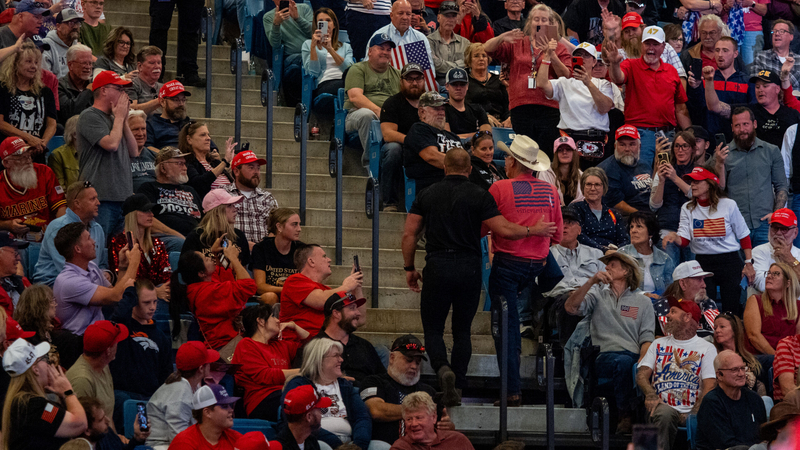
He said he hadn’t planned to protest at the Trump rally and went because he “just wanted to hear what he had to say.” He wanted to see the president for himself. It was when Trump started talking about Hamilton that Morsch stood up and began shouting.
“I was nervous as anything because I didn’t know if I would get arrested,” he said.
He confirmed he was neither arrested after being removed from the rally nor paid to be there, as Trump claimed.
“I’m glad I did it,” he said.
The lighter side
Finishing the night on a lighter note, Holt asked the candidates which streaming show they were currently watching and their favorite stretch of highway in Kansas.
Hamilton said he didn’t have the spare time to watch TV but favored sci-fi. Marshall seemed confused by streaming services and said: “I don’t know what you’re talking about,” adding he prefers to watch the Kansas City Chiefs, Kansas State University football and University of Kansas basketball.
Marshall’s favorite stretch of blacktop is Kansas Highway 177 between Manhattan and Cassoday, which includes the Flint Hills National Scenic Byway, and Hamilton’s was Interstate 35 through the Flint Hills.
Topeka, KS