PSC challenger seeks to advocate for landowners; incumbent calls herself ‘uniquely qualified’
Oct 22, 2026 | 5:17 pm ET
Description
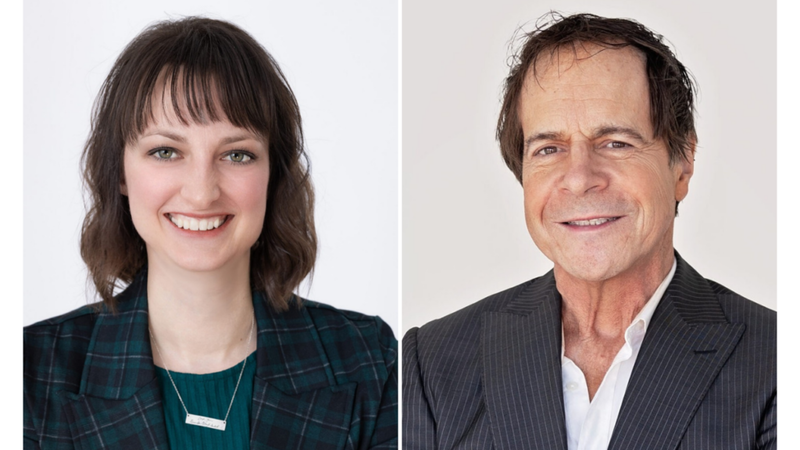
Republican Jill Kringstad, left, and Democrat Scot Kelsh are running for seats on the Public Service Commission. (Photos courtesy of the candidates)
A challenger for a seat on the Public Service Commission says North Dakotans do not feel like they are being heard by state regulators, while the incumbent defended the processes used by the state agency.
Democrat Scot Kelsh said people feel like developers of projects such as power lines and pipelines are “running roughshod” over landowners.
Kelsh, a former Fargo firefighter and state lawmaker, is challenging Republican Jill Kringstad for a two-year term on the Public Service Commission. Kringstad was appointed by Gov. Kelly Armstrong in January 2025 to fill the seat once occupied by U.S. Rep. Julie Fedorchak, who resigned her PSC seat when she was elected to Congress in 2024. The candidates participated in a Plain Talk Podcast debate Thursday hosted by Rob Port and Chad Oban.
Kringstad touted a change in state law that she advocated for as improving the public input process for the agency. The change allows the PSC to first hold a technical hearing, where a developer can provide detailed information and recent updates, before the three-person commission. Then the commission can go into a community to take public testimony.
She said the change helps eliminate people waiting hours for a company to present their case, a problem also identified by Kelsh.
“I helped draft a bill while I was on staff, and then when I was appointed just last year, I was able to champion that through the Legislature,” Kringstad said.
Kringstad also said the three-person commission must treat all parties fairly and follow the law when considering permits for power lines, pipelines and energy facilities.
“It’s not our job to kind of cheerlead on behalf of developers and make sure that they get their projects through,” Kringstad said. “And if you have developers come in, as we’ve seen, who are more aggressive and don’t treat landowners with respect, then their project goes harder, as it should.”
Kelsh said he agreed with the sentiment but that is not helping landowners who are feeling ignored by state government in general.
“We need an advocate on the PSC who’s actually going to talk about that and advocate for public policy changes that are going to make it better for our landowners, not make it worse like it seems to be becoming right now,” Kelsh said.
Kelsh cited his 18 years of experience in the state House of Representatives and his ability to work across party lines as part of his qualifications for a seat on the PSC. He served on Energy and Natural Resources and Finance and Taxation committees in the House.
Kringstad called herself “uniquely qualified” to serve on the commission. She said her background in accounting and economics and her time on the PSC staff allow her to dig into cases before the PSC.
She said that has helped her dissect electric utility rate increase requests that have come before the PSC.
She cited the PSC’s work on a rate increase request from Xcel Energy. While Xcel requested a rate increase of more than 19%, the commission approved an increase of about 10%.
“Ten percent sounds like a lot,” Kringstad acknowledged, but noted that it was the first increase in four years.
Kelsh acknowledged that electricity rates are low in North Dakota compared with other states but said some increases are the result of “bad decisions” by the utilities.
The PSC has authority over investor-owned utilities but not electric cooperatives, which are common in North Dakota.
“We really have to be careful it does not get away from us,” Kelsh said of utility rates.
One issue where Kringstad and Kelsh agreed was that power providers should not be allowed to pass along costs associated with large-load customers such as data centers to residential and other existing customers.
The PSC does not have regulatory authority over data centers but does have authority over the siting of some energy infrastructure affiliated with data centers such as power generation and power lines.
Kringstad cited $38 million in credits returned to Montana-Dakota Utilities customers because of the development of the Applied Digital data center complex at Ellendale. But she said it is not always easy to identify those savings on a utility bill and would like to make those benefits more clear.
“That’s where I think we can bring some additional transparency,” she said.
Kelsh is a native of Ellendale and has seen some benefits from the data center buildout in his hometown, such as enrollment growth in the schools and being able to afford repaving streets.
While there was extra energy available on the grid when Applied Digital first started building there, he said he is concerned about power availability for data centers that are under construction or proposed in North Dakota.
“Our grid and our generation capacity is just not there yet, and it will not be for years,” he said.
Two of the three seats on the Public Service Commission are up for election this year. Republican Sheri Haugen-Hoffart is seeking another full six-year term. She is being challenged by Democrat Jon Pederson, a professor at Mayville State University.
Reach North Dakota Monitor deputy editor Jeff Beach at [email protected]
Bismarck, ND