Dems in Congress say they’re wary Trump won't accept results of election
Oct 22, 2026 | 5:13 pm ET
Description
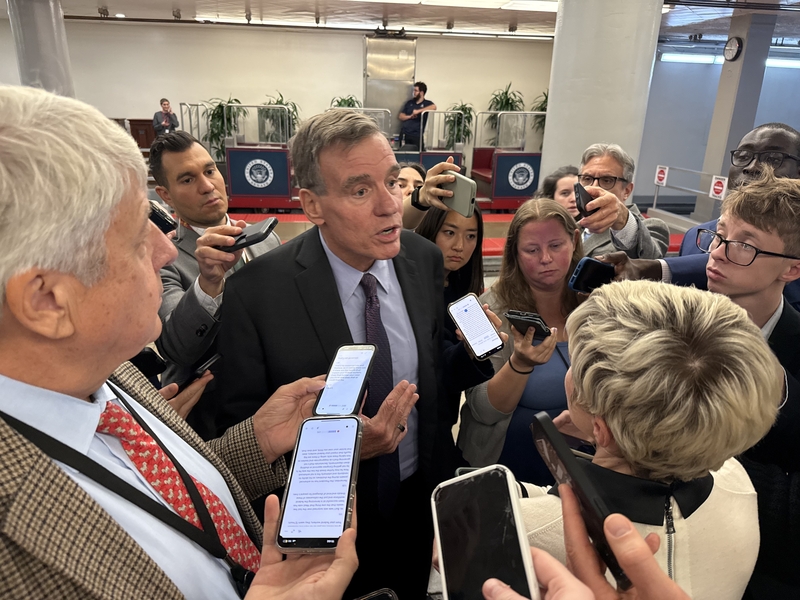
Virginia Sen. Mark Warner speaks with reporters in the U.S. Capitol building on Wednesday, Oct. 1, 2025. (Photo by Jennifer Shutt/States Newsroom)
As Election Day approaches, top Democrats on the intelligence committees in Congress are preparing for the possibility that President Donald Trump will allege foreign interference to discredit unfavorable results.
And they want leading U.S. intelligence officials to be immediately reachable if he does.
Sen. Mark Warner of Virginia and Rep. Jim Himes of Connecticut, the top Democrats on the Senate and House intelligence committees, outlined the scenario — one of among 50 they say they’ve considered — with reporters on Wednesday, less than two weeks before voting ends in the midterm elections.
“So when the president makes that announcement, you answer your cellphone to give us information about what’s happening,” Himes said the Democrats have told Director of National Intelligence Jay Clayton and CIA Director John Ratcliffe.
In recent weeks, the Trump administration has ramped up efforts targeting noncitizen voters, with arrests across the country, and is attempting to block suspected noncitizen voters from having their ballots counted in California. Democrats and voting rights advocates have warned for months that Trump could try to interfere in voting in the midterms.
All of it comes as Trump stares down the possibility that voters will place Democrats in control of Congress — an outcome that could doom his legislative agenda and mire him in investigations.
“We’re making the assumption that the president is not going to accept the results of what looks to be a very challenging election for him and his party,” Himes said.
But amid the highly publicized campaign against noncitizen voting, Democrats have kept an eye on the possibility that Trump could instead invoke a foreign threat to justify an attempt to assert control over elections or undermine the results, even as the Trump administration has cut federal support for election security.
China ‘election meddling’?
When Trump delivered a primetime address on election security in July, he spent a significant portion of the speech describing what he called China’s “sinister election meddling.” He said China had acquired 220 million voter files and the White House released declassified intelligence reports on the vulnerability of voting machines to foreign hacking.
Trump floated the possibility that vote totals could be electronically manipulated or that voting machines could change results. He suggested that election websites, poll books and voter registration databases could be vulnerable to exploitation by foreign adversaries.
“This evidence shows that the election system we have dangerously exposes and really exposes, like levels never thought possible, to hacking, exploitation, and foreign interference,” Trump said in the July speech.
The speech was met with sharp criticism from election security experts, who noted that the United States maintains a decentralized election system that makes any attempt at widespread interference extremely difficult.
For instance, every state except Louisiana uses paper ballots or generates some form of paper record for each ballot cast, according to data compiled by Verified Voting.
“Can we pre-bunk the notion that he may come up with a fabricated or single piece of intelligence that could be used as a reason to take illegal action?” Warner said, describing the Democrats’ thinking.
As a hypothetical, Himes outlined a scenario in which Trump announces at noon on Election Day that Iran has kicked off an operation to interfere in the election. Himes said he would go on TV and say he has received no briefings and no information, giving him no reason to believe the president’s comments are accurate.
“Now, does that end the crisis? No, but that’s the first step,” Himes said.
Doubts about interference
Warner and Himes belong to the Gang of Eight, a bipartisan group of high-ranking lawmakers who receive classified briefings on matters of intelligence and national security.
The pair drew a sharp distinction between foreign interference — which includes things like messing with voter rolls and attempting to alter results — and foreign efforts to influence elections, such as social media bots spreading certain messages.
Himes said that, as of now, “we are not seeing either the capability or the intent to interfere.”
He also said lawmakers haven’t received pre-election reports about the election threat landscape required by law.
In July, Himes, along with Democratic Reps. André Carson of Indiana, Joaquin Castro of Texas and Raja Krishnamoorthi of Illinois, wrote in a letter to the Office of the Director of National Intelligence, or ODNI, that the intelligence community had missed a report on election security vulnerabilities and foreign intelligence threats to federal elections that was due on May 7.
The ODNI didn’t respond to questions from States Newsroom on Thursday.
White House spokeswoman Lauren Bis said in a statement that Trump had done more than other previous president to ensure free and fair elections. She said the president is making clear that anyone who votes illegally “will be held accountable.”
“While extreme Democrats and the media continue to dismiss concerns about voter fraud, the Trump Administration is taking decisive action to protect our elections including prosecuting election crimes, strengthening election infrastructure security, and protecting vulnerable voters from fraud and coercion,” Bis said.
Reductions in workforce
The Democrats’ planning for a claim of foreign interference comes as the Trump administration has reduced cybersecurity resources for state and local election officials. The Cybersecurity and Infrastructure Security Agency, which typically plays a large role in election security efforts, has lost roughly a third of its workforce since Trump began his second term.
Trump has attacked CISA — a component of the Department of Homeland Security — under the leadership of previous director Chris Krebs, who worked to debunk misinformation after the 2020 election. Trump fired Krebs less than a month after the election. DHS has previously proposed eliminating CISA’s election security program, a $39 million initiative.
Jennifer Morrell, CEO and co-founder of The Elections Group, a nonpartisan organization that provides trainings and other resources to election officials, said the Trump administration “essentially decimated” CISA. Morrell said she had been a contractor for the agency.
“We lost years of work building our cyber and physical security infrastructure,” Morrell said Thursday during a University of Pittsburgh panel discussion on election integrity.
In September, Sen. Alex Padilla, a California Democrat, and Rep. Joseph Morelle, a New York Democrat, wrote in a letter to Homeland Security Secretary Markwayne Mullin and CISA Acting Director Nicholas Andersen that CISA hadn’t provided any funding to its Elections Infrastructure Information Sharing and Analysis Center, despite instructions from Congress to continue funding the program.
Padilla and Morelle noted that the center had for years provided security services to local election offices at no cost before funding was abruptly cut in early 2025. While the center continues to provide some services through a paid membership model, they wrote that it lacks its former reach.
Briefing urged
On Wednesday, Himes and Rep. Bennie Thompson, a Mississippi Democrat, urged Mullin to brief lawmakers on election security efforts. In a letter, they wrote that state and local election officials “are under tremendous pressure this election cycle.”
Homeland Security didn’t answer questions from States Newsroom on Thursday.
In some of the country’s largest jurisdictions, the consequences of the federal pullback have been muted. Big counties, with hundreds of thousands or even millions of residents, often have their own sophisticated cybersecurity programs.
Monica Gordon, the clerk of Cook County, Illinois, which includes Chicago, praised her information technology team. In a call with reporters, the Democratic official said her office was fortunate to have the latest innovations to protect voters’ information.
“We’ve been very fortunate but I am concerned about some of our smaller counties that have less resources,” Gordon said.
Tammy Patrick, chief programs officer at Election Center, an organization overseen by the National Association of Election Officials, said on the same call that states this year are leaning on their own resources because of the changes at CISA. Election officials have also relied more on help from nonprofit groups, she said.
State and local officials have done a great job of finding needed funding to replace some of those services and ensure sensitive systems are protected, said Morrell.
“But state officials and local officials cannot gather intelligence about threats from foreign nation states,” Morrell said, adding that “we’ve lost sort of the ability to be quickly alerted to that type of intelligence.”
All States Newsroom content is free to republish. Read our republishing policy for more information.