U.S. Court of Appeals finds due process violation in ICE incarceration of Iranian refugee in Kansas
Oct 22, 2026 | 4:32 pm ET
Description
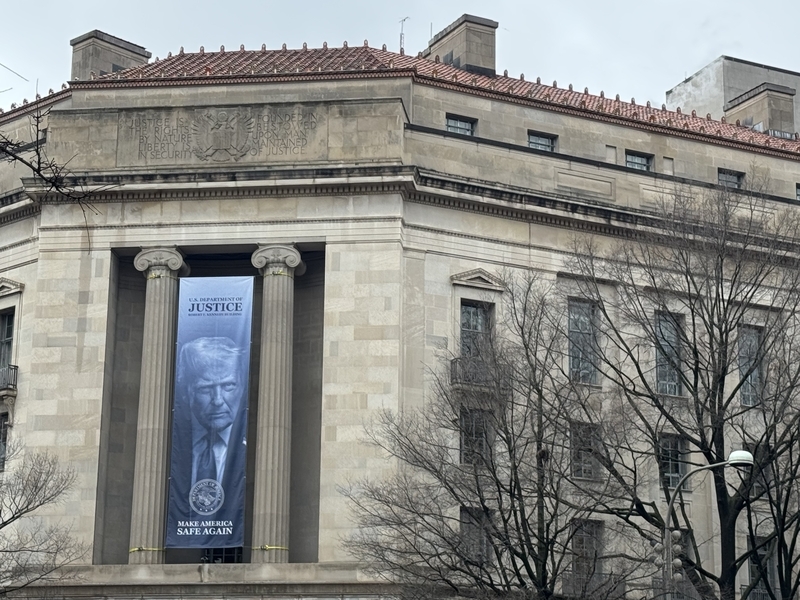
A banner showing President Donald Trump hangs on the Department of Justice on Feb. 20, 2026. The U.S. Court of Appeals in the 10th Circuit issued a 2-1 decision regarding fate of an Iranian immigrant who was arrested soon after moving to Kansas in 2025. (Photo by Shauneen Miranda/States Newsroom)
TOPEKA — The U.S. Court of Appeals for the 10th Circuit says a federal district court in Kansas misapplied legal standards in an immigration detention case and the federal government violated due-process regulations after incarcerating an Iranian national.
A 2-1 decision Wednesday rejected claims by the administration of President Donald Trump that a six-month detention clock that limited challenges to lawfulness of a detainee’s incarceration could be restarted each time a person was released and detained.
The case involved Kaveh Abedi, who was granted asylum in the United States as a child after his family fled Iran in 1991. He faced removal proceedings in 2002 after a drug possession conviction, but an immigration judge deferred deportation to Iran under the Convention Against Torture. Abedi has complied with terms of his supervised release for more than 20 years, the court’s opinion says.
After moving from California to Kansas in June 2025 with consent of federal officials, Abedi was taken into custody by U.S. Immigration and Customs Enforcement. He was informed he could be sent to a third country, the court record says, but he asserted that he wasn’t promptly granted the required informal interview to challenge revocation of his supervised release.
“The government does not dispute Mr. Abedi’s assertion that he has consistently complied with all terms of his order of supervision since he was first released in 2002,” the appellate decision says. “Nor, does the government dispute that his release was revoked based on the unilateral decision of ICE officials rather than anything he did.”
Abedi filed a habeas corpus petition to contest his detention at the Federal Bureau of Prisons’ Leavenworth prison and to seek an injunction blocking his transfer from Kansas. In October 2025, a U.S. District Court judge in Kansas denied habeas relief and concluded his detention was justified under federal law. The district court said he could file a new habeas petition if detained more than six months.
After eight months in custody, Abedi filed a second habeas petition and a judge allowed his released from immigration detention in February. The federal government sought to dismiss Abedi’s appeal regarding changes in his immigration status because his release from custody made those issues moot.
Court of Appeals Judges Gregory Phillips and Carolyn McHugh, both appointees of President Barack Obama, disagreed with government lawyers on mootness and concluded Abedi could remain at liberty under federal supervision.
Their majority opinion said it was a due process infraction not to conduct a prompt, informal interview with Abedi to challenge the basis of his detention. The judges rejected the Trump administration’s argument that the six-month detention standard could be reset with each re-detention. Instead of resetting, the Court of Appeals said the clock applied to the initial six months after the removal period began and shouldn’t be applied to Abedi’s subsequent stints in detention.
“On the merits, we conclude that the district court committed various legal errors in assessing Mr. Abedi’s claims for relief,” the opinion said.
The U.S. Supreme Court established a six-month period of presumptively reasonable detention in 2001.
U.S. Court of Appeals Judge Allison Eid, appointed by President Donald Trump, offered a dissent to the majority’s opinion.
“Kaveh Abedi has been released from immigration detention,” Eid wrote. “His habeas petition is therefore moot, and no mootness exception applies. Accordingly, I would dismiss this appeal.”
Topeka, KS