Early voting in North Dakota begins as one group looks to encourage Native voters
Oct 22, 2026 | 4:33 pm ET
Description
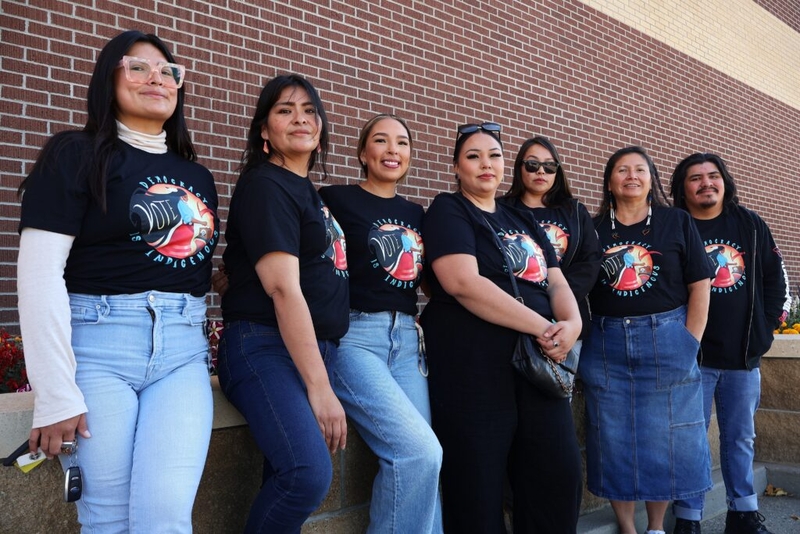
Daniela Aki, second from left, and others who joined a Sacred Pipe Resource Center early voting party pose for a photo before going into the Bismarck Event Center on Oct. 22, 2026. (Photo by Jack Dura/North Dakota Monitor)
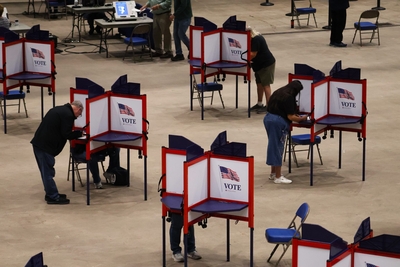
Early in-person voting begins in certain counties throughout North Dakota during the next week, an opportunity one Bismarck-area group is highlighting to encourage Indigenous people to vote.
Staff of the Sacred Pipe Resource Center gathered Thursday with half a dozen voters to all cast their ballots shortly after polls opened for the first day of Burleigh County’s early vote. They donned matching black T-shirts reading “Democracy is Indigenous,” took pictures together and walked inside the Bismarck Event Center to vote.
Voting can be confusing or intimidating and it’s helpful to have support, said Daniela Aki, the center’s director of civic engagement.
“That’s kind of what we want to do is, again, bring down those barriers to voting and say, ‘This isn’t a scary process. We understand it, so come along with us,’” Aki said.
Leta Killer, a Mandan, Hidatsa and Arikara Nation citizen, joined them. She said she wants to see change in the world, especially in North Dakota, and supports ballot measures for a $116.5 million Bismarck school bond issue for facility upgrades and free breakfast and lunch for K-12 students statewide.
“We’re all living here together so I would like to see us have a better community, better reaction, better relationships,” Killer said.
Victoria Fox said the bond referendum motivated her to vote to improve the schools where her 3- and 1-year-old children will one day attend.
“I just thought that it’s only right as a parent to advocate for them,” said Fox, who works as the outreach and development coordinator for the MHA Education Grant Program.
Sacred Pipe uses its partnerships with other organizations and word of mouth to gather urban Indigenous residents for voting parties, Aki said.
Sacred Pipe has other initiatives such as civic bingo to talk about candidates and offices and a chaperoned limousine ride for students who have turned 18 to arrive in style to cast their first vote, she said.
“Definitely Sacred Pipe has always kind of encouraged that urban tribal population to get out and vote and to be civically engaged to understand what’s going on in our community and how our voices can help shape those communities,” Aki said.
Identification and address requirements often present a barrier for urban Indigenous voters, many of whom come from different reservations and states, she said. Many of them are transient or might not have an up-to-date ID or a permanent address, or not know they can use a church or shelter as their address, she said.
Sacred Pipe promoted adding all five tribal IDs in North Dakota into state poll worker training, which Aki said hopefully makes the process easier for Native voters.
Burleigh County Auditor Mark Splonskowski said, “Anybody who comes with a tribal ID, they should be able to be processed, not a problem, and that’s something that we’re happy to make that improvement for.”
Some Native voters might feel nervous or like they don’t belong, Aki said. Voting isn’t an everyday act, she said.
“What I see with urban tribal populations is that if we’re not conditioned to do things like vote, then we don’t vote,” Aki said.
She encouraged people to take advantage of in-person early voting so they can quickly get in and out, rather than risk long lines on Election Day.
Free school meals debated as a win for families or wrong for North Dakota’s constitution
Stutsman and Ward counties are next for early in-person voting, starting Monday, followed by Cass, Grand Forks and Morton counties on Tuesday and Stark County Oct. 29. Sioux County offers several absentee voting days from Oct. 26-30.
Absentee voting has been available since Sept. 24. Nearly 30,000 North Dakotans had cast their ballots by Thursday afternoon, according to online voting numbers.
Absentee ballots need to be returned before polls close on Election Day, Nov. 3. Voters can return absentee ballots in person, by mail or county dropbox. Absentee ballots won’t be accepted at the polls on Election Day. Ballots received after Election Day won’t be counted.
Midterm elections historically have low voter turnout, such as barely 43% in North Dakota in the November 2022 general election. Secretary of State Michael Howe said he’d love to see 100%.
“The more engagement we can get from every eligible North Dakotan, I think that’s a more representative indication of how the overall electorate feels,” Howe said.
Reach North Dakota Monitor reporter Jack Dura at [email protected].
Bismarck, ND