Population loss, Hope Scholarship driving enrollment losses in West Virginia, school districts say
Oct 22, 2026 | 9:00 am ET
Description
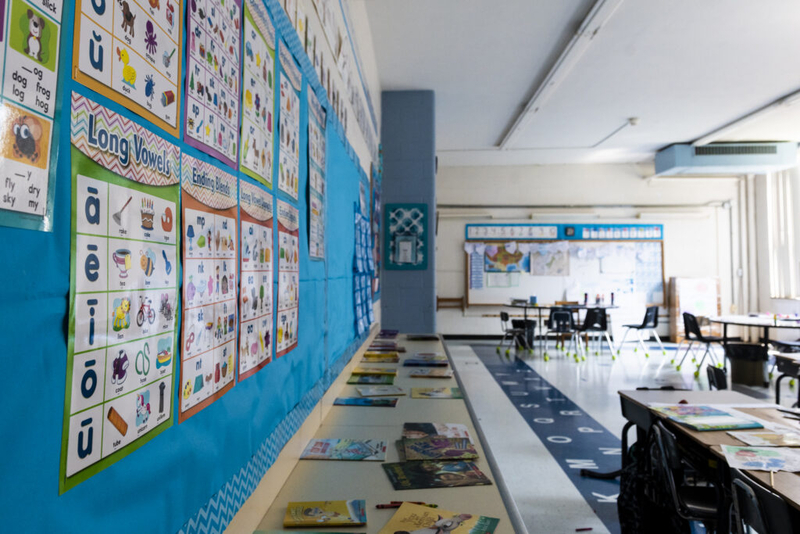
Inside a Kanawha County elementary classroom in West Virginia. (Photo by Lexi Browning/West Virginia Watch)
West Virginia public school enrollment experienced one of the steepest drops since COVID, and local superintendents in the hardest hit counties are pointing to demographic loss and the Hope Scholarship as causes.
The West Virginia Department of Education announced Tuesday an enrollment decline of more than 8,200 students, representing a loss of 3.5% of the total public school population. All counties have experienced some degree of loss, although the Department of Education did note a few charter schools saw gains.
Roane County, less than 50 miles from the state’s capital, experienced the sharpest decline, at 14%, triple the loss it experiences in a typical year.
Michelle Stellato, the superintendent for Roane County Schools, said she anticipated a steep reduction because the county had to close two elementary schools.
She found that of the 230 students who left the system, 100 had taken the Hope Scholarship, a program that allows families to use public dollars for private education, regardless of their income.
“I think parents recognize that they have options when we are closing schools and they exercise their right to use those options,” she said.
Georgia Hughes-Webb, the director of data management at the West Virginia Department of Education, said population loss doesn’t completely account for the enrollment decline, during an interview on MetroNews Talkline Wednesday.
Hughes-Webb noted that U.S. Census statistics show a 4.6% decline in school-age children between 2020 and 2025. During that same time, Hughes-Webb said public school enrollment dropped by 7.9%.
“Because the school enrollment loss is outpacing that overall population loss, we have to look to other explanations,” she said. “It could be that more families are choosing non-public options. We don’t quite have all the data we need to fully answer that question. But certainly, given the comparison between enrollment loss and population loss, there are bigger factors at play.”
Earlier this year, state Treasurer Larry Pack, who oversees the Hope Scholarship program, announced more than 26,000 students had applied for it, an increase of 11,000 from the year prior.
Pack said in a statement that the Hope Scholarship isn’t to blame.
‘We are not aware of any significant increase in private school or homeschool enrollment in recent years that would account for the broader decline in public school enrollment. Rather than blaming the Hope Scholarship, we should be focused on addressing the underlying challenges facing our education system,” Pack said.
To be sure, the increase in Hope Scholarship participation can’t be completely attributed to public school students leaving the system. The 2026-27 academic year is the first in which students already attending private school or homeschool could apply for the program.
Demographic decline and more school choice options are challenging public schools in both rural and urban areas across the state.
David Oliverio, spokesman for Harrison County Schools, which lost 397 students, said there’s more competition in population centers like Clarksburg from private, parochial and charter schools and the Hope Scholarship contributes to that.
“But I think it’s really important to remember that families are still choosing public education overwhelmingly over the alternative here in Harrison County,” he said.
Calhoun County, with a total population of less than 6,000 residents, lost 59 students, amounting to 7% of the district’s school population. Superintendent Michael Fitzwater said the sparse, and largely older population, means there just aren’t many children going into the school system in the first place.
But non-public school options are exacerbating the situation, he said.
“In addition to the overall population decline, public school enrollment is affected by families choosing other educational options, including private school and homeschooling,” Fitzwater said. “Those choices can further reduce public school enrollment even when the students and their families continue to live in Calhoun County.”
Even counties with extenuating circumstances, like Lewis County where a summer flood washed away a school, school choice options are cited as a piece of the puzzle.
“Other factors such as a very large graduating class last year compared to the new enrollments, the Hope Scholarship and homeschool participants have also contributed to our lower numbers,” wrote Carolyn Long, superintendent of Lewis County schools, in an email response.
School officials in Cabell, Marion and Mingo offered similar responses — population is declining and students are being lost to private education due at least in part to the Hope Scholarship.
But not every county in West Virginia is in a population freefall.
Berkeley County, situated in the Eastern Panhandle less than 100 miles from the nation’s capital, has experienced a 14% growth in overall population between 2020 and 2025.
Yet, it lost nearly 400 students in its enrollment. Berkeley ranked second only to Kanawha in the number of students using the Hope Scholarship in the 2024-25 school year, the latest academic year with an annual report.
Berkeley County Schools Superintendent Ryan Saxe said the district commissioned an independent study during the 2024-25 school year to determine why the enrollment was declining.
Despite population growth, the district found changes in birth rates, aging population and “increased participation in educational alternatives such as homeschooling, private schools, charter schools,and the Hope Scholarship program” are contributing factors to the decline, Saxe said.
“Of equal concern is the financial impact these changes have on public schools,” Saxe said.
School enrollment is the bedrock for the state’s school funding formula. During the 2026 legislative session, lawmakers tried to pass a bill to address the formula, which educators have said is outdated and inadequate.
That legislation died after being heavily watered down.
Late last month, the West Virginia chapter of the American Civil Liberties Union filed suit alleging the funding formula is shortchanging public schools so drastically that it’s unconstitutional. Then last week, the state board of education unveiled legislative proposals to fix the funding formula.
Del. Joe Statler, R-Monogalia County, is the chair of the House Education Committee. Since the Legislature gaveled out in March, he has led an effort to hear from stakeholders throughout the school system to figure out fixes for the school funding formula.
He said the committee will be digging into the numbers and looking over the proposal from the state board of education.
“I will tell you this is going to be the year of education,” Statler said. “Just hang in there.”
Stellato, the superintendent of Roane, said if there’s one thing lawmakers can do, it is to listen to the professionals, particularly the state school financial officer Uriah Cummings.
“Uriah Cummings has put forth an amended school finance formula, and he’s built it based off of our feedback and our struggles and the things that we know that are difficult to do and the way we run our schools,” Stellato said. “ I wish that the Legislature would give him an appropriate amount of their time and listen to the rationale behind it.”
Charleston, WV