Issue spotlight: North Dakota attorney general candidates cautious on AI use in law and order
Oct 22, 2026 | 6:00 am ET

Description
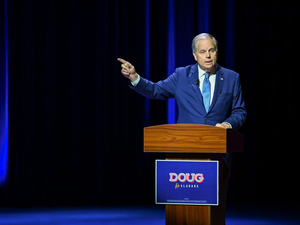
From the left, Democratic-NPL attorney general candidate Tim Lamb and Republican Attorney General Drew Wrigley. (Photos by Kyle Martin/For the North Dakota Monitor)
Candidates for North Dakota’s top law enforcement position say artificial intelligence will be transformative for society but is not a replacement for humans in investigations or legal matters.
Republican Attorney General Drew Wrigley, a two-time former U.S. attorney and past lieutenant governor, is running for reelection in a rematch against Democrat Tim Lamb, a Grand Forks attorney, former school board member and retired Army major.
The 2025 Legislature passed laws banning possession of computer-generated child sexual abuse images and requiring a disclaimer for AI used in political ads. An interim legislative committee is studying AI and data center topics for potential 2027 legislation.
Data center legislation begins to take shape in North Dakota
Wrigley said he doesn’t “impulsively lurch for more regulation of things,” and prefers to have “candid, expert-driven, societally sensitive conversations about this emerging technology.”
He also pointed to his office’s participation in litigation against social media platforms related to age-appropriate accessibility, saying, “we’re going to try to always stay on the front edge of that.” Lamb has criticized Wrigley for not doing more to get a larger settlement amount for North Dakota in a 47-state Meta lawsuit.
Wrigley said he personally uses AI sometimes when researching or comparing consumer products, but has not integrated it into his work. He said he has encouraged his office’s division directors to look for ways AI can save time on tasks in a responsible, ethical way, not to foist their obligations onto a machine. Wrigley said he won’t ask the Legislature for more resources just because AI is a hot topic.
If elected, Lamb said he would task an assistant attorney general to become an expert on AI topics. He also said he would work with other state attorneys general to develop oversight of AI and would prioritize consumer protection against AI fraud.
Lamb said he “would have to do some homework” and have discussions on what potential AI legislation might be necessary. He expressed concerns about AI models becoming too powerful and President Donald Trump and Congress not seriously considering regulations. Everything from transportation to commerce has government regulations, he said.
Meta to pay 47 states up to $17.1B in landmark child safety settlement
“What do we have that there isn’t government oversight? Nothing,” Lamb said.
Each candidate said the case of a Tennessee woman jailed for months last year in connection with a Fargo-area bank fraud because of her identification by an AI facial recognition software creates legitimate concerns. Her charges were eventually dismissed, and she is suing the city of Fargo for $10 million, according to court papers.
Lamb called it “a freak case” and said police officials “were all asleep at the wheel” throughout the chain of command. Wrigley said “there’s a little more to that story,” but called it “a cautionary for anybody” and a real concern. Investigators cannot take the human component out of their work or exclusively rely on AI, he said.
Similarly, Flock cameras have legitimate law enforcement uses, “but that doesn’t mean that that’s the end of the discussion,” Wrigley said. The cameras, which have been criticized as intrusive to privacy, have helped solve serious crimes nationally but need “a robust public discussion” about “where do we want the lines to be drawn,” he said.
Lamb said Flock cameras need to be limited to specific purposes such as surveillance of a mass of people at football games or athletic areas, but not necessarily everyday activity on a street corner.
In the legal realm, AI will not replace human judgment, Lamb said. There might be some applications for AI in the legal profession, “but I don’t think it’s imminent,” he said.
Crimes across all categories in North Dakota down in 2025, report shows
Wrigley cited legal professionals he knows who use AI in initial legal research and to draft documents. AI shows great promise for advancements in the medical profession for treatment of diseases and other uses, he added.
“That’s why I say we’re foolish not to embrace new technology. We’re equally foolish if we don’t do it in a really thoughtful, thorough way, transparently understanding the upside and downside and then make societal judgments about where we want to draw those lines,” Wrigley said.
North Dakota’s attorney general oversees a two-year budget of nearly $63 million and 270 full-time employees. The annual salary is $197,841.
The AG also sits on North Dakota’s three-member Industrial Commission and five-member Board of University and School Lands, which oversee topics such as the state-owned Bank of North Dakota, various energy matters and state investments.
Lamb also ran unsuccessfully for state auditor in 2024.
Reach North Dakota Monitor reporter Jack Dura at [email protected].
Bismarck, ND