Campaigning around Alabama, Doug Jones tries to open a path for Democrats
Oct 22, 2026 | 6:01 am ET
Description
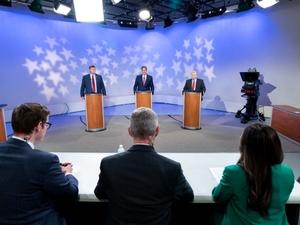
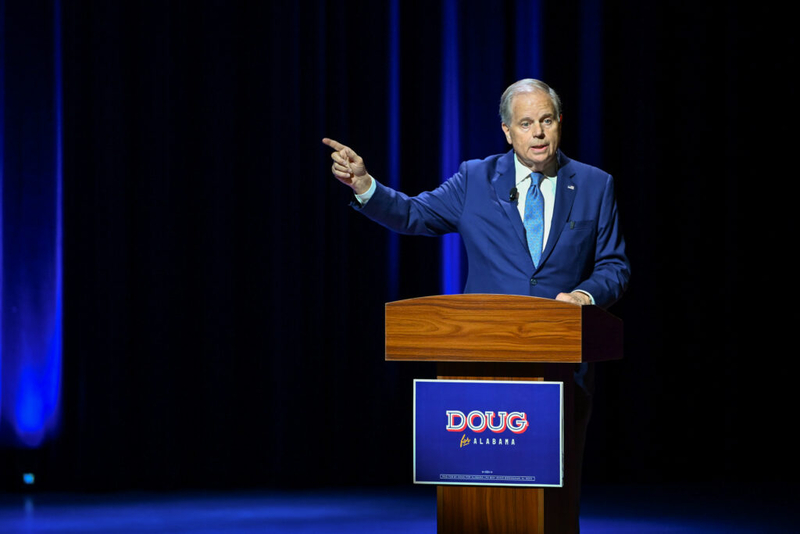
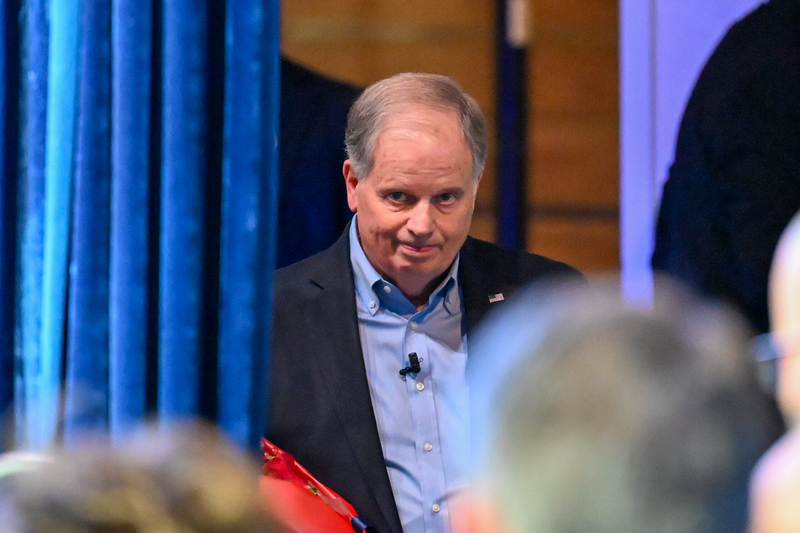
Democratic gubernatorial nominee Doug Jones speaking at a mock debate on Oct. 21, 2026, in Birmingham, Alabama. Jones faces an "uphill chug" to the governor's mansion, but he said the race is more about building infrastructure for the Democratic Party. (Anna Barrett/Alabama Reflector)
Former U.S. Sen. Doug Jones pulled raffle tickets out of a campaign hat. In the audience, members teased the Democratic gubernatorial nominee about picking attendees in the front row to ask questions.
“I did not set that up, folks. I promise you, I didn’t set it up,” he said after two people in a row came from the front row. The crowd of more than 300 at the September town hall in Anniston laughed.
The next voter was also on the front row. The fourth voter was not on the front row, but he was close.
“I’m gonna go with 715,” he said as the voter raised his hand and the crowd laughed. “OK, moving back a little bit.”
Town halls like the one in Anniston have shaped Jones’ campaign. The candidate has used them to tout his proposals and draw contrasts with Republican gubernatorial nominee Tommy Tuberville.
But Jones said in a recent interview that running for governor in Alabama as a Democrat remains an “uphill chug.”
“We’ve just got to grind it out, and we’ve got to stick to what we believe is the right thing in terms of what we want to do with state government,” Jones said. “We’ve also just got to stick with our process of not getting distracted with too much of the day-to-day stuff. Not get distracted with polls, not get distracted with all the money that Tuberville’s raised.”
Two polls released Tuesday showed the challenge the Democratic gubernatorial nominee faces. Both The Alabama Poll, run by Michael Lowry, a former aide to U.S. Rep. Robert Aderholt, R-Haleyville, and a poll conducted by the right-leaning Cygnal for Alabama Daily News and Gray Television found 51% of respondents said they would likely vote for Tuberville, and 39% for Jones, leaving about 9% undecided.
Jones, who defeated former Alabama Supreme Court Chief Justice Roy Moore in a special election for the U.S. Senate in 2017, is the only Democrat to have won a statewide race in Alabama in the last 18 years.
Tuberville has outraised Jones by nearly 2 to 1, bringing in almost $16.5 million since he launched his campaign in May 2025 to Jones’ roughly $6.4 million since his December launch. Messages seeking comment from the Tuberville campaign were left unanswered.
But in a year where Democrats around the country appear to be on the offensive, other gaps appear to be narrower. Democrats saw increased turnout in May’s primary. In September, Jones raised $1.12 million to Tuberville’s $1.13 million. Jones outraised Tuberville by almost $6,000 in October’s first weekly report, reporting $258,500 in cash contributions to Tuberville’s $252,800. In October’s second weekly report, Tuberville outraised Jones by $130,000, though Jones outspent the Republican nominee.
Whether Jones can become the first Democrat to win an Alabama gubernatorial race since 1998 is uncertain. But for Jones, winning on Nov. 3 may be less a marker of success than rebuilding the Democratic Party.
“We haven’t invested in party infrastructure. We haven’t invested in candidates. We’re doing that now, and one of these days, I believe that one or both of the houses will flip majorities. But it’s not going to happen this year,” Jones said. “I think narrowing the gap in many places, which I think we can do, is success. Success is a building process.”
David Hughes, a political science professor at the University of Louisiana at Lafayette who previously spent time at Auburn University at Montgomery, said in a phone interview Wednesday that if Tuesday’s polling is right, it would be a D+10 shift in Alabama’s R+20 environment. That would not be enough to win, but it could flip some Legislative seats.
“Flipping any seats is a win for the party,” he said. “They need to go after suburban districts with higher socioeconomic status voters, so folks with more education, more income. That’s where Democrats are rebuilding their brand right now.”
Travel around the state
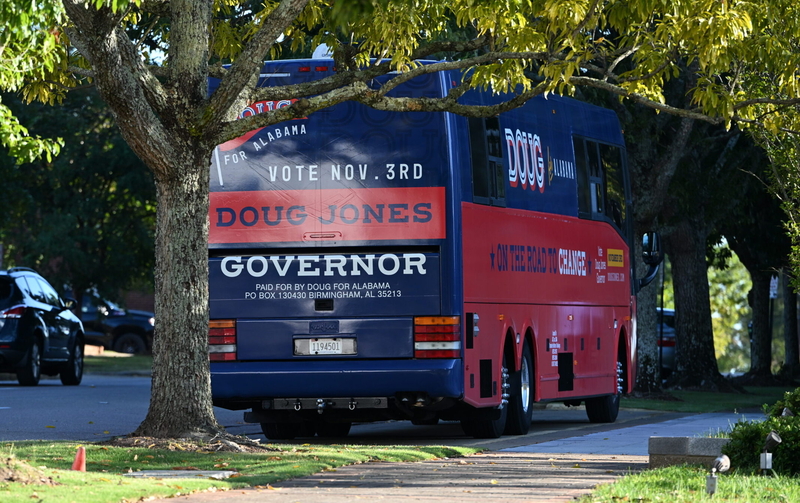
Jones’ town halls and rallies, usually occurring on weeknights, take place across the state: in cities like Montgomery and Mobile, rural towns and safe Republican counties. Jones held his 20th town hall since July 1 in Tuscaloosa on Monday night.
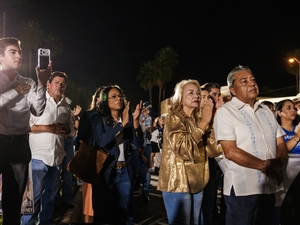
They draw crowds of varying sizes: 300 in Anniston, 300 in Shelby County, about 50 in Lowndes County, 400 in Baldwin County, 330 in Mobile, 130 in the Shoals and 2,000 at a rally in Huntsville.
Jones said in a recent interview that no matter where he goes, he hears the same thing from voters. He said Alabamians are concerned about the rising cost of living, healthcare and a lottery.
“We’ll be doing more town halls, but the fact of the matter is, if you are going to be a governor for everybody, you’ve got to let folks know that you are there for them and you’re listening to them,” he said.
Voter concerns enhance Jones’ laundry list of policy priorities that he launched with in December.
He wants to expand Medicaid, constitutionally protect IVF, independently audit the state’s prisons, end straight-ticket voting, push for early voting, “phase out” the state’s school voucher program, implement a lottery and enact a one-year moratorium on data centers.
Doug Jones calls for affordability measures, government reforms in policy speech
If he wins, Jones will still need the support of the Alabama Legislature to fund most of his priorities. The Legislature has been controlled by a Republican supermajority since 2010, and GOP control of the chambers is almost guaranteed to persist after Nov. 3: nearly every Democratic nominee for the Legislature, many running in deep-red districts, would have to win to reverse that.
The governor is also weak relative to the House and Senate, which can override gubernatorial vetoes by simple majority votes. But Jones says he can work with the Legislature.
“Sit down on it, get a bourbon, talk about it, find out what they want, what it is they really are looking at and what they need. Let them hear what we really need, and we just talk and we find common ground,” he said. “I did that in the U.S. Senate.”
At the Anniston town hall in early September, he touted the 2019 elimination of the Widow’s Tax – a bill he co-sponsored with Republican Sen. Susan Collins of Maine.
He markets the events as “unscripted” and often stays afterward to answer questions or greet voters. At the Anniston town hall, one voter asked Jones to pull his number to no avail.
Jones replied with a drawn-out “No, now let’s don’t get too anxious. I’ll see if I can find it in here, though. I’m sorry.”
That voter’s raffle ticket was not picked, but Jones stays after for anybody that has questions or just wants to say hello.
Challenges ahead
The winner of next month’s election will likely face challenges from the get-go. Former Finance Director Bill Poole and Legislative Fiscal Officer Kirk Fulford have repeatedly warned state agencies that fiscal year 2028 will be “challenging” and budgets will need to be conservative. The state’s two public employee insurance boards are seeking more funding and increasing premiums or direct costs amid rising healthcare costs.
Jones said in an interview that additional revenue from a lottery could help that.
“I make no illusions about the challenges. I’ve said that in my town halls. This is not going to be, ‘These are the things that we want to do, and we’re going to do everything we can to try to find a way to do them,’” he said. “I think that there is potential revenue out there in other sources.”
Alabama is the last state east of the Mississippi to not have a lottery. According to a 2021 projection from the Legislative Fiscal Office, a lottery in Alabama would generate $272 million to $358 million. That additional revenue, Jones said, could also fund other priorities like Medicaid expansion.
Jones said in an interview that there has always been an “appetite” for expanding the program, but never the will. He said he will do it with an executive order, leaving the Legislature to fund it.
“They hide under the guise of ‘oh the money.’ The fact is, 40 states have done this. They have found a way to do it,” Jones said. “That has clearly been a political issue.”
Hughes said Jones’ agenda would likely face many obstacles in the Legislature, especially after recent social media exchanges between the nominee and House Speaker Nathaniel Ledbetter, R-Rainsville.
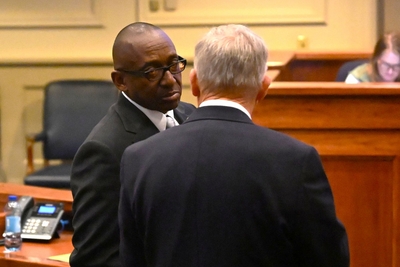
“They would almost certainly have a tempestuous relationship. In Alabama, the Legislature largely drives the bus, and so you know you’d see a situation in other southern states that have elected Democratic governors where the legislature just overrides their veto left and right,” Hughes said.
Outgoing state Sen. Greg Albritton, R-Atmore, said in a phone interview Monday that the political divisiveness in Montgomery has only gotten worse, and he sees no catalyst on the horizon that could change that.
“Unless they had some kind of meeting that they could agree on something,” he said. “But I just don’t know that that will happen politically. The right and left are just too far apart.”
Senate Minority Leader Bobby Singleton, D-Greensboro, the chair of the Alabama Democratic Party, said in an interview Tuesday that he hopes Republicans could work towards “betterment of the state of Alabama” even with a Democratic governor.
“It’s no different than with the Republicans being in power now. We don’t always agree with what we call their ‘Red Meat Agenda’ and the things that they want to get done,” he said. “There are also things that we are able to compromise on and make it work for both parties and for the state.”
Albritton said the only way Jones could get something done with a Republican supermajority would be through finding common ground, but said there is not much of it.
“He will be looking at a hostile legislative environment. It will be great fun for political observers, and no one else,” he said.
Issue contrasts
Data centers have become a major part of the race. Jones has said he will push for a one-year moratorium on construction of new facilities. That, he said, will give the Legislature time to pass guardrails and restrictions to ensure transparency.
He said in an interview that he would enact the moratorium through an executive order, but would much rather the Legislature do it.
“The best thing would be to work hard, get the people in place, and get those guardrails in place so that you can just lift it,” he said.
Tuberville’s position has wavered. In July, he embraced the technology, saying “we’re going to do data centers,” and called community concerns “bullcrap.” In an opinion column in September, Tuberville said as governor he would work to give communities the power to reject data centers and put them in the state’s highest property tax bracket.
Lowndes commission approves $1.15 billion tax break for a data center despite pushback
In a campaign ad earlier this month, Tuberville promised data center regulation and to remove tax breaks for the facilities. Speaking to the Birmingham Rotary Club last week, Tuberville affirmed his support for data centers, citing their economic impact.
“We’re gonna start as he said, ‘We’ll take all your data centers,’” Jones said. “The next thing I know, we’re going to be a dumping ground for data centers and big tech, and a lot of our communities are going to be destroyed.”
Hughes said the data center issue could help Jones with rural voters.
“They tend to poll the worst with rural voters, and so that could be grounds where Jones is able to pick up votes if he’s able to convince some rural voters to vote (Democratic) for data center stuff,” Hughes said.
Tuberville has called for the expansion of the CHOOSE Act, the state’s school voucher program. The program is currently limited to applicants whose household income is 300% above the poverty level, but is set to go universal next school year.
Jones has called for a phase out of the program, keeping students who are currently enrolled in the program in it but closing it to future applicants. He said he fears the quality of public education in Alabama will “wither away and die” under a Tuberville administration.
“That we will not just shirk, but we will abandon our duty to children in this state to get them educated in the best way, and we abandon it in favor of political pandering. And that money is going to leave public education,” Jones said.
Building a party
Hughes said a 2026 winning map for Jones must look like that of his 2017 win.
“You need to have Black voters turn out at roughly 30% of the electorate, with the assumption that the Democrat’s going to win around 90% of those votes. Then to make it to the halfway mark, you then need to get about 30% of the white vote,” Hughes said. “That’s where most Democrats in the Deep South fail. You have quite a lot of racial polarization in partisanship in Deep South states like Alabama and Mississippi.”
But Jones, like many Alabama Democrats before him, must run for office while attempting to build a party that has struggled to be effective outside the cities since losing control of the Alabama Legislature in 2010.
“I really believe that this election can change things in a different way, including a change in attitude,” he said. “Because I do believe that folks in this state, while you have partisans, most of the people in the state want to see change,” he said.
Singleton was elected chair of the party in August amid broad frustration with the lack of resources candidates received. He said Jones’ candidacy has already yielded some results: The Democratic Party has its largest slate of candidates since 2018.
“Having someone with Doug’s experience has given us some stability at the top of the ticket, the ability to recruit other members along with that ticket on the constitutional offices,” Singleton said. “He’s given a lot of Democrats a sense of pride again to say that, ‘Hey, I’m proud to be a Democrat.’”
Jones said these signs of growth in the Democratic Party – candidates on the ballot, increased voter turnout, engaged conversations with voters – are what matters to him in his campaign.
“Everybody talks about blue waves and flipping things, and I don’t. I talk about just change,” he said. “My goal, one of my goals, has always been to just have a competitive two-party system in this state.”
Wednesday night, Jones held a mock debate in Birmingham where he used television and radio clips of Tuberville to demonstrate why his opponent is not qualified to be governor and his stances on many of the race’s top issues.
After the event, which drew roughly 300 people, Jones said his 20 town halls proved his theory that Alabamians agree on more than they don’t.
“That’s what’s important about this campaign. That’s what we’ve been talking about,” Jones said. “Tommy Tuberville has not. He has just been calling people socialists, communists, furries – you name it. It is the most bizarre campaign I’ve ever seen run. That’s what I believe. People in this state and these town halls have confirmed we’re really one Alabama.”
Montgomery