Gov. Scott put property taxes and school consolidation center stage. Now Amanda Janoo is rallying opposition.
Oct 22, 2026 | 5:53 am ET
Description
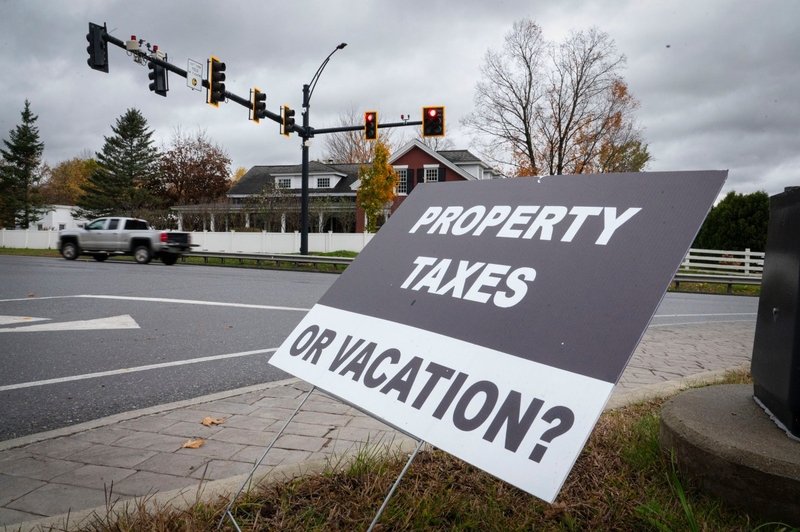
A sign questioning the property tax rate seen in Jericho on Friday, October 16, 2026. . Photo by Glenn Russell/VTDigger
JERICHO — Henry Listenik Jr. says he’s paying double what he did last year in property taxes.
The 69-year-old voted for Gov. Phil Scott in 2024, but Listenik said he doesn’t think Scott has followed through on his promises. Now Listenik doesn’t know who to vote for.
The Jericho resident said that his kids, who are parents themselves, are considering moving out of state because they can’t find jobs or keep up with the cost of living.
“Does our governor hear that?” he said in an interview.
Vermont’s property taxes are among the highest in the country and have risen more than 40% on average over the past five years. Scott, the five-term Republican, has campaigned on affordability since his first run for governor. And he’s persuaded legislators to use state revenue to buy down property taxes for the past two years.
Property tax rates are tied directly to education spending under the state’s current school funding system, which allows for little state control over how much local school districts spend.
Vermont’s system is totally unique because it generally allows local school districts to spend however much they want to educate students, as long as voters approve. Then, they subsequently calculate property tax rates for the average homeowner based on how much the district plans to spend per student. Because districts have this discretion over their own spending, there’s wide variation across the state in how much districts pay to educate each student.
Scott has pushed for a funding model that would allow the state to dictate school spending, rather than leaving it up to local districts. He reasons that a state-directed model could reign in costs and subsequently lower property taxes. Under his proposed model, districts would receive money from the state based on how many kids are enrolled and how expensive they are to educate.
A consolidated education system with larger, regional schools would reduce building maintenance and staffing costs, Scott has said. A consolidated model would also improve student outcomes, Scott has argued, because it would help close gaps in resources between schools.
To his Democratic challenger Amanda Janoo — a political newcomer stoking a competitive race for governor — Scott’s vision for reform is a “a thinly veiled attack on public education,” she said in an interview.
Janoo offers a platform that challenges Scott’s vision — and she’s rallying Scott’s opposition. Janoo is opposed to school consolidation and said she wants to make small schools sustainable by turning them into community centers of sorts, offering services such as healthcare, afterschool programs and adult school. She wants to lower property taxes for the average homeowner by levying higher taxes on second homes and short term-rentals.
In a September poll from Vermont Public, 41% of respondents said it was more important to them to keep property taxes as low as possible than it was to keep their local public school. Only 28% said it was more important to keep their local school.
It was equally important to 29% of respondents to keep property taxes low and preserve their local school.
An outsized number of polled Republicans — about two-thirds — said it was more important to keep property taxes low, while only a quarter of Democrats in the poll agreed.
Scott said during a press conference last month that he believes his position on education has made him less popular among voters, responding to two recent polls that showed a decline in his favorability.
“But I don’t regret anything that we’ve done. I think it’s necessary that we fix the system that we have,” Scott said.
Vermont spends among the most per-student nationwide, yet most students aren’t meeting grade-level standards, and graduation rates are declining. Its schools see troubling rates of declining enrollment.
Funding the system
Scott envisions education reform as the key to lowering property tax rates and has called the issue Vermont’s “most critical challenge.”
Meanwhile, Janoo’s platform vows to address some of the root causes of rising education costs, namely behavioral care for students and staff health insurance. She said she plans to lower healthcare costs in part by creating a system for universal primary care.
She envisions a tax system in which education funds are less solely dependent on taxing primary residences and include taxing second homes or Airbnbs.
Levying taxes on other forms of property would “discourage the use of housing for that purpose and also generate revenue that can reduce the property tax burden for residential Vermonters,” Janoo said.
Key to Scott’s vision is transitioning to a state-directed funding model, called a foundation formula, in tandem with school consolidation.
Most states use a foundation formula model, which allows the state to decide how much it spends to educate each student, with certain added adjustments for kids who are more expensive to educate, such as those from low-income families or English language learners. Scott has said that a foundation formula would help offer more resources to rural schools, and his education secretary has blamed test score disparities on the state’s current funding system.
“For what we’re paying, we should be number one,” said Scott in a recent campaign video.
Under current state law, Vermont will transition to a foundation formula model in 2029 so long as districts have the opportunity to consider mergers, and legislators pass laws to decide the specifics of the formula, among other contingencies.
Sheldon Foley, 42, of Waitsfield, said that he’s now paying $4,000 more in annual taxes than he did five years ago. After growing up in the Warren and Waitsfield area, he said it’s possible he might get priced out of his hometown and be forced to move.
“I’d be silly not to consider it,” Foley said.
Foley doesn’t have kids, and said he doesn’t know “the nuts and bolts” of the state’s education system. But he thinks the state needs reform to deal with its declining enrollment, he said.
“I’d hate to see schools close, but this isn’t sustainable,” Foley said. He said he plans to vote for Scott.
As lawmakers continue to debate reform, Scott has gotten them to follow his lead on using state revenue to buy down property taxes. This year, legislators agreed to spend $105 million in state revenue to soften the blow of what was a 12% average projected increase in property taxes.
Consolidation or keeping schools
While Scott has supported using property tax buydowns for short-term relief, his push for a consolidated model as a long-term fix has taken center stage in state politics, garnering both fans and skeptics.
After pushing for forced school district merger legislation this year, Scott ultimately joined lawmakers in backing a process that incentivized voluntary mergers. That process is getting underway this fall. Merger committees are required to submit a final report to the state in September 2027, and any mergers are expected to appear on the ballot on Town Meeting Day in 2028.
David Schoales of Brattleboro will be voting for Janoo because they disagree with Scott’s vision for consolidated school districts, they said. The retired educator sits on the steering committee for the Rural School Community Alliance, a coalition of educators and parents that want to preserve rural schools. Schoales said they aren’t convinced a consolidated model would save money or lead to better outcomes for students.
“It doesn’t look at the effect on students, it doesn’t look at the effect on education, and again, it doesn’t save any money,” they said.
Any costs saved by efficiencies in a consolidated model will be offset by other cost increases such as transportation, Schoales said. When schools in Arkansas consolidated, a 20 year study found the state saw little cost savings, according to The Hechinger Report.
Janoo, who grew up in Strafford attending classes of about a dozen students, said she wants to preserve rural schools because she sees them as pillars of rural communities.
The state has already witnessed a steady economic decline and a “hollowing out of a lot of our communities,” Janoo said. To close a community’s school is to basically give up on it as a whole, she said.
Janoo said she supports the community schools model, which focuses on providing resources to meet kids’ basic needs. A handful of schools across Vermont received federal grant funds in 2021 to pilot the model. In some schools, the program involved creating a food shelf for students, and in others it involved driving students to doctors appointments. Although federal funds dried up in 2024, some schools have kept the practice going on their own dime.
“I just know how important small schools and rural schools are in particular as the center and hub of our communities,” she said.
Read the story on VTDigger here: Gov. Scott put property taxes and school consolidation center stage. Now Amanda Janoo is rallying opposition..
Montpelier, VT